
Mapa mental
The Psychodynamic Approach
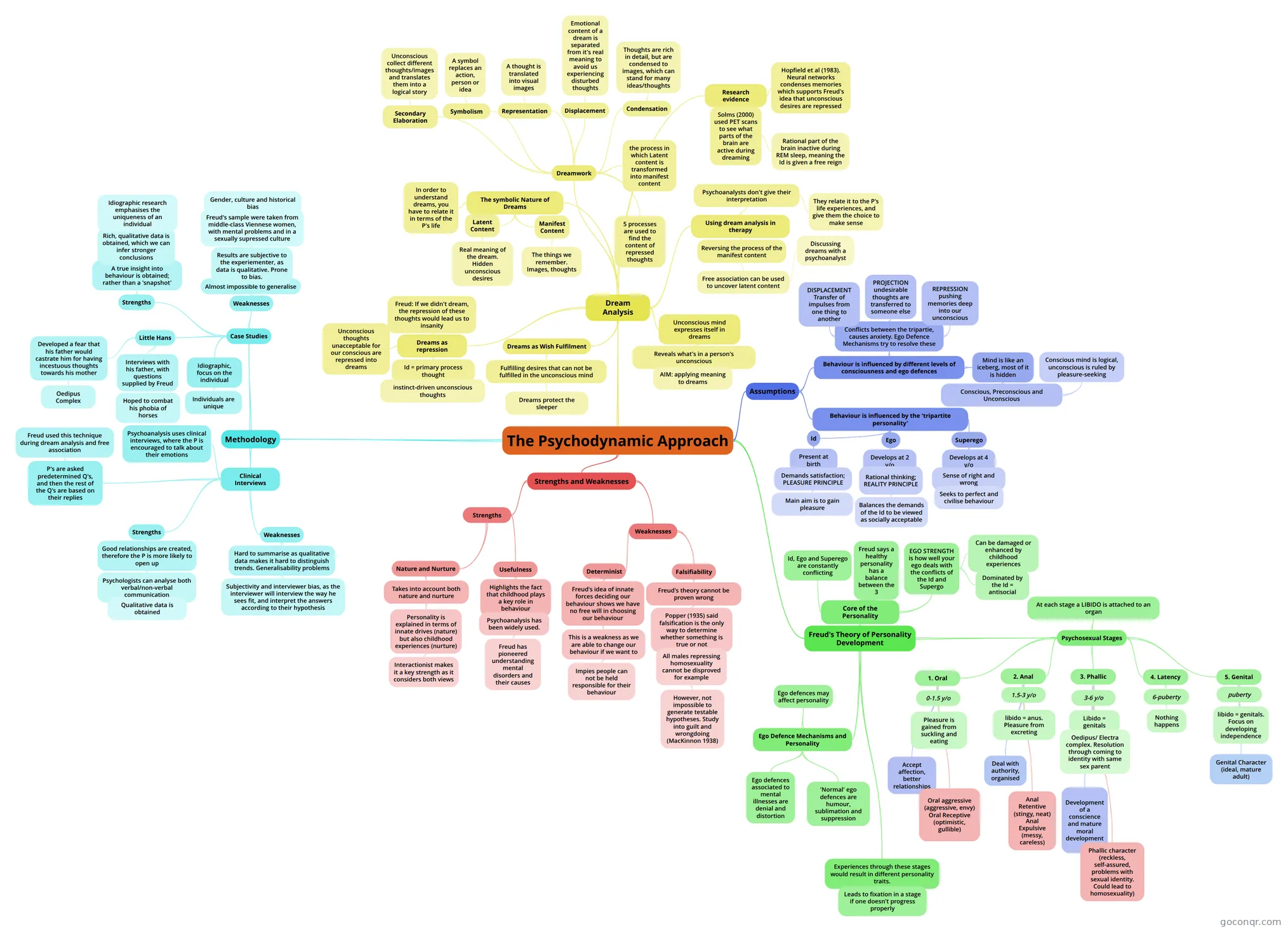
Mind map: The psychodynamic approach
Contenido del mapa
The Psychodynamic Approach
Assumptions
- Behaviour is influenced by different levels of consciousness and ego defences
- Mind is like an iceberg, most of it is hidden
- Conscious, Preconscious and Unconscious
- Conscious mind is logical, unconscious is ruled by pleasure-seeking
- Conscious, Preconscious and Unconscious
- Conflicts between the tripartie, causes anxiety. Ego Defence Mechanisms try to resolve these
- DISPLACEMENT Transfer of impulses from one thing to another
- PROJECTION undesirable thoughts are transferred to someone else
- REPRESSION pushing memories deep into our unconscious
- Mind is like an iceberg, most of it is hidden
- Behaviour is influenced by the 'tripartite personality'
- Id
- Present at birth
- Demands satisfaction; PLEASURE PRINCIPLE
- Main aim is to gain pleasure
- Demands satisfaction; PLEASURE PRINCIPLE
- Present at birth
- Ego
- Develops at 2 y/o
- Rational thinking; REALITY PRINCIPLE
- Balances the demands of the Id to be viewed as socially acceptable
- Rational thinking; REALITY PRINCIPLE
- Develops at 2 y/o
- Superego
- Develops at 4 y/o
- Sense of right and wrong
- Seeks to perfect and civilise behaviour
- Sense of right and wrong
- Develops at 4 y/o
- Id
- Behaviour is influenced by different levels of consciousness and ego defences
Freud's Theory of Personality Development
- Core of the Personality
- Id, Ego and Superego are constantly conflicting
- EGO STRENGTH is how well your ego deals with the conflicts of the Id and Supergo
- Can be damaged or enhanced by childhood experiences
- Dominated by the Id = antisocial
- Freud says a healthy personality has a balance between the 3
- Psychosexual Stages
- At each stage a LIBIDO is attached to an organ
- 1. Oral
- 0-1.5 y/o
- Pleasure is gained from suckling and eating
- Accept affection, better relationships
- Oral aggressive (aggressive, envy) Oral Receptive (optimistic, gullible)
- 0-1.5 y/o
- 2. Anal
- 1.5-3 y/o
- libido = anus. Pleasure from excreting
- Deal with authority, organised
- Anal Retentive (stingy, neat) Anal Expulsive (messy, careless)
- 1.5-3 y/o
- 3. Phallic
- 3-6 y/o
- Libido = genitals
- Oedipus/ Electra complex. Resolution through coming to identity with same sex parent
- Libido = genitals
- Development of a conscience and mature moral development
- Phallic character (reckless, self-assured, problems with sexual identity. Could lead to homosexuality)
- 3-6 y/o
- 5. Genital
- puberty
- libido = genitals. Focus on developing independence
- Genital Character (ideal, mature adult)
- puberty
- 4. Latency
- 6-puberty
- Nothing happens
- 6-puberty
- Experiences through these stages would result in different personality traits.
- Leads to fixation in a stage if one doesn't progress properly
- Ego Defence Mechanisms and Personality
- Ego defences may affect personality
- 'Normal' ego defences are humour, sublimation and suppression
- Ego defences associated to mental illnesses are denial and distortion
- Core of the Personality
Strengths and Weaknesses
- Strengths
- Nature and Nurture
- Takes into account both nature and nurture
- Personality is explained in terms of innate drives (nature) but also childhood experiences (nurture)
- Interactionist makes it a key strength as it considers both views
- Personality is explained in terms of innate drives (nature) but also childhood experiences (nurture)
- Takes into account both nature and nurture
- Usefulness
- Highlights the fact that childhood plays a key role in behaviour
- Psychoanalysis has been widely used.
- Freud has pioneered understanding mental disorders and their causes
- Psychoanalysis has been widely used.
- Highlights the fact that childhood plays a key role in behaviour
- Nature and Nurture
- Weaknesses
- Determinist
- Freud's idea of innate forces deciding our behaviour shows we have no free will in choosing our behaviour
- This is a weakness as we are able to change our behaviour if we want to
- Impies people can not be held responsible for their behaviour
- This is a weakness as we are able to change our behaviour if we want to
- Freud's idea of innate forces deciding our behaviour shows we have no free will in choosing our behaviour
- Falsifiability
- Freud's theory cannot be proven wrong
- Popper (1935) said falsification is the only way to determine whether something is true or not
- All males repressing homosexuality cannot be disproved for example
- However, not impossible to generate testable hypotheses. Study into guilt and wrongdoing (MacKinnon 1938)
- All males repressing homosexuality cannot be disproved for example
- Popper (1935) said falsification is the only way to determine whether something is true or not
- Freud's theory cannot be proven wrong
- Determinist
- Strengths
Dream Analysis
- Unconscious mind expresses itself in dreams
- Reveals what's in a person's unconscious
- AIM: applying meaning to dreams
- Reveals what's in a person's unconscious
- Dreams as Wish Fulfilment
- Fulfilling desires that can not be fulfilled in the unconscious mind
- Dreams protect the sleeper
- Fulfilling desires that can not be fulfilled in the unconscious mind
- Dreams as repression
- Id = primary process thought
- instinct-driven unconscious thoughts
- Unconscious thoughts unacceptable for our conscious are repressed into dreams
- Freud: If we didn't dream, the repression of these thoughts would lead us to insanity
- Id = primary process thought
- Using dream analysis in therapy
- Reversing the process of the manifest content
- Free association can be used to uncover latent content
- Discussing dreams with a psychoanalyst
- Free association can be used to uncover latent content
- Psychoanalysts don't give their interpretation
- They relate it to the P's life experiences, and give them the choice to make sense
- Reversing the process of the manifest content
- Research evidence
- Solms (2000) used PET scans to see what parts of the brain are active during dreaming
- Rational part of the brain inactive during REM sleep, meaning the Id is given a free reign
- Hopfield et al (1983). Neural networks condenses memories which supports Freud's idea that unconscious desires are repressed
- Solms (2000) used PET scans to see what parts of the brain are active during dreaming
- The symbolic Nature of Dreams
- Manifest Content
- The things we remember. Images, thoughts
- Latent Content
- Real meaning of the dream. Hidden unconscious desires
- In order to understand dreams, you have to relate it in terms of the P's life
- Manifest Content
- Dreamwork
- the process in which Latent content is transformed into manifest content
- 5 processes are used to find the content of repressed thoughts
- Condensation
- Thoughts are rich in detail, but are condensed to images, which can stand for many ideas/thoughts
- Displacement
- Emotional content of a dream is separated from it's real meaning to avoid us experiencing disturbed thoughts
- Representation
- A thought is translated into visual images
- Symbolism
- A symbol replaces an action, person or idea
- Secondary Elaboration
- Unconscious collect different thoughts/images and translates them into a logical story
- Unconscious mind expresses itself in dreams
Methodology
- Case Studies
- Idiographic, focus on the individual
- Individuals are unique
- Little Hans
- Developed a fear that his father would castrate him for having incestuous thoughts towards his mother
- Oedipus Complex
- Interviews with his father, with questions supplied by Freud
- Hoped to combat his phobia of horses
- Developed a fear that his father would castrate him for having incestuous thoughts towards his mother
- Strengths
- A true insight into behaviour is obtained; rather than a 'snapshot'
- Rich, qualitative data is obtained, which we can infer stronger conclusions
- Idiographic research emphasises the uniqueness of an individual
- Rich, qualitative data is obtained, which we can infer stronger conclusions
- A true insight into behaviour is obtained; rather than a 'snapshot'
- Weaknesses
- Almost impossible to generalise
- Results are subjective to the experiementer, as data is qualitative. Prone to bias.
- Freud's sample were taken from middle-class Viennese women, with mental problems and in a sexually supressed culture
- Gender, culture and historical bias
- Freud's sample were taken from middle-class Viennese women, with mental problems and in a sexually supressed culture
- Results are subjective to the experiementer, as data is qualitative. Prone to bias.
- Almost impossible to generalise
- Idiographic, focus on the individual
- Clinical Interviews
- Psychoanalysis uses clinical interviews, where the P is encouraged to talk about their emotions
- P's are asked predetermined Q's, and then the rest of the Q's are based on their replies
- Freud used this technique during dream analysis and free association
- Strengths
- Good relationships are created, therefore the P is more likely to open up
- Psychologists can analyse both verbal/non-verbal communication
- Qualitative data is obtained
- Psychologists can analyse both verbal/non-verbal communication
- Good relationships are created, therefore the P is more likely to open up
- Weaknesses
- Hard to summarise as qualitative data makes it hard to distinguish trends. Generalisability problems
- Subjectivity and interviewer bias, as the interviewer will interview the way he sees fit, and interpret the answers according to their hypothesis
- Hard to summarise as qualitative data makes it hard to distinguish trends. Generalisability problems
- Case Studies
Información
- Descripción
- A Level PY1 Psychology Mapa Mental sobre The Psychodynamic Approach, creado por HeyThereIAmKyle el 15/05/2013.
- Creado por
- HeyThereIAmKyle
- Visitas
- 1.850
- Etiquetas
- Valoración