
Mapa mental
financial accounting
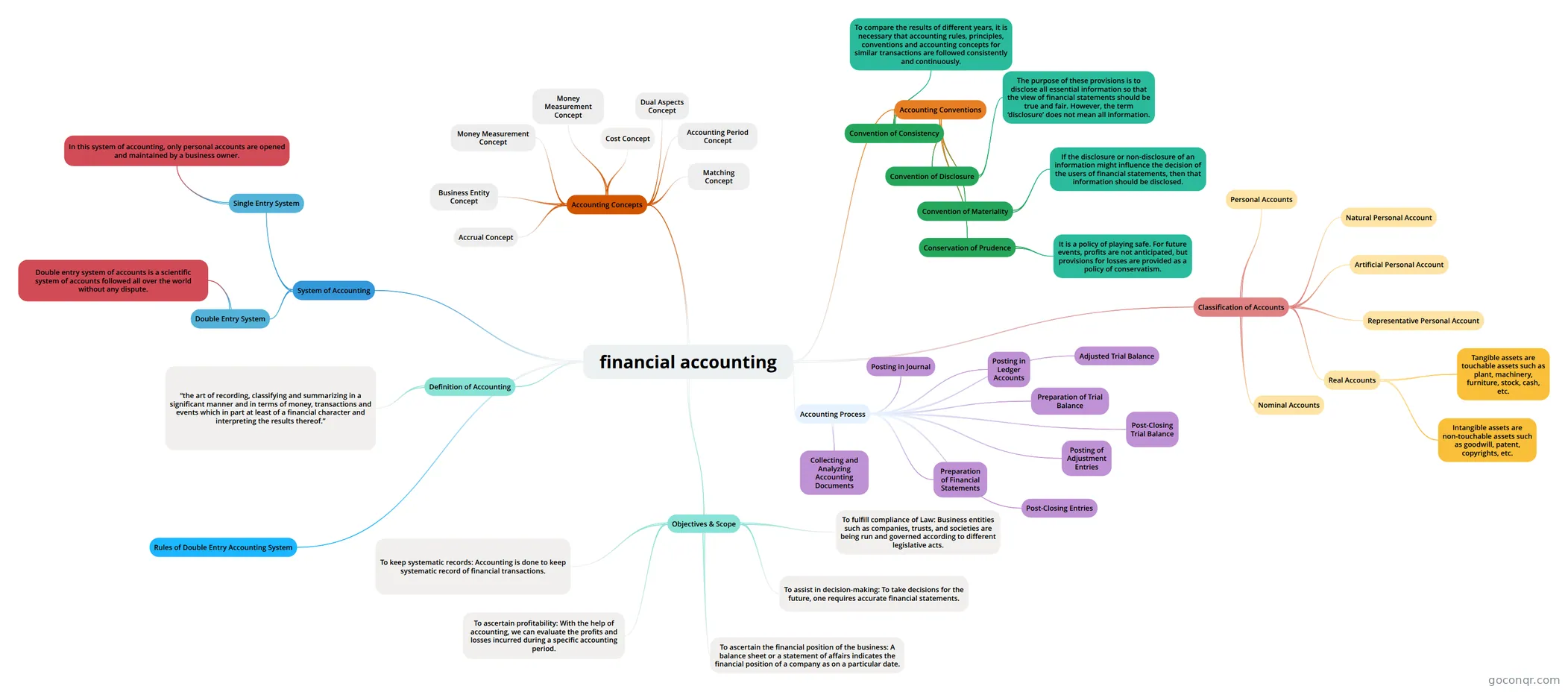
Mind map: financial accounting
Contenido del mapa
financial accounting
Definition of Accounting
- “the art of recording, classifying and summarizing in a significant manner and in terms of money, transactions and events which in part at least of a financial character and interpreting the results thereof.”
Objectives & Scope
- To keep systematic records: Accounting is done to keep systematic record of financial transactions.
- To ascertain profitability: With the help of accounting, we can evaluate the profits and losses incurred during a specific accounting period.
- To ascertain the financial position of the business: A balance sheet or a statement of affairs indicates the financial position of a company as on a particular date.
- To assist in decision-making: To take decisions for the future, one requires accurate financial statements.
- To fulfill compliance of Law: Business entities such as companies, trusts, and societies are being run and governed according to different legislative acts.
Accounting Process
- Collecting and Analyzing Accounting Documents
- Posting in Journal
- Posting in Ledger Accounts
- Preparation of Trial Balance
- Posting of Adjustment Entries
- Adjusted Trial Balance
- Preparation of Financial Statements
- Post-Closing Entries
- Post-Closing Trial Balance
Accounting Concepts
- Business Entity Concept
- Money Measurement Concept
- Money Measurement Concept
- Cost Concept
- Dual Aspects Concept
- Accounting Period Concept
- Matching Concept
- Accrual Concept
Accounting Conventions
- Convention of Consistency
- To compare the results of different years, it is necessary that accounting rules, principles, conventions and accounting concepts for similar transactions are followed consistently and continuously.
- Convention of Disclosure
- The purpose of these provisions is to disclose all essential information so that the view of financial statements should be true and fair. However, the term ‘disclosure’ does not mean all information.
- Convention of Materiality
- If the disclosure or non-disclosure of an information might influence the decision of the users of financial statements, then that information should be disclosed.
- Conservation of Prudence
- It is a policy of playing safe. For future events, profits are not anticipated, but provisions for losses are provided as a policy of conservatism.
- Convention of Consistency
Classification of Accounts
- Personal Accounts
- Natural Personal Account
- Artificial Personal Account
- Representative Personal Account
- Real Accounts
- Tangible assets are touchable assets such as plant, machinery, furniture, stock, cash, etc.
- Intangible assets are non-touchable assets such as goodwill, patent, copyrights, etc.
- Nominal Accounts
System of Accounting
- Single Entry System
- In this system of accounting, only personal accounts are opened and maintained by a business owner.
- Double Entry System
- Double entry system of accounts is a scientific system of accounts followed all over the world without any dispute.
- Single Entry System
Rules of Double Entry Accounting System
Información
- Descripción
- TOEFL Inglés Mapa Mental sobre financial accounting, creado por melissa andrea jaramillo morales el 21/06/2017.
- Creado por
- melissa andrea jaramillo morales
- Visitas
- 13
- Valoración