
Mapa mental
Electricity
Contenido del mapa
Electricity
Charge
- It is a property of matter possessed by certain particles. It can be either positive or negaitve.
- Q
- Charge's symbol in an equation
- Coulombs (C)
- Measurement of charge. 1C/second=1Amp.
- Electrons
- Each electron has a charge of -1.6*10^-19 So 6.25*10^18 electrons would equal ONE Coulomb.
Current
- The rate of flow of charge.
- Amps (A)
- Amperes, or Amps, are the measurement of current. 1 Coulomb per second=1A
- I
- The symbol for Amperes in an equation.
- Ammeter
- Tool used to measure current. It is placed IN SERIES to the area you wish to measure
- Current rules
- In series, Current always is the same.
- In parallel, current is split up and adds up to the same value at either end of the power source.
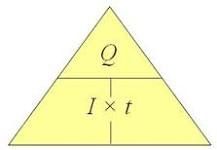
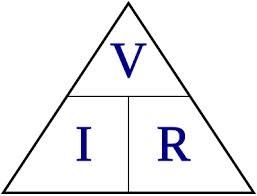
The Formulae Triangle for Charge and Amps
- The formulae and terms you should know: t=time in seconds I=Q/t 1A=1C/s
- Worked Example
- A lightning bolt carries 50,000C of charge to Earth in 0.22 seconds. Work out the current. I=Q/t I=50,000C/0.22 I=227272.7273A I=227000A (to 3 s.f.)
Potential Difference (Voltage)
- Potential Difference, otherwise known as Voltage, is a measure of the electrical energy (in Joules) that each Coulomb of charge has gained or lost when it moves between two points on a circuit.
- Voltmeter
- Tool used to measure Voltage. It is placed in PARALLEL to the to area being measure.
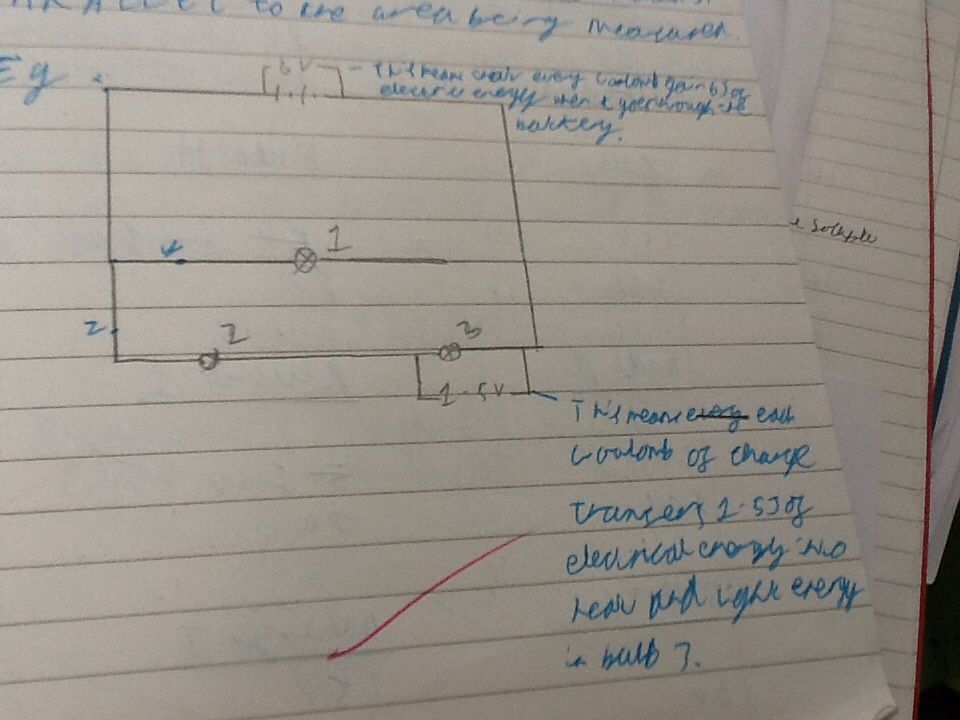
- Energy transfer
- To the left is a diagram that explains, using a worked example, that if a battery is 6V, it is giving every Coulomb of charge gets 6 Joules, and that if the charge were to run through a component that uses 1.5V of a Coulomb's 6V, every Coulomb of charge is giving that said component 1.5 Joules to use however said component uses it.
- Voltage rules
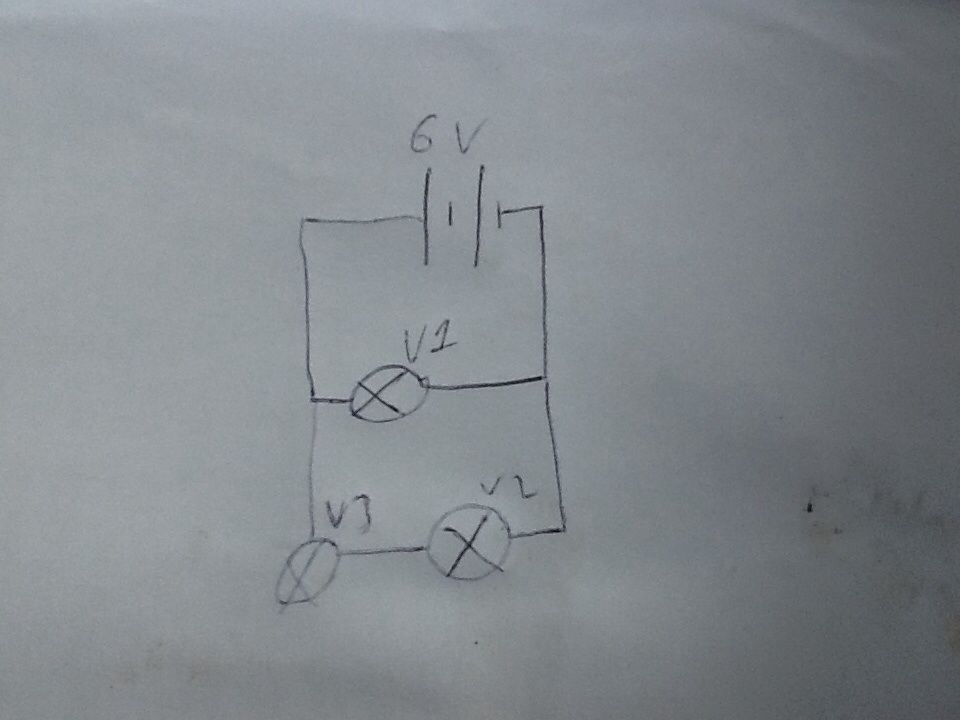
- Voltage in series is the same across the entire strait eg. V1=V2=V3
- Voltage in parallel always equals the same across the branches, for example, in the below diagram: V1=V2+3
- Resistance
- Resistance is a measure of opposition to the flow of charge through it. High resistance makes it more difficult to make current flow through it.
- Ohms
- The unit of measurement for Resistance. In equations, it is shown as an Omega symbol. It states how many volts you must put through the circuit to get 1A running through the circuit.
- Ohm's law
- Resistance (in Ohms)=Volts(V)/Amps(A)
- Worked example
- A resistor has 5V run through it. The resulting current is 0.2 Amps. Calculate the resistance. 5/0.2=25 25 Ohms
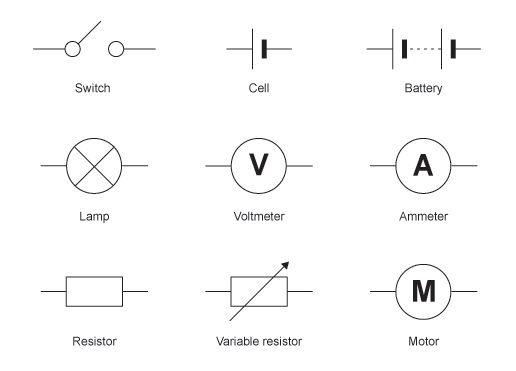
Circuit symbols
- Physicists and Engineers use circuit symbols and circuit diagrams to describe circuits pictorially. Here a couple symbols you should know!
- Circuit Diagram
- Below is an example of a circuit diagram, with a couple of components from the list above.
Watts
- A unit of power designed to describe power transfer in a practical way, as it was originally designed by energy companies as to help customers understand their power use.
- Power
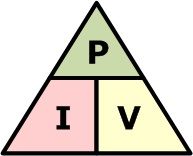
- Watts can be used to describe power usage and transfer using two equations: Power in watts (P)=V*I Energy transferred in Joules, E=P*times in seconds (t)
- Worked Example
- A small laboratory immersion heater passes 2A when connected to a 6V supply. What is the power of the heater? P=I*V =2*6 P=12 watts
Imágenes y archivos del mapa
Información
- Descripción
- A larger mind map of end-of-ks3 electricity!
- Creado por
- aidanmullins
- Visitas
- 641
- Etiquetas
- Valoración