
Mapa mental
The Biological Approach
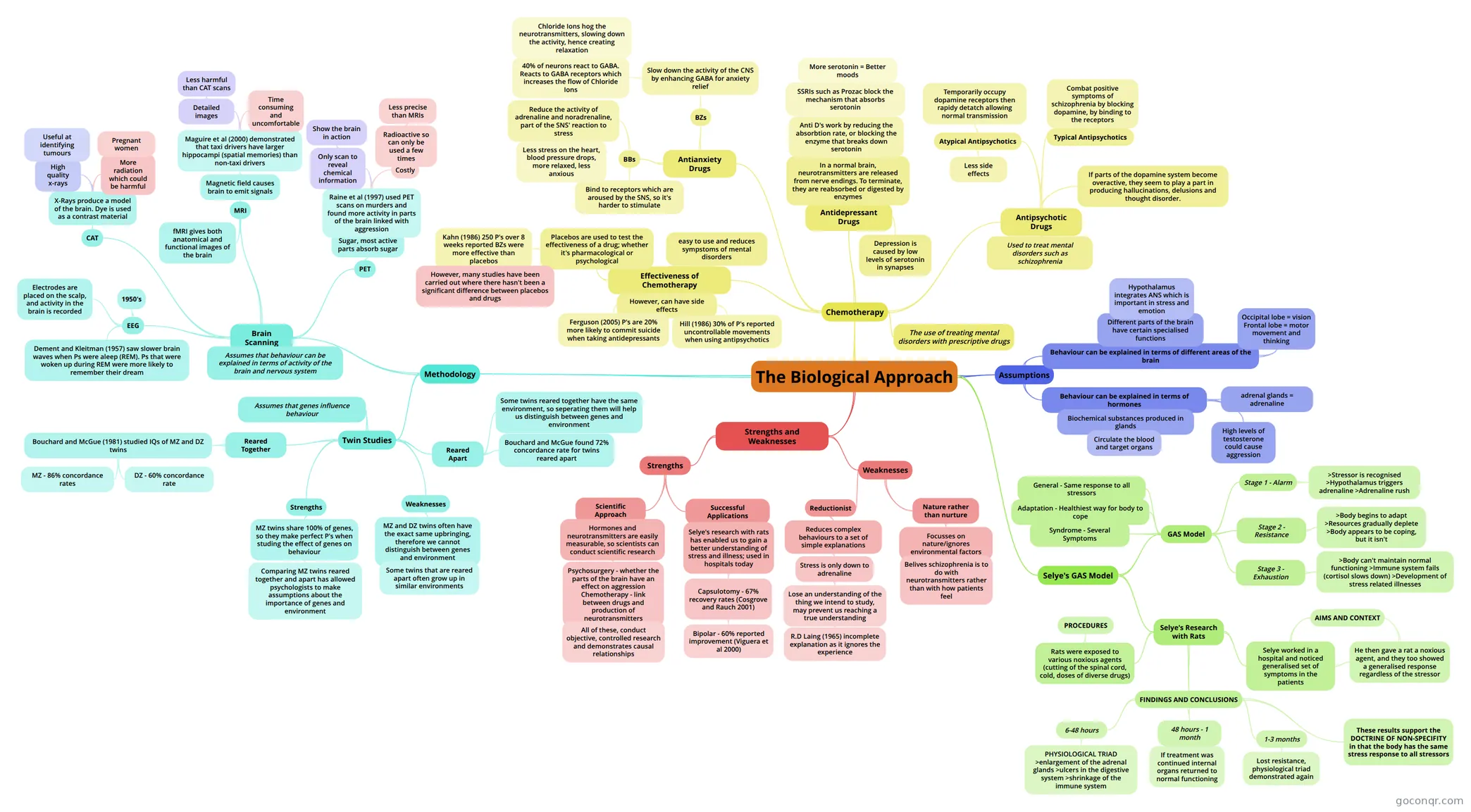
Mind map: The biological approach
Contenido del mapa
The Biological Approach
Selye's GAS Model
- GAS Model
- General - Same response to all stressors
- Adaptation - Healthiest way for body to cope
- Syndrome - Several Symptoms
- Stage 1 - Alarm
- >Stressor is recognised >Hypothalamus triggers adrenaline >Adrenaline rush
- Stage 2 - Resistance
- >Body begins to adapt >Resources gradually deplete >Body appears to be coping, but it isn't
- Stage 3 - Exhaustion
- >Body can't maintain normal functioning >Immune system fails (cortisol slows down) >Development of stress related illnesses
- Selye's Research with Rats
- Selye worked in a hospital and noticed generalised set of symptoms in the patients
- He then gave a rat a noxious agent, and they too showed a generalised response regardless of the stressor
- AIMS AND CONTEXT
- He then gave a rat a noxious agent, and they too showed a generalised response regardless of the stressor
- Rats were exposed to various noxious agents (cutting of the spinal cord, cold, doses of diverse drugs)
- PROCEDURES
- FINDINGS AND CONCLUSIONS
- 6-48 hours
- PHYSIOLOGICAL TRIAD >enlargement of the adrenal glands >ulcers in the digestive system >shrinkage of the immune system
- 48 hours - 1 month
- If treatment was continued internal organs returned to normal functioning
- 1-3 months
- Lost resistance, physiological triad demonstrated again
- These results support the DOCTRINE OF NON-SPECIFITY in that the body has the same stress response to all stressors
- 6-48 hours
- Selye worked in a hospital and noticed generalised set of symptoms in the patients
- GAS Model
Assumptions
- Behaviour can be explained in terms of different areas of the brain
- Different parts of the brain have certain specialised functions
- Hypothalamus integrates ANS which is important in stress and emotion
- Occipital lobe = vision Frontal lobe = motor movement and thinking
- Different parts of the brain have certain specialised functions
- Behaviour can be explained in terms of hormones
- Biochemical substances produced in glands
- Circulate the blood and target organs
- High levels of testosterone could cause aggression
- adrenal glands = adrenaline
- Biochemical substances produced in glands
- Behaviour can be explained in terms of different areas of the brain
Strengths and Weaknesses
- Weaknesses
- Nature rather than nurture
- Focusses on nature/ignores environmental factors
- Belives schizophrenia is to do with neurotransmitters rather than with how patients feel
- Focusses on nature/ignores environmental factors
- Reductionist
- Reduces complex behaviours to a set of simple explanations
- Stress is only down to adrenaline
- Lose an understanding of the thing we intend to study, may prevent us reaching a true understanding
- R.D Laing (1965) incomplete explanation as it ignores the experience
- Lose an understanding of the thing we intend to study, may prevent us reaching a true understanding
- Stress is only down to adrenaline
- Reduces complex behaviours to a set of simple explanations
- Nature rather than nurture
- Strengths
- Scientific Approach
- Hormones and neurotransmitters are easily measurable, so scientists can conduct scientific research
- Psychosurgery - whether the parts of the brain have an effect on aggression Chemotherapy - link between drugs and production of neurotransmitters
- All of these, conduct objective, controlled research and demonstrates causal relationships
- Psychosurgery - whether the parts of the brain have an effect on aggression Chemotherapy - link between drugs and production of neurotransmitters
- Hormones and neurotransmitters are easily measurable, so scientists can conduct scientific research
- Successful Applications
- Selye's research with rats has enabled us to gain a better understanding of stress and illness; used in hospitals today
- Capsulotomy - 67% recovery rates (Cosgrove and Rauch 2001)
- Bipolar - 60% reported improvement (Viguera et al 2000)
- Capsulotomy - 67% recovery rates (Cosgrove and Rauch 2001)
- Selye's research with rats has enabled us to gain a better understanding of stress and illness; used in hospitals today
- Scientific Approach
- Weaknesses
Chemotherapy
- The use of treating mental disorders with prescriptive drugs
- Antipsychotic Drugs
- Used to treat mental disorders such as schizophrenia
- Typical Antipsychotics
- Combat positive symptoms of schizophrenia by blocking dopamine, by binding to the receptors
- Atypical Antipsychotics
- Temporarily occupy dopamine receptors then rapidy detatch allowing normal transmission
- Less side effects
- If parts of the dopamine system become overactive, they seem to play a part in producing hallucinations, delusions and thought disorder.
- Effectiveness of Chemotherapy
- easy to use and reduces sympstoms of mental disorders
- However, can have side effects
- Hill (1986) 30% of P's reported uncontrollable movements when using antipsychotics
- Ferguson (2005) P's are 20% more likely to commit suicide when taking antidepressants
- Placebos are used to test the effectiveness of a drug; whether it's pharmacological or psychological
- Kahn (1986) 250 P's over 8 weeks reported BZs were more effective than placebos
- However, many studies have been carried out where there hasn't been a significant difference between placebos and drugs
- Kahn (1986) 250 P's over 8 weeks reported BZs were more effective than placebos
- Antidepressant Drugs
- Depression is caused by low levels of serotonin in synapses
- In a normal brain, neurotransmitters are released from nerve endings. To terminate, they are reabsorbed or digested by enzymes
- Anti D's work by reducing the absorbtion rate, or blocking the enzyme that breaks down serotonin
- SSRIs such as Prozac block the mechanism that absorbs serotonin
- More serotonin = Better moods
- SSRIs such as Prozac block the mechanism that absorbs serotonin
- Anti D's work by reducing the absorbtion rate, or blocking the enzyme that breaks down serotonin
- Antianxiety Drugs
- BZs
- Slow down the activity of the CNS by enhancing GABA for anxiety relief
- 40% of neurons react to GABA. Reacts to GABA receptors which increases the flow of Chloride Ions
- Chloride Ions hog the neurotransmitters, slowing down the activity, hence creating relaxation
- 40% of neurons react to GABA. Reacts to GABA receptors which increases the flow of Chloride Ions
- Slow down the activity of the CNS by enhancing GABA for anxiety relief
- BBs
- Reduce the activity of adrenaline and noradrenaline, part of the SNS' reaction to stress
- Less stress on the heart, blood pressure drops, more relaxed, less anxious
- Bind to receptors which are aroused by the SNS, so it's harder to stimulate
- Reduce the activity of adrenaline and noradrenaline, part of the SNS' reaction to stress
- BZs
Methodology
- Twin Studies
- Assumes that genes influence behaviour
- Reared Apart
- Some twins reared together have the same environment, so seperating them will help us distinguish between genes and environment
- Bouchard and McGue found 72% concordance rate for twins reared apart
- Reared Together
- Bouchard and McGue (1981) studied IQs of MZ and DZ twins
- MZ - 86% concordance rates
- DZ - 60% concordance rate
- Bouchard and McGue (1981) studied IQs of MZ and DZ twins
- Strengths
- MZ twins share 100% of genes, so they make perfect P's when studing the effect of genes on behaviour
- Comparing MZ twins reared together and apart has allowed psychologists to make assumptions about the importance of genes and environment
- MZ twins share 100% of genes, so they make perfect P's when studing the effect of genes on behaviour
- Weaknesses
- MZ and DZ twins often have the exact same upbringing, therefore we cannot distinguish between genes and environment
- Some twins that are reared apart often grow up in similar environments
- MZ and DZ twins often have the exact same upbringing, therefore we cannot distinguish between genes and environment
- Brain Scanning
- EEG
- 1950's
- Electrodes are placed on the scalp, and activity in the brain is recorded
- Dement and Kleitman (1957) saw slower brain waves when Ps were aleep (REM). Ps that were woken up during REM were more likely to remember their dream
- CAT
- X-Rays produce a model of the brain. Dye is used as a contrast material
- High quality x-rays
- Useful at identifying tumours
- More radiation which could be harmful
- Pregnant women
- High quality x-rays
- X-Rays produce a model of the brain. Dye is used as a contrast material
- MRI
- Magnetic field causes brain to emit signals
- Maguire et al (2000) demonstrated that taxi drivers have larger hippocampi (spatial memories) than non-taxi drivers
- Detailed images
- Less harmful than CAT scans
- Time consuming and uncomfortable
- Detailed images
- Maguire et al (2000) demonstrated that taxi drivers have larger hippocampi (spatial memories) than non-taxi drivers
- fMRI gives both anatomical and functional images of the brain
- Magnetic field causes brain to emit signals
- PET
- Sugar, most active parts absorb sugar
- Raine et al (1997) used PET scans on murders and found more activity in parts of the brain linked with aggression
- Costly
- Radioactive so can only be used a few times
- Less precise than MRIs
- Radioactive so can only be used a few times
- Only scan to reveal chemical information
- Show the brain in action
- Costly
- Raine et al (1997) used PET scans on murders and found more activity in parts of the brain linked with aggression
- Sugar, most active parts absorb sugar
- Assumes that behaviour can be explained in terms of activity of the brain and nervous system
- EEG
- Twin Studies
Información
- Descripción
- A Level PY1 Psychology Mapa Mental sobre The Biological Approach, creado por HeyThereIAmKyle el 18/05/2013.
- Creado por
- HeyThereIAmKyle
- Visitas
- 259
- Etiquetas
- Valoración