
Apuntes
Calculating Empirical Formula

Contenido del apunte (7)
Página 1
Example 1
Suppose 3.2g of sulfur reacts with oxygen to produce 6.4g of oxide. What is the empirical formula of the oxide?
Sulfur + Oxygen → ??
3.2g 6.4g
According to the conservation of mass, we know that 3.2g of oxygen must have been used in making the product.
Atomic mass:
Sulfur: 32
Oxygen: 16
Therefore, 0.1 moles of sulfur and 0.2 moles of oxygen were used to make the product.
The ratio of these is 1:2, so the empirical formula of the sulfur oxide is \(SO_2\)
Página 2
Example 2
12g of carbon reacts completely with 2g of hydrogen. The formula mass of the resulting hydrocarbon is 28. What is its molecular formula?
Carbon + Hydrogen → ??
12g 2g
According to the conservation of mass, we know that 14g of hydrocarbon must have been made.
Atomic mass:
Carbon 12
Hydrogen 1
So there is one mole of carbon atoms and two moles of hydrogen atoms, i.e. a 1:2 ratio.
So the empirical formula of the hydrocarbon is \(CH_2\).
But the formula mass of that compound would be 14. Therefore we know that the molecular formula of the compound created is twice that, i.e. \(C_2H_4\), commonly known as ethene.
Página 3
Calculation using percentage composition by mass
The percentage of each compound present can be used to determine the empirical formula of a compound.
When performing these calculations, it is best to layout your work in a table like the one shown below.
How this table works
You will be given the mass percentages in the question. The relative atomic mass can be found in the periodic table. Fill these into the top two rows of the table.
Next, divide the percentages by the atomic mass for each element. This tells you how many moles of each element you would have if you had 100g of the substance whose formula you are trying to find.
Divide through by the smallest of these numbers to find their ratios - eg in the example above divide each number in the third row by 1.6.
Now you have the ratio of the elements in the substance - these become the subscripts in the empirical formula.
Página 4
Example 3
Example:
A compound has the following percentage composition by mass:
Ca = 24.4% N=17.1% O=58.5%
What is its empirical formula?
Answer:
Prepare a table as shown in the previous page.
You may have to round some of the ratios to the nearest whole number eg 2.99 becomes 3.
The table shows that the empirical formula is \(CaNO_3\)

Página 5
Calculation when oxygen value not provided
Sometimes it is difficult to obtain an oxygen value by experiment, so you have to do a little more work in your calculations.
The sum of all the compositions must add up to 100%, so if you are given the compositions of the other elements in the substance, simply subtract their percentages from 100 to find the total oxygen percentage composition.
Then proceed as normal!
Example:
A compound has the following percentage composition by mass:
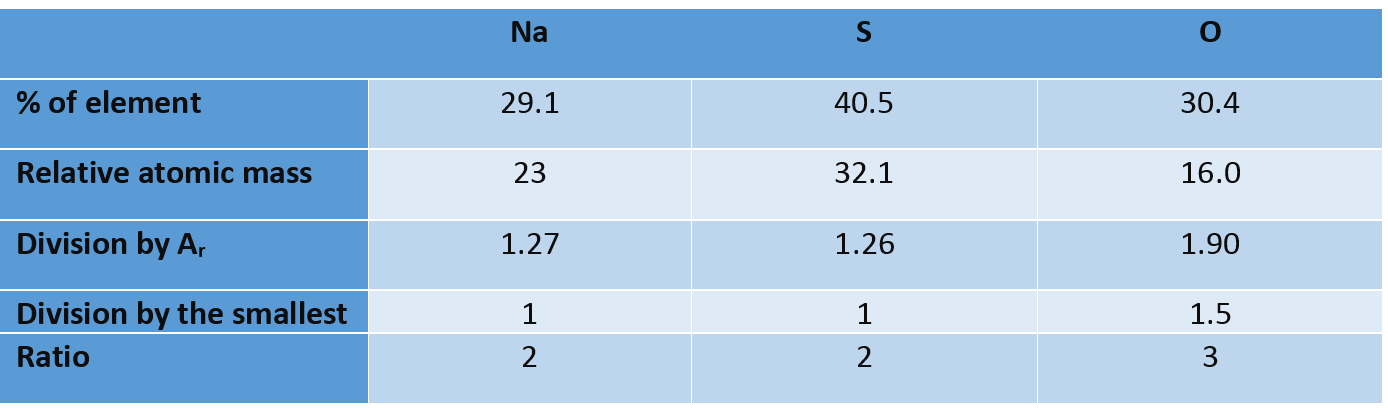
Na = 29.1% S = 40.5% The remained is oxygen
Answer:
The percentage composition of oxygen can be found by subtracting from 100.
Percentage of oxygen = 100 - (29.1+ 40.5) = 30.4%.
The table shows that the empirical formula is \(Na_2S_2O_3\)
Página 6
Calculation using Combustion Analysis
The proportion of an element in a given compound does not vary.
The proportion of carbon in carbon dioxide will always be \(\frac{12}{44}\)
The proportion of hydrogen in water will always be \(\frac{2}{18} = \frac{1}{9}\)
Example 1:
Suppose a 1.87g sample of an organic compound is completely burned, producing 2.65g of carbon dioxide and 1.63g of water. This information can be used to find the empirical formula of the organic compound.
Answer:
Mass of carbon in organic compound sample = \( 2.65 \times \frac{12}{44} 0.723g\)
Mass of hydrogen in organic compound sample = \(1.63 \times \frac{1}{9} = 0.181g\)
These two masses add up to give 0.904g - we know that the remaining mass in the organic compound must be made up of oxygen.
Therefore, there was 0.966g of oxygen. The usual table can now be made to find the empirical formula.
The table shows that the empirical formula is \(CH_3O\)

Página 7
Example 4
Example:
Combustion analysis of 2.16g of an organic compound produced 4.33g of carbon dioxide and 1.77g of water. What is its empirical formula?
Answer:
2.16g of an organic compound produced 4.33g of carbon dioxide and 1.77g of water
The sample contains \(\frac{4.33 \times 12}{44} = 1.18g\) of carbon and \(\frac{1.77}{9}=0.196g \) of hydrogen.
This means that it must contain \(2.16-0.196-1.18=0.784g\) of oxygen.
Now we can make a table:

The table shows that the empirical formula is \(C_2H_4O\)
Información
- Descripción
- El usuario ha eliminado su información de asignaturas Apunte sobre Calculating Empirical Formula, creado por Usuario eliminado el 14/08/2017.
- Creado por
- Usuario eliminado
- Visitas
- 315
- Historial
-
- Creado por Niamh Ryan · 3 ago 2017
- Copiado por Niamh Ryan · 10 ago 2017
- Copiado por Niamh Ryan · 14 ago 2017
- Valoración