
Apuntes
Physical Properties
Contenido del apunte (4)
Página 1
Alkanes
Alkanes: A homologous series of hydrocarbons with the gnereal formula \(C_nH_{2n+2}\)
The boiling temperatures of alkanes increases with increasing molecular mass:
Increasing molecular mass →Increasing number of electrons → Increase in instantaneous and induced dipoles
Increasing molecular mass → Increasing length of carbon chain → Number of points of contact between molecules increases → More instantaneous induced dipoles → Greater overall London force
The boiling temperatures of alkanes decrease with increasing branching:
Unbranched alkanes pack together very well because of their shape →High number of points of contact
Increasing branching → Molecules don't pack together so well → Decrease in number of points of contact → Decrease in overall intermolecular force of attraction
Alcohols
Alcohols: A homologous series of hydrocarbons with the general formula \(C_nH_{2n+1}OH\)
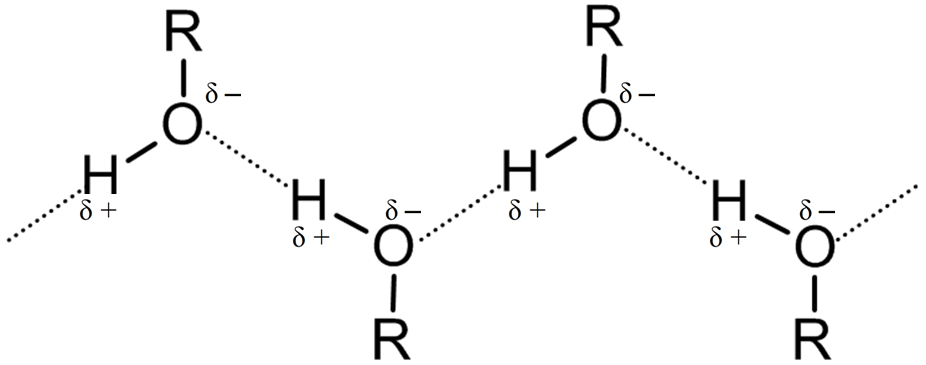
The boiling point of alcohols are higher than that of the corresponding alkane:
Alcohols can form intermolecular hydrogen bonds due to presence of -OH group.
Alkanes only interact via London forces and therefore experience less intermolecular forces than alcohols
Enthalpy of vaporisation: A measure of the amount of energy that is required to completely separate the molecules of a liquid and convert it into a gas at the same temperature
Hydrogen Halides
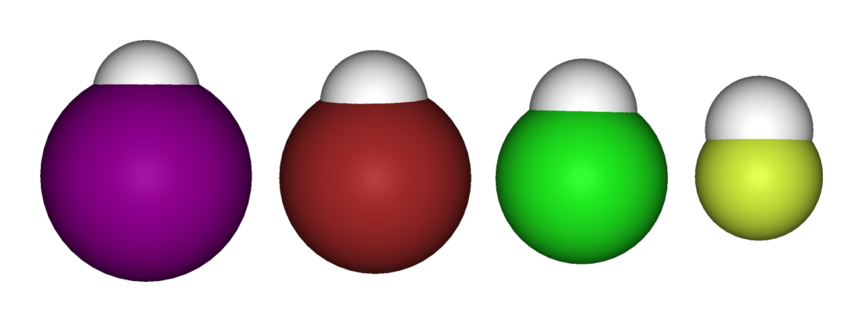
The steady increase in boiling temperatures from HCl to HI is the result of the increasing number of electrons per molecule which in turn results in an increase in London forces.
The boiling of HF is significantly higher than the other three hydrogen halides because its hydrogen bonding is very strong due to the very high electronegativity of fluorine.
Página 2
Water
Water has two unusual properties:
Relatively high melting and boiling points for a molecule with so few electrons
Density of ice at 0°C is less than that of water at 0°C
Melting and boiling points
The hydrogen bonds between water molecules are particularly strong for a molecule with only ten electrons.
Water molecules can form up to two hydrogen bonds per molecule.
These hydrogen bonds must be completely broken in order to vaporise water - this requires a large amount of energy so water has a high boiling point.
Density
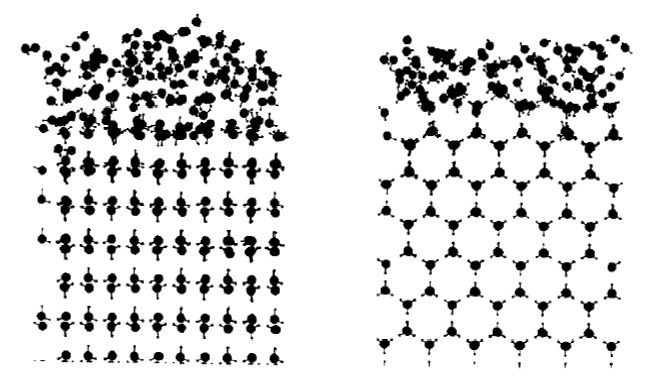
Ice has a lower density than water because molecules in ice are arranged in rings of six, held together by hydrogen bonds.
The structure creates large areas of open space inside the rings. When ice melts, the ring structure is destroyed and the average distance between the molecules decreases, causing an increase in density.
Página 3
Solvents
In order for a substance to dissolve:
The solute particles must be separated from each other and then become surrounded by solvent particles
Forces of attraction between the solute and solvent particles must be strong enough to overcome the solvent-solvent forces and the solute-solute forces.
Dissolving ionic solids
Many ionic solids dissolve in water.
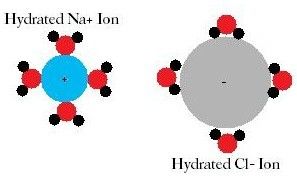
The energy required to separate the ions in the solid is either completely, or partially supplied by the hydration of the ions.
The interaction between the sodium ions and the water molecules is called an ion-dipole interaction.
The chloride ions are hydrogen bonded to the water molecules.
Página 4
Forming hydrogen bonds with water
The solubility of alcohols in water decreases with increasing hydrocarbon chain length:
Ethanol and water can mix in all proportions because the water-ethanol hydrogen bonds are of a similar strength to water-water and ethanol-ethanol hydrogne bonds
London forces predominate between alcohol molecules as chain length increases → Decreasing solubility
Compounds that cannot form hydrogen bonds with water:
Non-polar molecules such as alkanes do not dissolve in water because the attraction between the alkane and water molecules is not strong enough to disrupt the hydrogen bonded system between the water molecules
Some polar molecules do not dissolve in water because they either do not form hydrogen bonds with water, or any hydrogen bonds which they do not form are much weaker than hydrogen bonds in water
In general, when choosing a solvent, think of the rule "Like dissolves like"
A non polar solvent will be most suitable for dissolving a non polar substance, or even a substance that has a substantial non-polar part to its molecule.
Información
- Descripción
- El usuario ha eliminado su información de asignaturas Apunte sobre Physical Properties, creado por Usuario eliminado el 21/08/2017.
- Creado por
- Usuario eliminado
- Visitas
- 17
- Historial
-
- Creado por Niamh Ryan · 17 ago 2017
- Copiado por Niamh Ryan · 21 ago 2017
- Valoración