
Apuntes
Indian Constitution
Contenido del apunte (9)
Página 1
Lecture-2
Constitution is a written document, containing laws and rules, which determines and describes the form of government, the relationship between citizens and government, the interrelation between levels of government. Constitution of India is the supreme law of India. It upholds the principle that all citizens are equal before the eyes of law. It is a set of established fundamental principles, according to which a state has to be governed. Constitution is necessary as it is a set of rules, which properly govern the country. We want to live in a society that is just and equitable.
Structure of Constitution:
Federal: Relation between Central and State authority, how power is distributed. Central govt is not answerable to the State Govt.
Features:
Two levels of Govt
Independent Judiciary
Bicameralism
Each tier has it's own jurisdiction-> legislation, taxation and administration
Objective of Federalism-> If 2 levels work together, we promote unity and accommodate regional diversity. Function in harmony with each other. India is a Federal country [State(day to day matters->police, irrigation matters etc), Central/Union(national importance-> Defense,Foreign Affair, Banking, Communication, Currency etc), Panchayats/Municipalities]
2. Supremacy: It has to be of Supreme Law, it has to be rigid. It must be different from the ordinary law(eg: Business law, Civil Law, Penal Law, Family Law, Contract Labor Law...all these are basic law).
3. Distribution of Powers: Doctrine of Separation of Power is concept which determines the structure and organization of day to day functioning of government. It's to avoid abuse of power in 1 hands by distributing it to different level of federal form of government.
Legislation, Executive and Judiciary are 3 organs of government.
Lecture-3
Salient Features of IC
Longest written known constitution, it's flexible as well as rigid.
12 schedules, 448 articles in 25 parts, 104 amendments | Jan 25, 2020 |
Original Const 8 schedules, 395 articles
High diversity (geographical factors)
IC is a derivative of Govt of India Act of 1935 *a bulky document*
Constituent Assembly made IC, Constituent Assembly were dominated by Lawyers(they leave no loopholes by using Legal Jargons)
Single Const for both Central and State
Contains Fundamental Principles as well as detailed structure of administration
Non Federal features/Features of Unitarian Federation/Unitarianism
Strong Center
Single Constitution
Single Citizenship
Flexibility of Constitution
India is described as Union of State, it implies 2 things
Indian Federation is not the result of agreement of State
No State can withdraw from this Federalism
Division of Power is vertical, it results in duality of Govt (center and state). We have Quasi-Federation.
Preamble of India: Summary of Constitution Goals -> Sovereign, Socialist, Secular, Democratic, Republic, Welfare State to secure Justice, Equality, Liberty, Fraternity, Dignity of Individual, Unity and integrity of Nation. Preamble was amended once by 42nd amendment (1976)- 3 words added -> socialist secular integrity
Source of Power- Constitution derives it authority from people of India
Meanings
Sovereign: Independent State, no authority above us, free to conduct our own affairs (external, internal)
Socialist: Sovereign State in which everyone in society equally owns factor of production
Secular: Not concerned with any religion, respect every religion, co-existence of all the religion
Democratic: Power is in hands of citizen, Power(social, economic, supreme) is with us people [monarchy(king/queen-hereditary) and republic(president-people choose)]
Justice: social(equality in front of society), economic(equal opportunity on economy), political(right to vote,freedom to express thought, belief, faith etc)- provided by FR and DPSPs
Equality: absence of special privileges to all sections of society, equality of status (civic, political, economy)
Fraternity: Brotherhood, single citizenship, sense of brotherhood
Dignity of Individual: Every individual personality is different, and should be respected
Unity and Integrity of Nation
Significance of Preamble: Basic philosophy and fundamental values in terms of political, moral, religion on which IC is based, it expresses what we thought of making India as a country, it is an introduction to whole IC.
Página 2
Lecture-3
Adult Sufferage: Article 326 -> Right to Vote, above 18 years of age+(61st amendment), all Indians
Recast by Amendments: 7th, 42nd, 44th, 73rd, 104th
1st Amendment-> 1950
104th (last Amendment)-> 2020
Fundamental Rights | Article 12-35 | Part III
Right to Property was FR, but now only a constitutional right. (44th Amendment)
Directive Principles of the State Policy | PART IV
Lecture-4
Bicameral Legislature
Parliament has 2 houses- Lok Sabha & Rajya Sabha which means, at Central/Union Level, we have Bicameralism
At present we have 28 states, and 8UT
6 out of 28 states have Bicameral- UP, Bihar, Maharashtra, Karnataka, Telangana, Andhra Pradesh
Prior to this, 7 states were having Bicameral (it was J&K). In August, 2019, govt Scrapped Article 373, then it got divided into J&K and Ladakh, converting them into UT.
State Legislature has 2 houses
Legislative Assembly(Lower House), Legislative Council(Upper House)
3 UT have Unicameral -Delhi, Pondicherry, J&K. Other remaining 5 UT have neither Uni, nor Bi, they are directly ruled under President.
Legislative Assembly is present only in Unicameral.
Parliamentary Form of Govt:
Based on British Westminster Model.
President Elected here represents the nation, he is the head of the State but does not rule it.
PM is head of the govt, the ministers are members of Parliament and Union Council of Ministers are responsible to Lok Sabha
Judicial Review power is given in the article 13; it says any law, any action, any legislation, any amendment, which is in violation, abridgment and contravention to any thing, that is given in part III of the constitution, shall be declared as ultra vires (Latin: "beyond the powers" is a Latin phrase used in law to describe an act which requires legal authority but is done without it.)
Judicial Activism: It is the pro active role, played by the Judiciary, it is for the protection of rights of the citizen and for the promotion of justice of the society. Public Interest Litigation->the person, filing the petition, must not have any personal interest in the matter, but it should be concerned with the larger public involved.
Emergency Provision: PART XVIII | Article 352-360 deals with the emergency.
National Emergency(Proclamation of Emergency, approval of Parliament within 30 days, infinite time)
Constitutional Emergency (President Rule, approval of Parliament within 2 months, rule can be extended up to 6 months, till 3 years)
Financial Emergency
Página 3
Lecture-5
Fundamental Rights | Article 12-35 | Part III
The Fundamental Rights are defined as the basic human rights of all citizens.
These are governed by SC and Judiciary
These rights build a set of values in the society and regulate the conduct of the individuals and state, especially the legislature and the executive.
Features
Some FR are available to citizens of India, some are available to foreigners or legal person (corporation/companies).
Article 16, 19, 29 are available just to Indian citizen.
Most of them are available against the arbitrary action of the State. (for limitation of the State).
They are not sacrosanct/permanent.
During Martial Law/Military Rule, FR are restricted.
Article 12, Article 13
We have 6 Fundamental Rights.
Lecture-6
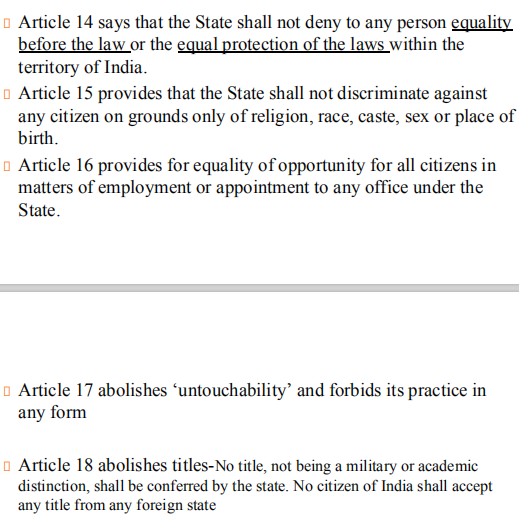
Right to Equality (Article 14-18)
Página 4
Lecture-6
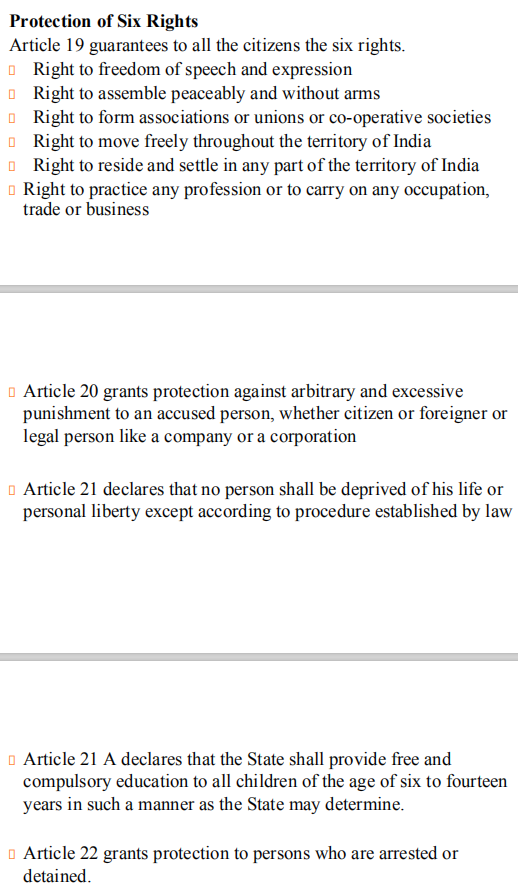
2. Right to Freedom (Article 19-22)
Página 5
Lecture-6
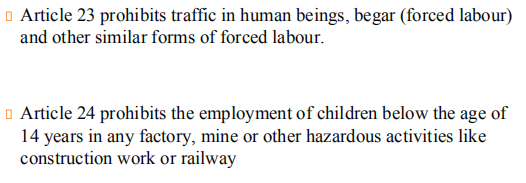
3. Right against Exploitation (Article 23-24)
Lecture-7
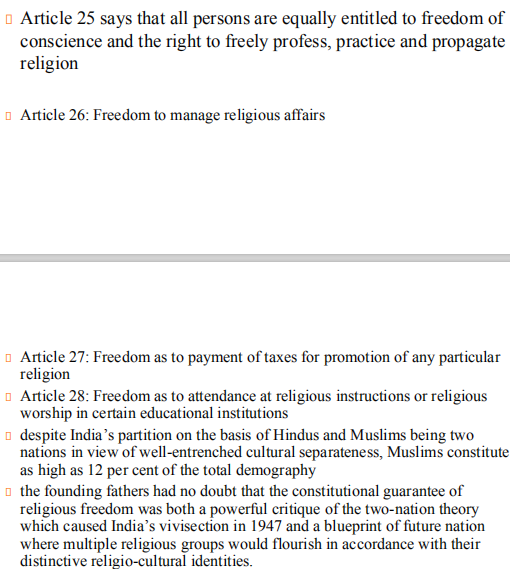
4. Right to Freedom of Religion (Article 25-28)
Página 6
Lecture-7
5. Cultural and Educational Rights (Article 29-30)
Article 29-Protection of interests of minorities.
Article 30-Right of minorities to establish and administer educational institutions.
Such institutions are called minority educational institutions.
6. Right to Constitutional Remedies (Article 32)
WRITS (basically means order, there are total 5 Writs)
Habeas Corpus: a writ of habeas corpus is used to bring a prisoner or other detainee (e.g. institutionalized mental patient) before the court to determine if the person's imprisonment or detention is lawful.
Mandamus: a judicial writ issued as a command to an inferior court or ordering a person to perform a public or statutory duty.
Prohibition: The writ of prohibition is issued by any High Court or the Supreme Court to any inferior court, or quasi judicial body prohibiting the latter from continuing the proceedings in a particular case, where it has no jurisdiction to try. After the issue of this writ, proceedings in the lower court etc. come to a stop. Popularly called "Stay Order"
Certiorari: Certiorari means to be certified. It is issued by a higher court to a lower court or tribunal either to transfer a case pending with the latter to itself or to squash the order of the latter in a case. It is issued on the grounds of excess of jurisdiction or lack of jurisdiction or error of law.
Quo-Warranto: The word Quo-Warranto literally means "by what warrants?" or "what is your authority"? It is a writ issued with a view to restrain a person from holding a public office to which he is not entitled. The writ requires the concerned person to explain to the Court by what authority he holds the office. If a person has usurped a public office, the Court may direct him not to carry out any activities in the office or may announce the office to be vacant. Thus High Court may issue a writ of quo-warranto if a person holds an office beyond his retirement age.
Point to Ponder over: While the writ of prohibition is available during the pendency of proceedings, the writ of certiorari can be resorted to only after the order or decision has been announced.
Article 33 -> Article 33 empowers the Parliament to restrict or abrogate the fundamental rights of the members of armed forces, para-military forces, police forces, intelligence agencies and analogous forces.
Aritlce 34 -> Article 34 provides for the restrictions on fundamental rights while martial law is in force in any area within the territory of India.
Article 35 -> Article 35 lays down that the power to make laws, to give effect to certain specified fundamental rights shall vest only in the Parliament and not in the state legislatures.
Página 7
Lecture-8
Fundamental Duties |PART IVA | Article 51A
Total 11 Fundamental Duties
Originally, no concept of FD existed in Constitution. It came into force by 42nd Amendment, on 11th Dec 1976
They are defined as moral obligation of citizen, to help promote a spirit of patriotism to uphold unity of India. To abide/respect by the Constitution and respect its ideal and institutions, the National Flag and National Anthem
To uphold and protect the sovereignty, unity and integrity.
These are non-enforceable.
Lecture-9
Features of FD
Non enforceable and non justiciable.
the Fundamental Duties are confined to citizens only and do not extend to foreigners.
Some of them are moral duties while some are civic.
They serve as a reminder to the citizens that they have obligations to their nation.
They serve as a warning against the anti-national and antisocial activities.
Indira Gandhi, the then Prime Minister, justified the inclusion of fundamental duties in the Constitution and argued that their
inclusion would help to strengthen democracy.
What were the Verma Committee observations on Fundamental Duties?
In 1998, during Atal Bihari ji Govt, they had appointed Justice JS Verma and formed committee, as they needed suggestions to teach FD to citizens. FD existed, but they weren't much functional. So they did below shiet to make sure nibbas are following FD
The Prevention of Insults to National Honour Act (1971) prevents disrespect to the Constitution of India, the National Flag and the National Anthem.
The Protection of Civil Rights Act (1955) provides for punishments for offences related to caste and religion
The Unlawful Activities (Prevention) Act of 1967 provides for the declaration of a communal organization as an unlawful association
The Wildlife (Protection) Act of 1972 prohibits trade in rare and endangered species
The Forest (Conservation) Act of 1980 checks indiscriminate deforestation and diversion of forest land for non-forest purposes
The Representation of People Act (1951) provides for the disqualification of members of the Parliament or a state legislature for indulging in corrupt practice, that is, soliciting votes on the ground of religion or promoting enmity between different sections of people on grounds of caste, race, language, religion and so on.
Página 8
Lecture-10
Directive Principles of State Policy | PART IV | Article 36-51
DPSP are ideals which are meant to be kept in mind by the state when it formulates policies and enacts laws.
Instrument of Instructions (BRA)
They seek to establish economic and social democracy in the country.
DPSPs are ideals which are not legally enforceable by the courts for their violation.
They are the principles that aim at providing social and economic justice and set the path towards the welfare state.
The framers of the Constitution borrowed this idea from the Irish Constitution of 1937, which had copied it from the Spanish Constitution
These principles are to act as a guiding force of the policy-making in a modern democratic State.
Classified into 3 categories
Socialist Principles (Article 38, 39, 39A, 41, 42, 43, 43A, 47)
Gandhian Principles (Article 40, 43, 43B, 46, 47, 48)
Liberal-Intellectual Principles (Article 44, 45, 48, 49, 50, 51)
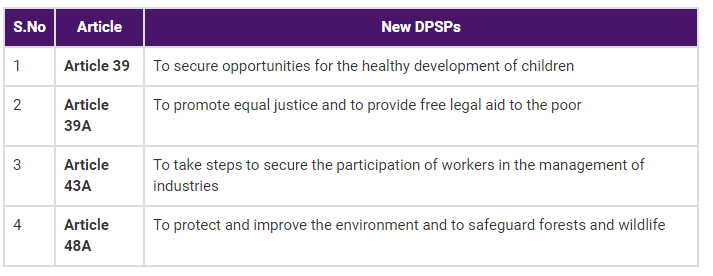
What are the new DPSPs added by the 42nd Amendment Act, 1976?
Página 9
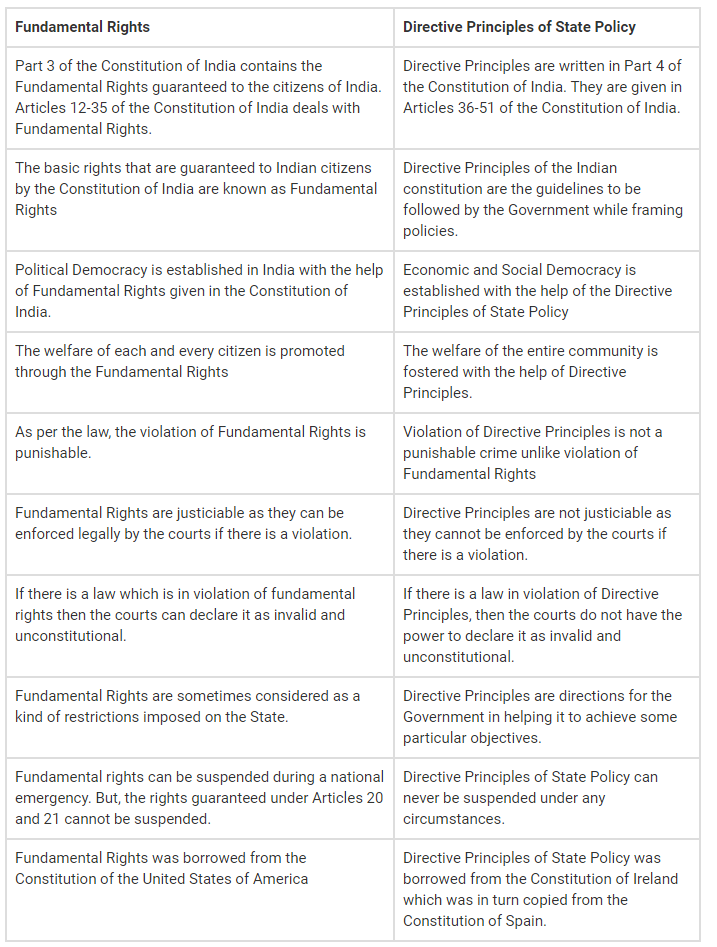
DIFFERENCES BETWEEN FUNDAMENTAL RIGHTS AND DIRECTIVE PRINCIPLES OF STATE POLICY
Información
- Descripción
- Revision Notes
- Creado por
- Kushagra Kumar · oct 2020
- Actualizado
- 5 oct 2020
- Visitas
- 20
- Valoración