
Apuntes
Sin título
Contenido del apunte (4)
Página 1
UNIDAD 1
GARCIA JURADO Y ARENAS
¿QUE ES LA FONETICA?
Es el estudio de los sonidos del habla. Estos sonidos, al tener una funcion comunicativa, otorgan a lo fonetica el rango de disciplina linguistica.
En 1932, se realiza en Holanda el Primer Congreso Internacional de Ciencias Foneticas, en esta reunion se congregaron estudiosos interesando en algun aspecto de los sonidos del habla . Asi surgieron otras ciencias interesadas en ciertos aspectos de estos sonidos. De esta diversidad de areas se deriva el caracter interdisciplinario de esta materia, que incorpora aspectos metodologicos y desarrollos cognitivos e instrumentales de esas disciplinas.
ciencias foneticas: fonetica, acustica, psicoacustica, otorrinolaringologia, fisiologia, fonologia.
El estudio de los sonidos del habla dependen del aporte de otros campos y, al mismo tiempo, estos requieren de descripciones especificas que solo las podria aportar la fonetica. Es una ciencia al servicio e otras ciencias y cuyas raices se encuentran en la investigacion empirica.
¿Que es un fonetista? ¿Cual es especificamente su campo? En general se define a la fonetica como una disciplina deicada al estudio acustico, fisiologico y perceptivo del habla y de los actos del habla. Las actividdaes de un fonetista abarcan un rango amplio de posibilidades, pero hay aspectos basicos como la anatomia de la lengua; el analisis acustico de la señal del habla; la ectromiografia.
En sintesis, la fonetica es una diciplina linguistica, que tambien abarca los fenomenos que provienen e un mundo fisico. tilizando asi la contribucion de tecnicas de otras ciencias para lo acustico y lo psicoacustico , la anatomia y la fisiologia. El hecho de que recurra a tecnicas dinvestigacion de otras disciplinas ha llevado durante años a dudar de que sea pertinente considerarla como ciencia.
Pero veremos que es una disciplina con lineamientos especificos y un perfil propio que adquiere cada vez mas actualidad, en conjunto a un mayor rigor cientifico.
FONETICA Y FONOLOGIA
Tienen un parentesco estrecho debido a que ambas estudian los sonidos, pero sus distinciones rovienen del alcance tematico de cada una.
Fonetica: Describe y sistematiza todos los elementos fonicos que el hombre produce.
Fonologia: Estudia las invariancias o patrones de sonidos que en todas las lenguas del mundo subjacen as inmerabes variantes fonicas.
Por un lado esta la tarea de describir los sonidos de todas las lenguas, y por el otro, la de indagar sobre las diferencias fonicas que cumplen una funcion distintiva dentro de una lengua particular, describiendo asi un sistema fonologico.
Estas disciplinas se pueden relacionar con los conceptos de lengua y habla.
El habla es definida, en funcion de la lengua, como su contracara individual. Asi, el habla, en tanto participacion individual del sujeto, participa tambien como escritura. La lengua se inscribe en un sistema de valores cuyo medio de produccion es indiferente. La lengua es un deposito de signos que cada individuo a recibido de otros miembros de la misma comunidad. El habla es activa e individual.
UNIDADES DE ANALISIS
Los sonidos de una lengua son las vocales y las consonantes definidas en terminos de rasgos fonologicos convencionales, pero estos rasgos deben referirse a fenomenos foneticos observables.
El aporte de la fonetica es hacer inventarios de indices articulatorios y acusticos que permitan describir la estructura material de un fonema.
RAMAS ARTICULATORIAS, ACUSTICAS Y PERCEPTIVA
En la comunicacion oral, la señal de habla juego un rol fundamental porque refleja las consecuencias de la produccion de habla y constituye la principal fuente de informacion ara el oyente. La percepcion de habla presenta la particularidad de que el sujeto que percibe la señal tambien el que produce habla.
El conjunto de fonemas ordenados segun las reglas linguisticas se transforman en sonidos por el hablante, transmitidos a un oyente y percibidos por el. Todos los hablantes poseen un filtro fonologico que les permite seleccionar aquellos elementos de la señal acustica necesarios para comprender el mensaje. La fonetica sera por las operaciones articulatorias necesarias para realizar la forma de la expresion, por las caracteristicas de las ondas sonoras emitidas por el hablante, por el proceso que permite al oyente recuperar la forma de la expresion extraida de esa sustancia y, por ultimo, por las relaciones entre los datos, estamos en condiciones de afirmar que la suma de todos estos aspectos es una carga pesada para plantearla en forma unificada.
Página 2
UNIT 1
BASIC CONCEPTS
PRONUNCIATIO AND SPELLING
Not all the sounds which we hear and produce have the purpose of communication. We need to distinguish between:
Those sounds that occur without a particular purpose of communication: explotions, thunder, rain.
Those which do have a particular purpose but do not involve human articulation: car horns, a whistle, a cellphone ringtone.
Those produce by human articulation (vocal cords), which are represented by vowel, consonants, or which can have prosodic ropieties.
Today, linguistics ignore the teory of the rigin of the language by onomatopoeic words, because they say that these words are written or pronounced differently in all languages. There is another theory hat proposes that language has originated by interjections, this proosal has been discarded for the reason above.
Language is made up of human vocal noises (vocal sounds), or its graphic representation (letters on a paper). These are used systematically and nventionally by certain community with the purpose of communication.
Language does not have a single medium of expression. We use two modes: the written and the oral one. Nowadays, we speak about multimodal communication, since we also make use of images and sounds
In some languages, there is a straightforward correlation between the visiual representation and the phonic substance, i.e. in spanish. English, on the other hand, has a different sound-letter correspondence and is not a phonetic language. you have to earn the implicit rules which will tell you how a particular combination of letters is read and pronounced.
STRESS
A feature which is common to english and all anguages is the existence of stress withn the words.
Each word contains a syllable which can be considered to be strong and the others which are weak. We call the first stressed syllables and the second unstressed syllables.
English places stress in different syllables in most words.
Stress can be studied in terms of production and perception:
A) The speaker uses greater muscular energy in stressed syllables than in unstressed syllables.
B) he listener perceives stressed syllables as louder, or longer or having a difference in quality.
When you perceive the stress(es) of a polysyllabic word, there are some weak or untressed syllables which und stronger than the rest of the unstressed syllables, in a hierarchy. The stress which is not as strong ae primary stress but stronger than the rest is called secondary stress.
The syllables containing the primary and those which have secondary stress always include strong vowels.
Words may contain only one syllable, two or more. When the word is monosyllabic, stress will be produced or percived on that syllable only, but when the word is polysyllabic, primary stress will be placed on different positions in the words and allowing sometimes the presence of secondary stress.
If we consider the position in which sress is placed, we can classify words according to whether stress falls on the last syllable, the penultimate syllable or the antepenultimate syllable.
THE RHYTHM OF ENGLISH
Some languages, such as Spanish, have a syllable-timed rhythm.
In contrast, English has a sequence of stronge and weak sylables, which is considered by most phoneticians to be the most typical characteristic of english rhythm.
VOWEL SCHWA
There is one vowel of english which is a good example of weakening. This vowel is schwa. If the vowel schwa is present you can classifying the syllable weak and consider it as unstessed.
PROMINENCE
When we move from word level consider the utterance as a discoursal or phonologcal unit of analysis, a different concept of stress has to be used. The concept is prominence. Prominence then implies that the speaker selects certain items of information as the acoustic and aditory signals that the listener has to play attention to because these items are the most important.
Not all the stress syllables of each word may be selected as prominent syllables. Some words are highlihted by the speakers according to the informational value that they carry.
The number of prominent syllables in an tterance may be restricted by the number of syllables that it has or the semantic or pragmatic relevance they have.
Consequently, there are words which are particulary likely to receive prominence, such as main verbs, adverbs, adjetives, nouns, demostrarive pronouns, etc.
Non-prominent syllables include words such as auxiliary verbs, conjuctions, prepositions, pronouns, relative pronouns, etc.
With the purpose of highlighting these content words, structural words suffer a process of vowel weakening reduction, contraction or elision when they are in initial or medial position in the utterance.
LINKING
In normal conversations we do not pronounce words one at time. We generally lnk them to provide smooth connection to make our message more effective and fluent.
One special case of linking includes the linking of a fal consonant sound in a word to an initial vowel sound from the next word.
There is a special case of linking called linking "r". This accurs only in british english, as the final "r" or "re" letters in some words are nor ronounced, when this words re followed by a vowel beginning the next word, then linking "r" is prouced.
PHRASING AND PAUSING
When we group together, we follow a grammatical criterion all the time, but there is not always a concidence between our group of words and sentence. Our utterances may cover sentence elements or only words.
How do establish the boundaries or limits for them? Daniel Jones developed the concept of breath groups. This means that are stretches of speech between pauses, and these are marked with double slant lines //. In itten languages, there is an attempt to gnal breath groups boundaries by means of the commas or stops. In spoken langage we use a short break or pause.
But ausing will ultimately depend on each speaker according to the meaning or the context of the situation. Other factors may include tying not to out of breath, being extremely careful in our speech or being more didactic.
Página 3
UNIT 2
KELLY
PHONETICS AND PHONOLOGY
Phonetics refers to the study of speech sounds. A phonetician usually works in one or more of the following areas:
the anatomical, neurological and pysiological bases of speech (physiological phonetics)
the action and movements of the speech rgans in producing sounds (articulatory phonetics)
the nature and acoustics of the sound waves which tranit speech (acoustic phonetics)
how speech is received by the ears (auditory phonetics)
how speech is perceive by the brain (perceptual phonetics)
Phonetics does not necessarily have a direct connection with the study of language itself. While the phoetic disciplines listed above can be studied independently of one another, they are clearly connected: speech organs move to produce sounds, which travel in sound waves, which are received by the ears and transmitted to the brain.
Phonetics deals with the physical reality of speech sounds, phonology is primarily concerned with how we interpret and systematise sounds. Phonology deals with the system and patterns of the sounds which exist within particular languages. The study of the phonology of english looks at the vowels,consonants and suprasegmental features of the language.
THE DESCRIPTION OF SPEECH
WHAT ARE THE MAIN FEATURES OF PRONUNCIATION?
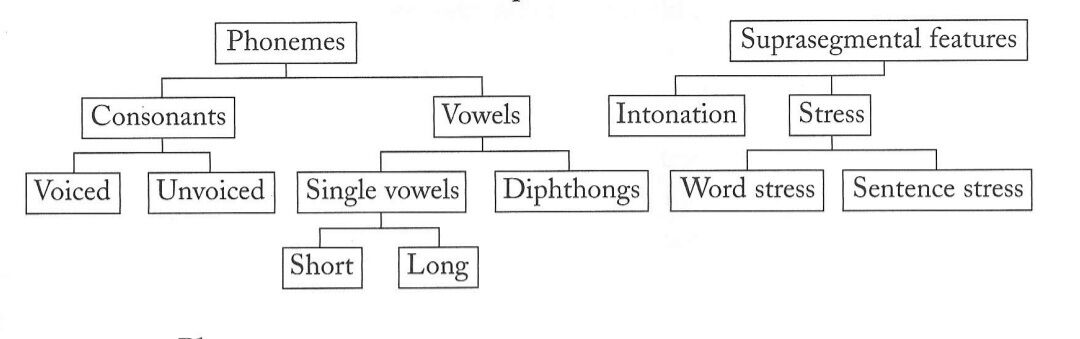
PHONEMES
Phonemes e the different sounds within a language. When considering meaning, we see how sing one sound rather than anothed can change the meaning of the word. It is this principle which gives us the total number of phonemes in a partricular language.
Sounds may be voiced or unvoiced. Voiced sounds occur in the vocal cords in the larynx are vibrated.
The set of phonemes onsist of two categories: vowel sounds and consonant sounds. Vowel sounds are all voiced, and may be single, or a combination involving a movement from one vowel sounds to another; such combination are known as diphthongs. Single vowel sounds ay be short or long.
Consonant aounds may be voiced or unvoiced.
vowel: 12
diphthongs: 8
consonants: 24
SUPRASEGMENTAL FEATURES
They are features of speech which generally apply to groups of segments, or phonemes, The features which are important in English e stress, intonation, and how sounds change in connected speech.
With regard to individual words, we can identify and teach words stress. Usually one syllable in a word will sound more prominent than the others.
With regard to utterances, we can analyse and teach intonation as well as stress. Stress gives hythm to speech. One or more rds within each utterance are selected b he speaeras worthy of stressing, and this made prominent to the listener. Intonation is the way in which the pich of the voice ges up and down in the course of an utterance.
Utterance sess and intonation patterns are often linked to the mmunication of meaning
THE PHYSIOLOGY OF PRONUNCIATION
We all use the same speech organs to produce tho sounds we become accustomed to producing.The set of sounds we acquire, however, may vary. We also learn to use our voices in different ways.
To a certain extent we can learn to use our speech organs in new ways in order to produce learnt sounds in a freign language, or to lose unds from our own language which are not appropriate in the foreign language. It seems. however, that after childhood our ability to adopt an unfamiliar set of sounds diminishes somewhat.
In the human larynx (voice box) there are two flaps of elastic, connective tissues known as vocal cords, which can open and close. During normal breathing ,and also in the production of unvoiced sounds, the cords are open. When the edges of the vocal cords come close tgether, the air which passes between them makes them vibrate resulting in voicing. The peach of the sound is controlled by muscles which slacken and lengthen the cords for low tones, and shorten the cords, pulling them taut for high-pitched tones.
We speak using the lips, tongue, theeth, hard and soft palates and alveolar ridge. The nasal cavity comes into play for certain sounds, and the movement of the lower jaw is also important. Articulation happens en e arstream is interrupted, shaped, restricted or diverted.
Página 4
UNIT 3
ORGANS OF SPEECH
They are not primarily organs of speech at all. Their first job is to make sure that the body survives. But we also use the same organs to produce very delicately and very accurately modulated chains of sound though which we communicate, so if we want to undestand the speech process from the production side is necessary to know at least enough about the functioning of these organs to enable us to describe how sounds and ssequences of sounds are produced
THE LUNGS
Structure: 2 sponge- like organs joined by the windpipe or trachea. Two possible movements: Exalation and Inspiration
Role in speech production:
Source of energy or motor
Lung air capacity and muscular activity: organization and length of utterances
peech is produced during exhalation
LARYNX
Structure : a box- like structure: cartilage and muscle. It ctains the vocal cords or folds
Role in speech:
first station: modification to the airstream
VOCAL CORDS
Structure: 2 folds of ligaments and elastic tissue.Gap between them: glottis
Four actions:
Open: normal breathing and voiceless sounds
Close: air s held behind, but then released: glottal stop
Semi-close: glottal fricative
Rapid opening and closing with vibration voiced sounds. Rate of vibration: pitch: vibration
THE RESONATING CAVITIES
THE PHARYNX
Structure: tube-like structure: just above the larynx. Flexible length: top end s divided ito two,one part eing the back of the mouth and the other being the beginning of the way through the nasal cavity.
three sections: laryngopharynx, oropharynx and nasopharynx.
Function:
Aplifier or resonator. No english sound is produce in the pharynx.
THE ORAL CAVITY
Most important resonator: A- great mobility of itsorgans / B- Changes of size and shape
The base: the tongue
The front: the lips
The back: pharyngeal wall
The top: nasal cavity
ARTICULATORS
Elements hich vary the shape of the resonators and further interference with the passage of air.
Active: capable of movement : tongue, lips, soft palate
Passive: incapable of movement : teeth, alveolar ridge, hard palate and lower jaw
THE LIPS
Structure: The lips constitute the final orifice of the outh cavity whenever the nasal passage is shut off.
Role in speech:
The two lips can assume varos shapes and each shape is going to define the quality of a sound, vowel or consonant:
close-rounded: Both lips form a circle, as the ends come together. ex: "wood"
open-rounded: the circle is not as pronounced. It is present in the vowel in the word "hot"
spread: the lips ends distance themselves, as in "see"
neutral: there is no movement of approximation or distance of the lips ends, as in "ah"
THE TEETH
Structure: At the front of the mouth, behind the lips. Divide into upper and lower.
Movement: The upper teeth are used in speech to interfere with or stop the air flow with the help of the tongue or the lower lip.
Sound produced:
The upper teeth: lower lip: labiodental sounds. The tongue: the upper teeth: dental.
Loss of teeth and their influence in speech: The oss of the lower incisors may have an adverse effect on certain sounds.
ALVEOLAR RIDGE
Structure: or teeth ridge: between the top front teeth and the hard palate
surface: rougher and covered with little ridges.
Role in speech:
tip or blade of the tongue: alveolar ridge: alveolar (d,t,s,z) (there are re sounds to mention).
Other alveolar sounds: "n" and "l" or example in the words Nile; "d" and "t" in the word dental.
Sounds produced in this area are called alveolar.
THE PALATE
Structure: often called the "root of the mouth", bony inmovable parts: the center of the mouth. Anyone can feel its smooth surface with the tongue.
Role in speech:
tip of tongue and blade of tongue: alveolar ridge nd palate: palatoalveolar sounds (george, church)center of the tongue: palate: palatal sounds (yield,you).
THE SOFT PALATE
Structure: Soft area at the back of the mouth which we can touch with the tongue: pensant end, the uvula
Role in speech:
movable rticulator : the position fo the soft palate: nasal or oral.
Lowered: air out through the nasal cavity, nasal sounds (whith a simultaneous vibration of the vocal cords).
Raised: access to the nasal cavity blocked, oral sounds.
contact etween the back part of the tongue: the velum: velar sounds.
THE TONGUE
Structure: a complex muscular structure whidoes not sow obvios sections; but for the purpose of it, is convenient to imagine the surface of the tongue divided into three parts: The part which is normally lies opposite the soft palate is called the back, the part which normally lies opposite the hard palate is called the front; and the part wich normally lies opposite the teethridge is called the blade.
Role in speech:
it is possible to spread out the fore parts of the tongue latey, or to contract it laterally. It is not a very important feature, but there are few sounds in which lateralcontractions plays an essential part, but there are a few sounds in which lateralcontraction plays an essential part.
Generally, in the articulation of vowels, the tongue tip remains low ehind the lower teeth. The body of the tongue may be "bunched" in different ways, the front may be the highestpart, as when we say the vowel of "he", or the back may be most prominent, as in the case of thevowel "who", or the ole surface may be relatively low and flat, as in the case of the vowel in "ha".
the various parts of the tongue may also come into contact th the roof of the mouth, The tip, bade and rimsmay rticulate withhe teeth, as for the "th" sounds; or with the upper alveolar ridge, as in the case of "t,d,s,z,n" or the atipical contact may only partial, as in the case of "l"
the front of the tongue may aiculate against or near the hard palate.
the back of the tongue can form a total obstruction by its ontact, with the soft palate, raised in the case of "k,g" and lowerd for "n", as in sing.
LOWER JAW
Role in speech:
moving it up and down can decrease or increase the size of the cavity and so influence the quality of the sounds produced. Although this movement is not crucial, since we can speak intelligibly with a fixed jaw position,as when spoken a pipe, we nevehless de ove our jawonstantly in speech and it is not easy to inhibit the movement.
sometimes jaws a called articulators but cannot enter in contact th others. Lower aw moementwill control gapetween upper and lower teeth and the disposition of lips. Space between upper and lower teeth enter into description of sounds articulation since jaw movement is also altering distance between tongue and roof of mouth.
Información
- Descripción
- Terciario Ingles Apunte sobre Sin título, creado por Melina Mera el 16/06/2024.
- Creado por
- Melina Mera
- Visitas
- 2
- Valoración