
Apuntes
Globals 9 Sem. 2 Exam
Contenido del apunte (1)
Página 1
Growth and Development
What is the difference between growth and development?
Economic Growth (GDP/capita): measure of value of output of goods and services within a country during a time period
Economic Development (HDI): measure of the welfare of humans in a society
Growth (Doesn't measure quality of life!)
Examples:
Small portion of population own a large amount of the wealth -> level of human welfare of majority would become limited
Workers within Informal Work Sectors don't have a contract and don't know how much they're going to earn daily, while Formal Employers have a contract and agreed salary
Development
Levels of Poverty
Absolute Poverty refers to a condition where a person does not have the minimum amount of income needed to meet the minimum requirements for one or more basic living needs like food, water, sanitation, clothing, shelter, health care and education over an extended period of time.
Relative Poverty is the condition in which people lack the minimum amount of income needed in order to maintain the average standard of living in the society in which they live.
Inequality in Three Dimensions of Welfare:
Life Expectancy or Longevity (Health)
Literacy Rates or Knowledge (Education)
Standard of Living (Employment)
MARKET FAILURE
Three Effects of Market Failure
Externality (Negative and Positive)
Income Distribution -> Inequity of Income because Corporations make way more money than workers because they send their items to be made in foreign countries with Cheap Labor due to not having minimum wage in those countries.
Environmental Impact -> Corporations are often sources of pollution.
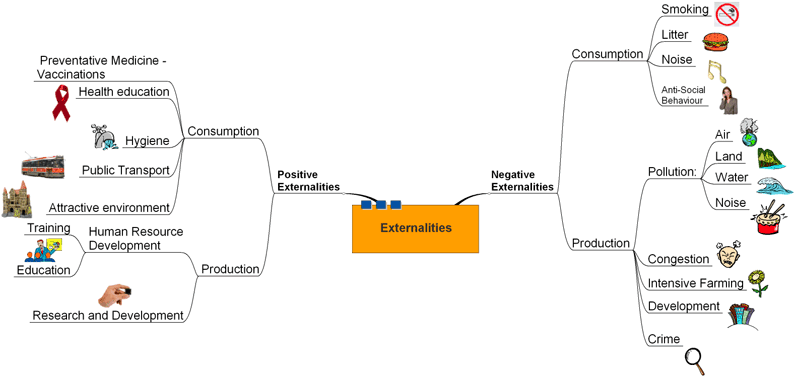
Positive Externality has beneficial effects on 3rd parties.
Negative Externality has costs incurred by 3rd parties.
http://www.youtube.com/watch?v=jqCR-9nBgWQ (Enclavar)
Formation of Waterfalls
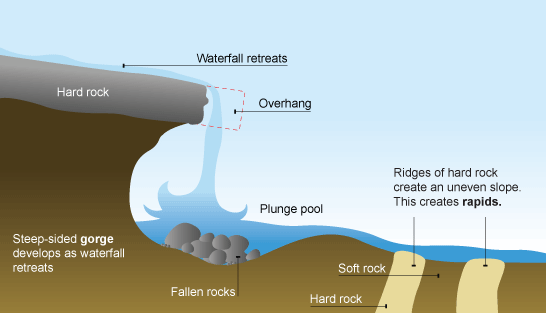
Waterfalls form when there is a sudden interruption in the course of a river.
Form when:
Rivers meet a band of softer, less resistant rock after flowing over relatively hard, resistant rock.
The underlying softer rock is worn away quickly and the harder rock is undercut.
In time, the overlying harder rock will become unsupported and collapse.
Formation of Plunge Pools
After it collapses, some of the rock will be swirled around by the river, forming a plunge pool.
Formation of Gorges
This process is likely to be repeated many times, causing the waterfall to retreat upstream leaving a steep-sided gorge.
Formation of Rapids
Rapids occur when layers of hard and soft rock are very thin, and no obvious break of slope develops as in a waterfall.
http://www.youtube.com/watch?v=FIn0UoeDyVg (Enclavar)
Formation of V-Shaped Valley
Any spare energy possessed by a river near its source is used to transport large boulders along its bed this results in cutting rapidly downwards, or vertical erosion.
Vertical erosion leads to the development of steep-sided, narrow valleys shaped like a V.
Formation of Interlocking Spurs
The valley sides are steep and loose rock thats being washed into its load.
The river is forced to wind its way around protruding hillsides known as interlocking spurs.
Transportation
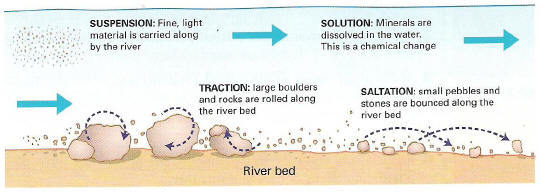
Traction: rolling stones along the bed
Saltation: sand-sized particles bounce along the bed in a 'leap-frog' movement
Suspension: slit and clay-sized particles are carried within water flow
Solution: some minerals dissolve in water
Erosional Processes
Attrition: when boulders and other material being transported collide and break up into smaller pieces
Hydraulic Action: when the sheer force of the river dislodges particles from the river's banks and bed
Abrasion: when smaller material, carried in suspension, rubs against river banks
Corrosion: when acids in the river dissolve rocks
Long-Term Causes
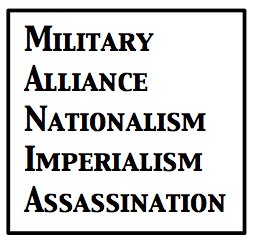
Nationalism by Serbia having extreme patriotism to assassinate the Archduke for their want of an independent country with Bosnia and Herzegovina. Serbians were supported by The Black Hand (Serbian Nationalistic Society). The reason behind the assassination of Archduke Franz Ferdinand was that the Austria-Hungarian Empire annexed Bosnia and Herzegovina.
Colonial Rivalries between Great Britain and Germany (Central Power) and Great Britain and the Ottoman Empire (Central Power). Great Britain needed India and the Middle East and needed to protect it's land and sea routes to them which included the Strait of Gibraltar and the Suez Canal, while Germany wanted to build the Berlin-Baghdad Railroad to send superior products to the Middle East and drive out other trade in that area. Great Britain also needed the Dardanelles Strait for easy access to the Mediterranean Sea which belonged to the Ottoman Empire.
Imperialism for the Middle East by Germany, Russia, and Great Britain. Germany wanted to build the Berlin-Baghdad Railroad for superior trade with the Middle East. Russia wanted to expand in the Balkans and the Middle East. The Middle East was the key to survival of the British Empire.
Militarism in the urge for Germany and Great Britain to show their supremacy. Before the war began it was obvious to many European nations that it was coming due to the growth in the mass of armies. In 1870, Germany defeated France and took back Alsace and Lorraine leaving France seeking revenge, but in need of allies. Great Britain's navy built the first super battleship called the "Dreadnought" and have 64 battleships (more than every other country in WWI). Germany threat a challenge by building their own "Dreadnoughts", but British contain the Germain navy by controlling the Scapa Flow.
Systems of Alliances there was the Triple Entente and the Triple Alliance. The Triple Entente involved Serbia, Russia, France, and the British Empire, while Triple Alliance involved Austria-Hungary, Germany, and the Ottoman Empire.
Short-Term Causes/Events
Balkan Wars: 1908, 1912- Two successive military conflicts that deprived the Ottoman Empire of almost all its remaining territory in Europe.
June 28, 1914 - Archduke Franz Ferdinand
of Austria, heir to the Austrian throne, is assassinated in Sarajevo, Bosnia.
July 23, 1914 - Austria sends an ultimatum to Serbia threatening Serbia’s independence. The ultimatum is written so that no acceptable compromise could be made.
July 25, 1914 - Serbia orders mobilisation of troops; Russia arranged to be stationed on Austrian border.
July 28, 1914 - Austria declares war on
Serbia.
July 29, 1914 - Inflexibility of Military to adapt to diplomatic needs when Russia wants to help
Serbia and orders full mobilisation.
August 1, 1914 – Germany demands that
Russia stop mobilisation in fear that the Von Schleifen plan would not work. Russia doesn't stop it's mobilisation. Germany declares war on Russia.
August 3, 1914 - France begins mobilisation; Germany declares war on France.
August 4, 1914 - Germany invades Belgium.
August
5, 1914 - Great Britain, who had
made an agreement to protect Belgium’s neutrality, declares war on Germany.
Also, being an ally of both Russia and France, she would have entered the war
eventually. Germany is astonished that Great Britain would go to war over a
“scrap of paper,” meaning its agreement with Belgium.
GROWTH AND DEVELOPMENT
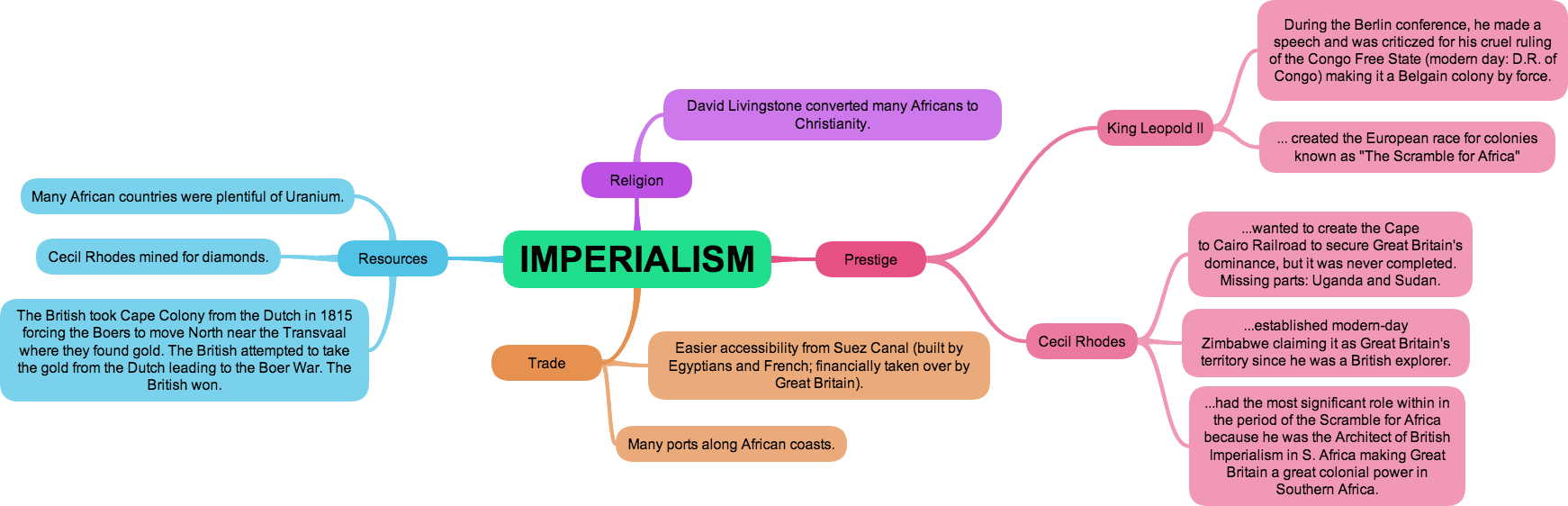
IMPERIALISM
market failure
DRAINAGE BASINS AND RIVERS
world war i
Información
- Descripción
- International Baccalaureate Global Studies 9 Apunte sobre Globals 9 Sem. 2 Exam, creado por Fadila Farag el 13/06/2014.
- Creado por
- Fadila Farag · jun 2014
- Actualizado
- 14 nov 2016
- Visitas
- 633
- Valoración