
Drift to War 1933-1939
Diapositivas del conjunto (7)
-

- Appeasement was the approach adopted in 1937 by British Prime Minister Neville Chamberlain and French Leader Eduoard Daladier. Essentially, appeasement was the process of giving Hitler what he wanted.
- Contributing factors to the policy of appeasement:
- Britain and France were unprepared for war
- Chamberlain was aware that British defence forces were not prepared for war
- A large section of the British public believed that the Treaty of Versailles was too harsh on Germany
- Public saw nothing wrong with Hitler trying to unite German speaking people
- Many saw Nazi Germany as a safeguard against the spread of communism
-
- The Anschluss 1938: Germany and Austria Unite
- Hitler wanted to unite many Germans living in Austria back with those in Germany (against Treaty of Versailles and St Germain)
- Austria's Nazi Party and Hitler campaigned for union (Anschluss)
- Hitler threatened to move troops into Austria to 'restore order'
- Austrian chancellor called for Britain and France to make Hitler back down
- In March 1938, German troops march into Austria, a plebiscite was then organised where 99.75% of the population voted to unite
- Britain and France lay idle as the two countries united
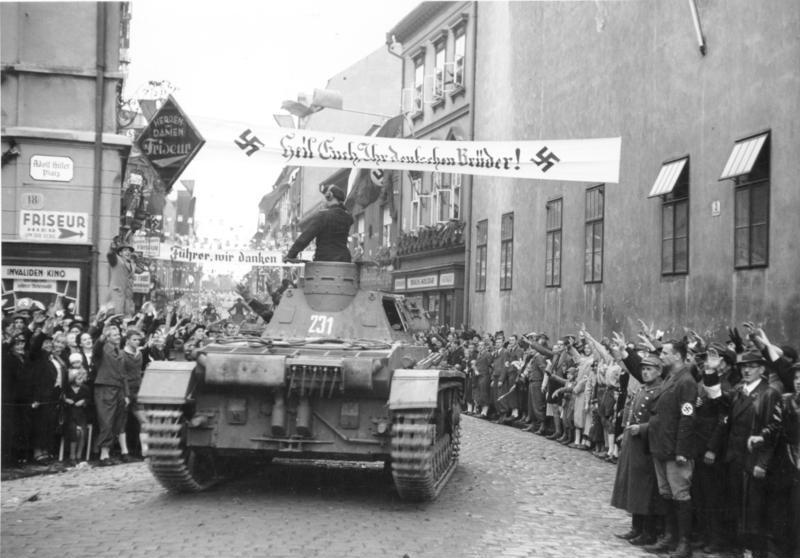
- Pie de imagen: Celebrations in the streets as Austria and Germany unite
-
Sudetenland and Munich Agreement 1938
- Czech leader, Edvard Benes, was appalled by Anschluss and wanted British and French promises for protection against the Germans. They gave promises this time.
- Hitler's interest lay in the Sudetenland of Czechoslovakia due to the heavy population of Germans. In May 1938, Hitler expressed support for Sudeten Germans, threatening invasion if Czechoslovakia did not hand the region over.
- Benes was prepared to fight. The Czechoslovakian's had a modern army and British support. Tensions rose and led to crisis talks in Munich in September 1938.

-
- In a last attempt to avoid war, talks where held in Munich over German actions in Czechoslovakia.
- On 29th September 1938, Mussolini, Hitler, Daladier and Chamberlain gathered for the Four Power Summit in Munich
- Under the Munich Agreement the leaders decided to give the Sudeteneland to Hitler
- Neither the Czechs nor the USSR were consulted over the agreement
- Chamberlain believed this agreement was necessary for 'peace for our time'
- The media hailed the agreement as a triumph, although, there were many critical voices of the agreement. Opinion polls from September 1938 in Britain demonstrated the public thought appeasement would not stop Hitler.
- Meanwhile in the US, deep unease developed regarding Germany.

-
- Appeasement Ends:
- Hitler moves into the Sudetenland in October 1938
- March 1939, Hitler invades the rest of Czechoslovakia
- Hitler's next intentions were Poland; France and Britain warned Hitler that they would declare war, if he invaded Poland
- Appeasement ended as a policy
- Poland threatened:
- Hitler wanted to reclaim the Polish Corridor and city of Danzig
- He was concerned about opposition from Stalin because Poland bordered the USSR
- Stalin's Worry:
- The USSR concern with Germany was evident when they joined the League of Nations in 1934 and signed the Mutual Assistance Pact 1936
- Stalin was not consulted over the Munich Agreement, and believed Chamberlain and Daladier were pointing Hitler eastwards
-

- Pie de imagen: Stalin (left) shaking hands with Nazi Foreign Minister Ribbentrop (right)
- While Stalin met with Chamberlain and Daladier over alliance discussions in March 1939, he also met with Nazi Foreign Minister Ribbentrop too.
- Stalin opted for alliance with Germany
- Terms of the treaty:
- USSR and Germany would not attack one another
- Divide Poland between the two countries
- Stalin could take the Baltic States (Lithuania, Latvia and Estonia)
- The treaty was used by Germany to invade Poland and for the USSR to prepare for war
-
Poland and the Outbreak of War
- 21 March 1939 - Hitler demanded that Danzig be returned to Germany
- Danzig under the Treaty of Versailles was meant to remain a ‘free city’ under the League’s control
- Further, Hitler demanded Germany be given access to the Polish Corridor to East Prussia
- Here Britain and France pledged support to Poland in the event of an attack
- Hitler's response was to cancel both the The Anglo-German Naval Agreement and German-Polish Non-Aggression Pact
- Mussolini and Hitler sign the Pact of Steel May 22, 1939, in which they promised to support each other in the event of war
- Hitler invaded Poland on September 1, 1939
- Britain and France kept their pledge to aid Poland upon invasion; they declared war against Germany on the 2 September, 1939
Información
- Descripción
- El usuario ha eliminado su información de asignaturas Diapositivas sobre Drift to War 1933-1939 , creado por Usuario eliminado el 01/09/2017.
- Creado por
- Usuario eliminado · sep 2017
- Actualizado
- 1 sep 2017
- Visitas
- 21
- Historial
-
- Creado por Andrew Burke · 28 jun 2017
- Copiado por Andrew Burke · 30 jun 2017
- Copiado por Andrew Burke · 1 sep 2017
- Valoración