
Lektion 1A: Strukturen Show
Diapositivas del conjunto (4)
-
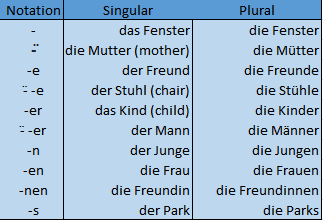
- In German dictionaries and vocabulary lists, singular nouns are listed along with a notation that indicates how to form the plural. There are five main patterns for forming plural nouns. (see table for examples)
-
Plurals: Masculine and Neutral
- Most masculine and neutral nouns form the plural by adding -e or -er. Plurals with the -er ending always add an Umlaut when the vowel in the singular form is an a, o or u.
- der Tag (day) ---> die Tage
- das Buch ---> die Bücher
- If the singular form of a noun ends in -el, -en or -er, there is no additional plural ending, but an Umlaut is added to the stem vowel a, o or u.
- der Apfel (apple) ---> die Äpfel
- das Zimmer (room) ---> die Zimmer
-
- For feminine nouns ending with -in, add -nen to form the plural.
- die Freundin ---> die Freundinnen
- die Studentin ---> die Studentinnen
- For most other feminine nouns, add -n if the singular form ends in -e, -el or -er. Add -en if it does not. Note that feminine plurals with these endings never add an Umlaut.
- die Blume (flower)---> die Blumen
- die Frau ---> die Frauen
-
- The -s ending is added to most words borrowed from other languages and to most nouns ending with vowels other than e.
- das Sofa ---> die Sofas
- das Auto ---> die Autos
- das Baby ---> das Babys
Información
- Descripción
- El usuario ha eliminado su información de asignaturas Diapositivas sobre Lektion 1A: Strukturen Show, creado por Usuario eliminado el 08/10/2017.
- Creado por
- Usuario eliminado · oct 2017
- Actualizado
- 8 oct 2017
- Visitas
- 60
- Etiquetas
- Historial
-
- Creado por Taylor Donato · 8 oct 2017
- Copiado por Taylor Donato · 8 oct 2017
- Valoración