
Atomic Mass
Diapositivas del conjunto (4)
-
- The atomic mass of an element is a weighted average mass of the atoms in a naturally occurring sample of the element.
- Average Atomic Mass
-
What is an isotope of an element?
- Isotopes are atoms that have the same number of protons but a different number of neutrons than other atoms of the same element.
- Because isotopes of an element have different numbers of neutrons, they also have different mass numbers. They DO have the same atomic number, however.
- Average Atomic Mass
-
- Natural abundance is the relative amount of a certain isotope of an element out of 1. It can be described as a decimal or as a percent.

- Pie de imagen: For example, above are the natural abundances of the two isotopes of chlorine as percents. They add up to 100%.
-
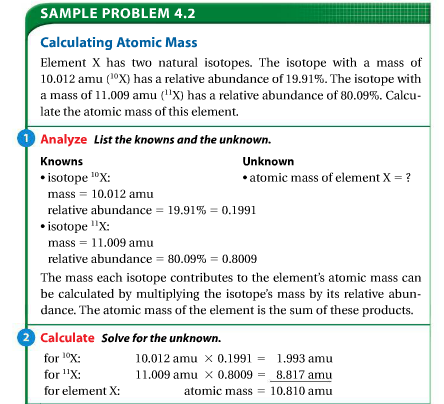
How do you calculate atomic mass?
- To calculate:
- 1. Multiply the mass of each individual isotope by its natural abundance (expressed as a decimal)
- 2. Add the products
- This will give the percent of the element taken up by each isotope out of 1.
- Example -------->
Información
- Descripción
- How to calculate atomic mass
- Creado por
- Usuario eliminado · dic 2017
- Actualizado
- 17 dic 2017
- Visitas
- 11
- Etiquetas
- Historial
-
- Creado por Holly Nephew · 17 dic 2017
- Copiado por Holly Nephew · 17 dic 2017
- Valoración