
Fichas
Covalent Bonding
Fichas del conjunto (9)
- 1Define covalent bondThe strong electrostatic attraction between a shared pair of electrons and the nuclei of the bonded atoms
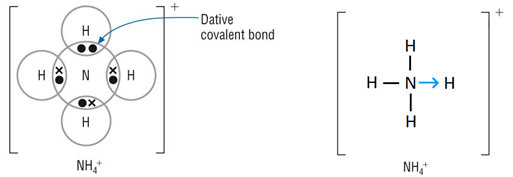
- 2What is a dative covalent bond?In dative covalent (coordinate) bonding, one of the atoms provides both of the shared electrons
- 3TRUE OR FALSE: Some compounds have less than 8 electrons in their outer shell, whilst some have more than 8TRUE
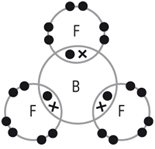
- 4Give an example of a compound with fewer than 8 electrons in their outer shellIn boron trifluoride, boron only has 6 electrons in its outer shell
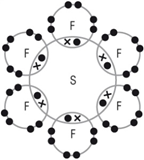
- 5Give an example of a compound with more than 8 electrons in their outer shellIn sulphur hexafluoride, sulphur has 12 electrons in its outer shell. This is known as 'expanding the octet'.
- 6TRUE OR FALSE: All covalent bonds are the same strengthFALSE
Not all covalent bonds are the same strength - 7What determines the strength of a covalent bond?Covalent bond strength differ depending on how much the outer atomic orbitals of the bonded atoms overlap, and how strongly the atomic nuclei are attracted to the shared electrons
- 8What does the average bond enthalpy measure?The average bond enthalpy measures the energy required to break a covalent bond
- 9What happens to the average bond enthalpy when bond strength increases?The stronger a bond is, the more energy is required to break it, and so the greater the value of the average bond enthalpy
Información
- Descripción
- El usuario ha eliminado su información de asignaturas Fichas sobre Covalent Bonding, creado por Usuario eliminado el 05/03/2018.
- Creado por
- Usuario eliminado · mar 2018
- Actualizado
- 5 mar 2018
- Visitas
- 20
- Historial
-
- Creado por Yinka F · 20 feb 2018
- Copiado por Yinka F · 5 mar 2018
- Valoración