
Fichas
Polarisation
Fichas del conjunto (14)
- 1What is electronegativity?Electronegativity is the ability of an atom to attract the bonding electrons in a covalent bond
- 2What is electronegativity measured on?It is measured on the Pauling scale - a higher number means an element is better able to attract the bonding electrons
- 3What determines whether a bond has more covalent or ionic character?The difference in electronegativity between the bonded atoms
- 4Ignoring the noble gases and hydrogen, describe the trend in electronegativity in the periodic tableElectronegativity tends to increase across periods and decrease down groups. This means the most electronegative element is fluorine. Oxygen, nitrogen and chlorine are also very strongly electronegative
- 5TRUE OR FALSE: The covalent bonds in diatomic gases are non-polarTRUE
- 6Why are the covalent bonds in diatomic gases non-polar?Because the atoms have equal electronegativities and so the electrons are equally attracted to both nuclei
- 7The bonds between carbon and hydrogen are essentially non-polar. Why?Carbon and hydrogen have similar electronegativities and so the electrons are equally attracted to both nuclei
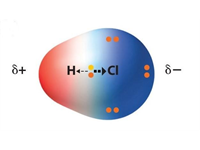
- 8What makes a covalent bond 'polar'?If the two atoms in a covalent bond have different electronegativities, the bonding electrons are pulled towards the more electronegative atom. This makes the bond polar.
- 9Complete the sentences: Polar molecules have an overall __________. The __________ of the molecule will decide whether or not it has an overall __________. If the polar bonds are arranged ________________ the dipoles cancel each other out and the molecule is _____-________ (e.g. CO₂)Polar molecules have an overall DIPOLE. The SHAPE of the molecule will decide whether or not it has an overall DIPOLE. If the polar bonds are arranged SYMMETRICALLY the dipoles cancel each other out and the molecule is NON-POLAR (e.g. CO₂).
- 10TRUE OR FALSE: Bonds between atoms are either purely ionic or purely covalent. There is no in-betweenFALSE
Bonds between atoms of different elements are RARELY purely ionic or purely covalent. Instead there's a gradual transition from ionic to covalent bonding - 11What can you use to predict the types of bond that will form between two elements?Differences in electronegativities - the greater the difference, the less covalent and more ionic the bond will be
- 12If the difference in electronegativities is less than 0.4, generally what type of bond is present?Non-polar covalent bonds
- 13If the difference in electronegativities is between 0.4 and 2.0, generally what type of bond is present?Polar but still mainly covalent
- 14If the difference in electronegativities is more than 2.0, generally what type of bond is present?Mainly ionic
Información
- Descripción
- El usuario ha eliminado su información de asignaturas Fichas sobre Polarisation, creado por Usuario eliminado el 05/03/2018.
- Creado por
- Usuario eliminado · mar 2018
- Actualizado
- 5 mar 2018
- Visitas
- 16
- Historial
-
- Creado por Yinka F · 21 feb 2018
- Copiado por Yinka F · 5 mar 2018
- Valoración