
Fichas
Primary and Secondary Immune Responses
Fichas del conjunto (8)
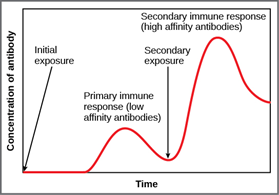
- 1Outline the primary immune responseWhen a pathogen enters the body for the first time, the antigens on its surface activate the immune system.
The primary response is slow as there are not many B lymphocytes that can make the antibody needed to bind to the pathogen.
Eventually, the body will produce enough of the right antibody to overcome the infection.
Meanwhile, the infected person will show symptoms of the disease.
After being exposed to an antigen, both T and B lymphocytes produce memory cells, which remain in the body for a long time. Memory B lymphocytes record the specific antibodies needed to bind to the antigen. The person is now immune. - 2Outline the secondary responseIf the same pathogen enters the body again, the immune system will produce a quicker, stronger immune response.
Clonal selection happens faster.
Memory B lymphocytes divide into plasma cells that produce the right antibody to the antigen.
Memory T lymphocytes are activated and divide into the correct type of T lymphocytes to kill the cell carrying the antigen.
The secondary response often gets rid of the pathogen before you begin to show any symptoms. - 3Describe the graph of changing concentration of antibody during the primary and secondary response (from the time of initial exposure)
- 4TRUE OR FALSE: Memory B and T lymphocytes have a limited lifespanTRUE
- 5Complete the sentences: Someone who is immune to a particular ___________ will not always stay immune forever. ___________ can be maintained by being continually ___________ to the pathogen, so you continue to make more and more _________ B and T lymphocytes.Someone who is immune to a particular PATHOGEN will not always stay immune forever. IMMUNITY can be maintained by being continually EXPOSED to the pathogen, so you continue to make more and more MEMORY B and T lymphocytes.
- 6Compare the speed of response during the primary response and the secondary responsePRIMARY
Slow
SECONDARY
Fast - 7Compare the cells activated during the primary response and the secondary responsePRIMARY
B and T lymphocytes
SECONDARY
Memory cells - 8Compare the symptoms present during the primary response and the secondary responsePRIMARY
Symptoms are present
SECONDARY
Symptoms are NOT present
Información
- Descripción
- El usuario ha eliminado su información de asignaturas Fichas sobre Primary and Secondary Immune Responses, creado por Usuario eliminado el 05/03/2018.
- Creado por
- Usuario eliminado · mar 2018
- Actualizado
- 5 mar 2018
- Visitas
- 13
- Historial
-
- Creado por Yinka F · 5 feb 2018
- Copiado por Yinka F · 5 mar 2018
- Valoración