
Fichas
Aerobic Respiration
Fichas del conjunto (35)
- 1What is the overall equation for aerobic respiration?6O₂ + C₆H₁₂O₆ --> 6CO₂ + 6H₂O
- 2O₂ is known as the...Final electron acceptor
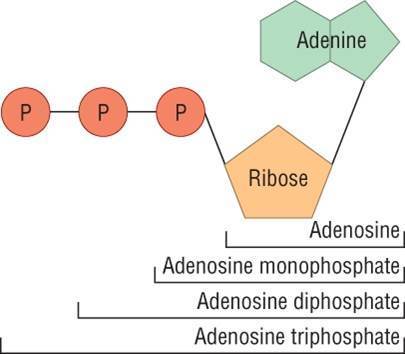
- 3What does ATP stand for?Adenosine triphosphate
- 4Describe the structure of ATP
- 5What is hydrolysis?The chemical breakdown of a compound due to reaction with water
- 6Complete the sentence: Hydrolysis occurs when _______ is released: ATP --> _____ --> _____ --> AdenosineHydrolysis occurs when ENERGY is released:
ATP --> ADP --> AMP --> Adenosine - 7Describe the structure of mitochondria
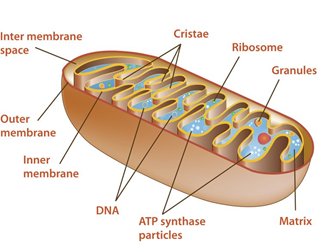
- 8What is the role of the intermembrane space?The intermembrane space is a compartmentalised space where concentration gradients can be made
- 9What are the 4 stages of aerobic respiration?Glycolysis
Link reaction
Krebs cycle
Oxidative phosphorylation - 10Where does glycolysis take place?In the cytoplasm
- 11Outline the process of glycolysis
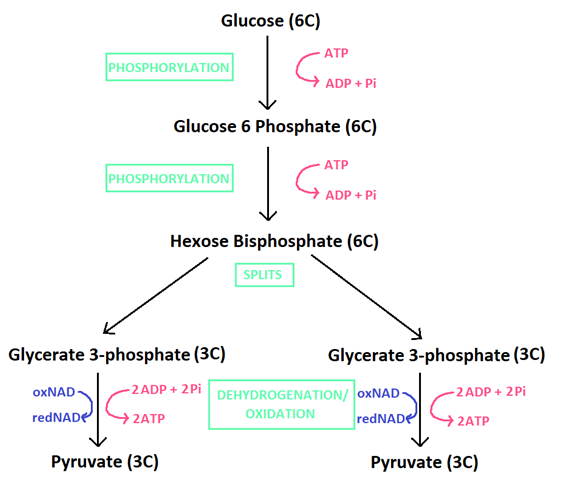
- 12What is NAD?A nucleic acid which acts as a coenzyme
- 13What are the products of glycolysis?2 redNAD
2 pyruvate
2 ATP (net gain) - 14Which process are the 2 redNAD produced in glycolysis used in?Oxidative phosphorylation
- 15Which process are the 2 pyruvate produced in glycolysis used in?Link reaction
- 16Which process are the 2 ATP produced in glycolysis used in?Used for energy
- 17Where does the link reaction occur?In the matrix of the mitochondria
- 18Outline the process of the link reaction
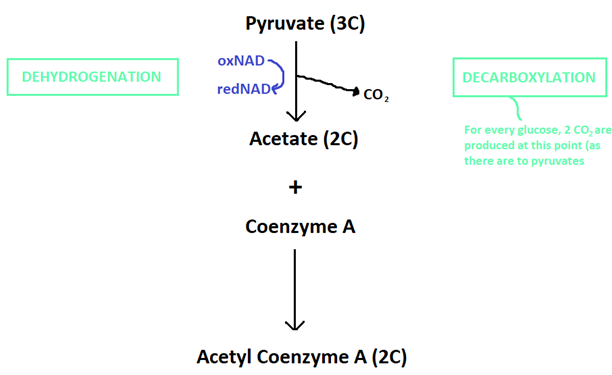
- 19What are the products of two link reactions?2 acetyl coenzyme A
2 CO₂
2 redNAD - 20Which process are the 2 acetyl coenzyme A produced in two link reactions used in?Krebs cycle
- 21Which process are the 2 CO₂ produced in two link reactions used in?Released as waste product
- 22Which process are the 2 redNAD produced in two link reactions used in?Oxidative phosphorylation
- 23Where does the Krebs cycle occur?In the matrix of the mitochondria
- 24Outline the process of the Krebs cycle
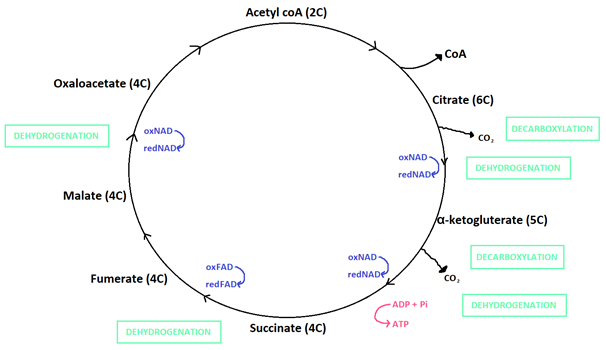
- 25What happens to the coenzyme A?Coenzyme A is recycled between the link reaction and the Krebs cycle
- 26What are the products of one Krebs cycle?1 coenzyme A
Oxaloacetate
2 CO₂
1 ATP
3 redNAD
1 redFAD - 27Which process is the coenzyme A produced in one Krebs cycle used in?Reused in the next link reaction
- 28Which process is the oxaloacetate produced in one Krebs cycle used in?Regenerated for use in the next Krebs cycle
- 29Which process is the CO₂ produced in one Krebs cycle used in?Released as a waste product
- 30Which process is the ATP produced in one Krebs cycle used in?Used for energy
- 31Which process is the redNAD produced in one Krebs cycle used in?Oxidative phosphorylation
- 32Which process is the redFAD produced in one Krebs cycle used in?Oxidative phosphorylation
- 33Complete the sentence: So far (in the first 3 stages of aerobic respiration), ___ ATP are produced from _________-level _______________So far (in the first 3 stages of aerobic respiration), 4 ATP are produced from SUBSTRATE-level PHOSPHORYLATION
- 34Outline the electron transport chain in oxidative phosphorylation1. redNAD releases hydrogen by dehydrogenation
2. Each hydrogen atom is split into a H⁺ and an e⁻
3. The electrons pass through a series of proteins embedded in the inner mitochondrial membrane
4. redFAD releases hydrogen by dehydrogenation
5. The transfer of electrons from the electron carriers to the protein complex changes the shape of the protein, creating a channel that allows H⁺ to flow from the matrix to the intermembrane space
6. There is more H⁺ in the intermembrane space than the matrix
7. An electrochemical gradient is set up. This is also known as the proton-motive force
8. The electrons are passed onto the next protein complex in the inner mitochondrial membrane, causing it to be reduced while the previous one is oxidised
9. The electrons are passed onto the final protein complex, causing it to be reduced whilst the previous one is oxidised - 35Outline the process whereby ATP is synthesised by ATP synthase1. H⁺ in the intermembrane space move down their electrochemical gradient
2. This causes ATP synthase (in the inner mitochondrial membrane) to spin, creating enough energy to catalyse the phosphorylation of ADP to produce ATP (ADP + Pi --> ATP)
3. The H⁺ ions are released back into the matrix where it is transported into the intermembrane space again or reacted with oxygen to form water
4. oxNAD and oxFAD are recycled and used in glycolysis, the link reaction and the Krebs cycle
5. The process in which energy from a proton gradient is used to make ATP is called chemiosmosis
Información
- Descripción
- El usuario ha eliminado su información de asignaturas Fichas sobre Aerobic Respiration, creado por Usuario eliminado el 05/03/2018.
- Creado por
- Usuario eliminado · mar 2018
- Actualizado
- 5 mar 2018
- Visitas
- 23
- Historial
-
- Creado por Yinka F · 17 feb 2018
- Copiado por Yinka F · 5 mar 2018
- Valoración