
Fichas
Reactions of Alkenes

Fichas del conjunto (21)
- 1Why are alkenes able to undergo electrophilic addition reactions?The double bond has got plenty of electrons and is easily attacked by electrophiles.
The double bond is also nucleophilic - 2What are electrophiles?Electron pair acceptors (e.g. H⁺ and NO₂⁺)
- 3What are nucleophiles?Electron pair donors
- 4What is the general electrophilic addition reaction equation for ethene and XY?H₂C=CH₂ + X-Y --> CH₂XCH₂Y
- 5Describe the mechanism for electrophilic addition1. The X-Y bond breaks (heterolytic fission) and the electrons are taken from the bond are taken by the Y atom to form a negative ion with a lone pair of electrons
2. Two electrons from the C=C double bond attack the δ+ X atom, creating a new bond between carbon 1 and X
3. Carbon 2 is left electron deficient - it becomes a positively charged carbocation intermediate
4. The Y⁻ acts as a nucleophile, attacking the positively charged carbocation intermediate, donating its lone pair of electrons to form a new bond
5. Overall the X-Y molecule has been added to form a saturated compound - 6Draw the mechanism for electrophilic substitution
- 7Describe the reactants and conditions for the production of alkanes from alkenesHydrogen gas
Nickel catalyst
150°C - 8Describe the process in which alkenes react to from dihaloalkanesAlkenes react with halogens to for dihaloalkanes. The halogens add across the double bond, and each of the carbon atoms ends up bonded to one halogen atom. This is an electrophilic addition reaction
- 9Give the balanced symbol equation for the reaction between ethene and halogen X₂H₂C=CH₂ + X₂ --> CH₂XCH₂X
- 10Describe the test for unsaturationAdd bromine water to your unknown hydrocarbon sample
If your unknown hydrocarbon is an alkene, the colour will change from orange to colourless (dibromoalkane, which is colourless, is made) - 11Describe the reactants and conditions for the production of alcohols from alkenesHydrated by steam
300°C
60-70atm
Solid phosphoric (V) acid catalyst - 12For the production of ethanol from ethene, the reaction is reversible and the reaction yield is low (5%). What can be done to increase the yield?Recycle the unreacted ethene gas
This makes the overall yield of ethene 95% - 13What do alkenes react with to form haloalkanes? What type of reaction is this?Hydrogen halides
Electrophilic addition reaction - 14What does Markownikoff's rule state?The major product from addition of a hydrogen halide (HX) to an unsymmetrical alkene is the one where hydrogen adds to the carbon with the most hydrogens already attached. The reaction to form this product will have occurred via the most stable carbocation intermediate
- 15TRUE OR FALSE: If the hydrogen halide adds to a symmetrical alkene (e.g. ethene), only one product can be formedTRUE
- 16Complete the sentences: If the hydrogen halide adds to an unsymmetrical alkene, there are _____ possible products. The amount of each product formed depends on how _________ the ________________ formed in the middle of the reaction is.If the hydrogen halide adds to an unsymmetrical alkene, there are TWO possible products. The amount of each product formed depends on how STABLE the CARBOCATION formed in the middle of the reaction is.
- 17What are the three possible carbocations?
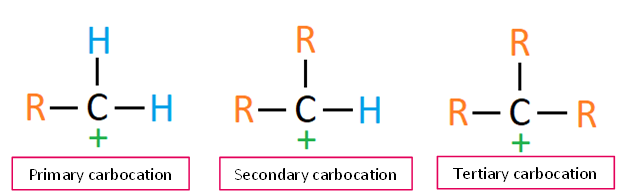
- 18TRUE OR FALSE: Carbocations with more alkyl (R) groups are more stableTRUE
- 19Carbocations with more alkyl (R) groups are more stable. Why?The alkyl groups feed electrons towards the positive charge
- 20How can you show that an alkyl group is donating electrons in a diagram?Drawing an arrow on the bond that points to where the electrons are donated
- 21TRUE OR FALSE: Less stable carbocations are much more likely to form than more stable onesFALSE
MORE stable carbocations are much more likely to form than LESS stable ones.
The first step of the mechanism is more likely to lead to the formation of the most stable carbocation
Información
- Descripción
- El usuario ha eliminado su información de asignaturas Fichas sobre Reactions of Alkenes, creado por Usuario eliminado el 12/03/2018.
- Creado por
- Usuario eliminado · mar 2018
- Actualizado
- 12 mar 2018
- Visitas
- 14
- Historial
-
- Creado por Yinka F · 7 mar 2018
- Copiado por Yinka F · 12 mar 2018
- Valoración