
Test
Exemplar 13.2: Fractures
Este test tiene tipos de pregunta que se abren en el reproductor de siempre.
Preguntas del test (26)
1A bone will fracture when the force acting on the bone is greater than the bone strength.
- AVerdadero
- BFalso
2Single large forces are likely to cause fractures at the weakest point of the affected bone, whereas small repetitive forces are likely to cause fractures at the point of impact.
- AVerdadero
- BFalso
3Label the following image with the correct fracture types.
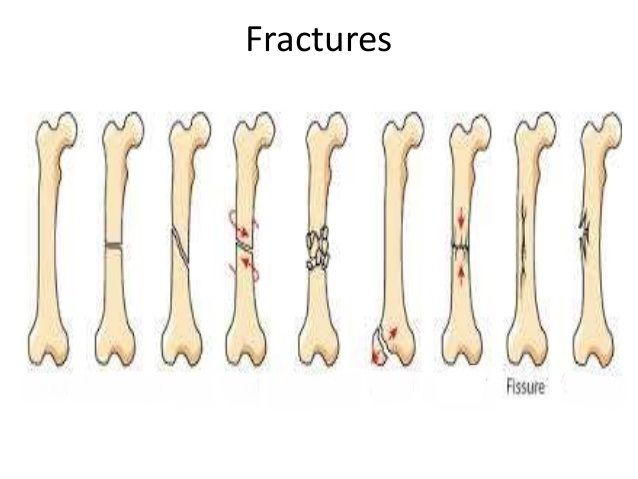
- ANormal bone
- BTransverse
- COblique
- DSpiral
- EComminuted
- FAvulsion
- GImpacted
- HGreenstick
4Each of the following are a type of fracture. Fill in the blank with the correct type of fracture for the description given. Note that I do not put "fracture" after naming the type (i.e.: The answer will just be "spiral" rather than "spiral fracture").
-[blank_start]Closed[blank_end]: The bone breaks but the skin remains intact. It's also called a simple fracture.
-[blank_start]Open[blank_end]: The bone breaks and protrudes through the skin. It's also called a compound fracture.
-[blank_start]Complete[blank_end]: The fracture involves the entire width of the bone.
-[blank_start]Greenstick[blank_end]: Bone fragments are still partially joined. Also called an incomplete fracture. This one is more common in children.
-[blank_start]Displaced[blank_end]: Broken ends of bones move out of correct anatomical alignment. It's also called an unstable fracture.
-[blank_start]Nondisplaced[blank_end]: Broken ends of bones remain aligned. It's also called a stable fracture.
-[blank_start]Comminuted:[blank_end] Bone fragments into many pieces. This is common in individuals with brittle bones.
-[blank_start]Avulsion[blank_end]: A fragment of bone is separated from the rest of the bone. It may also involve displacement of surrounding tissues.
-[blank_start]Linear[blank_end]: Fracture occurs parallel to the bone's axis.
-[blank_start]Transverse[blank_end]: Fracture occurs at a right angle to the bone's axis.
-[blank_start]Oblique[blank_end]: Fracture occurs diagonal to the bone's axis.
-[blank_start]Spiral:[blank_end] Fracture spirals around the bone. Usually occurs as the result of a twisting force. It's more common in children.
-[blank_start]Impacted[blank_end]: 2 ends of the bone are forced together. It's also called a buckle fracture. It's often seen with children's arm and hip fractures.
-[blank_start]Pathologic[blank_end]: Caused by a disease that weakens the bone. These include osteoporosis, bone cancer, and osteogenesis imperfecta.
-[blank_start]Stress[blank_end]: Caused by small repetitive forces on the bone. Often occurs in sports or exercise.
-[blank_start]Compression[blank_end]: A bone is crushed. Occurs most commonly in vertebrae, and common in patients with osteoporosis.
-[blank_start]Depression[blank_end]: Bone is forced inward. Occurs commonly in skull fractures.- AClosed
- BOpen
- CComplete
- DGreenstick
- EDisplaced
- FNondisplaced
- GComminuted:
- HAvulsion
- ILinear
- JTransverse
- KOblique
- LSpiral:
- MImpacted
- NPathologic
- OStress
- PCompression
- QDepression
5You have a patient with an open fracture. Which of the following would you consider to be true about this patient?
- AHe's at an increased risk for osteomyelitis.
- BHe might have brittle bones.
- CThis fracture needs immediate attention to prevent further damage to surrounding tissues.
- DThis fracture may involve displacement of the surrounding tissues.
6Which of the following fractures would be more common in children?
- AGreenstick
- BComminuted
- CAvulsion
- DCompression
- ESpiral
- FImpacted
7You have a 16 year old female patient who has a broken bone. She's curious about how bones heal, so she asks you if you know the process for bone healing. She's an intelligent girl that's interested in nursing, but she's only ever taken high school level biology. Select which statements would be appropriate for teaching this girl the healing process for bones.
- A"There are 3 stages to bone healing: inflammatory, reparative, and remodeling."
- B"The inflammatory stage is when the damage happens and a clot called a hematoma occurs around the break."
- C"These white blood cells called macrophages and neutrophils enter the wound get rid of debris and bacteria during the reparative phase."
- D" During the remodeling stage, these bone cells called fibroblasts, osteoblasts, and chondroblasts secrete this strong substance called cartilage to form a soft callus and connect the bones."
- E"Blood vessels reform in the area during the reparative phase."
- F"During the reparative stage, the soft callus is replaced by woven bone that forms a hard callus."
- G"The reparative phase will last 2-4 weeks for simple fractures.
- H"In the remodeling phase, the woven bone is replaced by this hard bone called lamellar bone."
- I"Your bone will return back to its original strength in a few months."
8When a bone fractures and heals normally, it's called a union. If a bone does not heal properly it can be classified as a delayed union, nonunion, or malunion. Select from the dropdown menu which type of union goes with each definition.
-[blank_start]Nonunion[blank_end]: A fracture that shows no clinically significant progress toward complete healing for at least 3 months.
-[blank_start]Delayed union[blank_end]: Occurs when the healing process takes significantly longer than expected, usually more than 3-6 months.
-[blank_start]Malunion[blank_end]: The bone fragments join in a position that is not anatomically correct.- ANonunion
- BDelayed union
- CMalunion
- DDelayed union
- ENonunion
- FMalunion
- GMalunion
- HNonunion
- IDelayed union
9You are teaching a class about fracture prevention to a group of people at a community center. This group consists of all age groups of people. Which of the following should you teach your audience?
- A"Parents, make sure your children wear safety equipment in any applicable situation. These include seat belts, helmets, and knee and elbow pads."
- B"If you work in a factory or factory-like situation, you should make sure you wear hard hats."
- C"You should make sure you consume an adequate amount of calcium."
- D"You should maintain a healthy weight, but how much you exercise doesn't matter."
- E"If you smoke and drink too much, you should quit smoking and cut down on your alcohol consumption. You do not, however, have to completely cease drinking."
- F"If you have a toddler around the house, you should use protective gates at stairs."
- G"If you have an older parent that is living alone that you are worried about, you should not move things around in their home."
- H"Older adults, specifically older adult women, should get regular screenings for osteoporosis."
10You are treating a patient who came into your emergency room with compartment syndrome following a fracture in the forearm. Which of the following is true about compartment syndrome?
- ADecreased blood flow leads to constriction of the blood vessels, which causes more edema and a continuing cycle of pressure in the limb.
- BSymptoms include severe pain and tenderness, swelling, paresthesia, pallor, numbness or paralysis, and decreased or absent pulse and normalization to room temperature in the proximal portion of the affected limb.
- CThe first step to treating it is to remove a tight cast.
- DIt can only be prevented by delaying casting until the swelling is gone.
- EIt can lead to a Volkmann contracture and paralysis, but not amputation.
11You have an elderly, obese patient that is immobilized following a leg fracture. You believe her to be at risk for deep vein thrombosis. You want to give a nursing student the experience in head-to-toe assessment, so you have a nursing student assess her while you watch. Before having the student assess her, you teach the student about deep vein thrombosis. Which of the following statements made by the student proves that she understands your teaching?
- A"If the patient's skin is red, warm, and swollen, and the patient reports leg pain and cramping, we will call her physician immediately."
- B"The doctor may call the radiography department to perform a Doppler ultrasound."
- C"The patient should not be on bed rest, even if DVT is confirmed."
- D"If I don't find DVT, I can prevent it by utilizing compression stockings or boots, ambulating the patient as much as tolerated, and suggesting prophylactic anticoagulants to her doctor."
- E"If a DVT dislodges, it can travel to the brain and cause a stroke, travel to the lungs and cause a pulmonary embolism, or travel to the heart and cause a myocardial infarction."
- F"Decreased blood flow, old age, obesity, inactivity/bed rest, smoking, and cancer are all the risk factors for DVT."
12Which of the following is true about fat embolism syndrome (FES)?
- AIt may occur in conjunction with open long bone or pelvic fractures.
- BAny release of fat from the bone marrow after a fracture presents a problem.
- CThe classic manifestations of FES are the result of blocked blood flow and the presence of free fatty acids.
- DThe signs and symptoms of FES usually develop immediately after the injury is sustained
- EFES will usually require mechanical ventilation.
- FFES is usually not preventable.
13Which of the following is true about fracture-related infections?
- AA patient with HIV is more likely to get a surgical infection than a child is.
- BFemales are more likely to get infections from fractures than men are.
- CCommon infecting organisms are Pseudomonas, Staphylococcus, and Clostridium.
- DA patient with an open fracture is less likely to get an infection than a patient with a closed, displaced fracture.
- EA patient who underwent surgical correction for a fracture is more likely to get an infection than a patient who only received a cast.
- FProper hygiene of the wound may includes surgical debridement, drainage, and culture for identifying the infecting organism.
- GInfections can really only cause cellulitis and osteomyelitis.
- HIf the infection is severe or unresponsive to antibiotics, amputation may be necessary.
14Which of the following is untrue about bone fractures in children and adolescents?
- AChildren often experience long bone fractures as a result of sports and play.
- BSPIRAL fractures are uncommon in children.
- CUnexplained midshaft spiral fractures may be an indicator of child abuse.
- DChildren often recover quickly from fractures
- EAdolescents are likely to suffer from stress fractures
15Which of the following is untrue about bone fractures in young, middle, and older adults?
- AAthletes often experience stress fractures
- BAdults, in general, may have a lengthened recovery time.
- COlder adult women have an increased risk of hip fractures, and are more likely to develop complications.
- DPost-menopausal women and older adults will have an especially higher chance of lengthened recovery time.
16Place the steps for emergency care of a non-spinal bone fracture in the correct order. This care is occurring inside of a care facility.
Immobilizing the fracture and preventing infection: [blank_start]step 1[blank_end]
Assess the extremities for pulses, movement, and sensation: [blank_start]step 3[blank_end]
Apply ice packs to reduce swelling: [blank_start]step 4[blank_end]
If the client is bleeding, apply a pressure dressing and sterile dressings to open wounds: [blank_start]step 2[blank_end]- Astep 1
- Bstep 3
- Cstep 4
- Dstep 2
17If a patient is experiencing a non-spinal bone fracture and you are giving care outside of a care facility, which of the following is an appropriate intervention to initiate
- ATry to reset the bone if it's out of alignment.
- BKeep the patient comfortable until the medics arrive.
- CApply splints above and below the joint.
- DProvide the patient water.
18You are handling a patient with a suspected spinal fracture. Which of the following is an appropriate intervention specifically related to a fracture in this area?
- AImmobilize the cervical spinal region.
- BImmobilize the thoracic spinal region.
- CImmobilize the lumbar spinal region.
- DKeep the patient completely immobilized until medics arrive.
19You have a patient that must undergo a surgery to fix his fractured bone. He's just received the news from his doctor, and he's very worried because he's never been in surgery before. He asks you what this surgery might entail. Select the statements that are accurate for teaching this patient about the surgeries he could receive.
- A"Depending on the amount of tissue damage, you will either undergo an external or an internal fixation."
- B"In external fixation, the bone is placed into alignment, and nails, screws, wires, plates, or rods are used to keep it in place."
- C"In internal fixation, metal pins and screws are placed into the bone above and below the fracture, then attached to a metal bar outside the skin."
- D"The full name for the internal fixation procedure is 'open reduction and internal fixation.'"
- E"Reduction is the process of the bone being put into correct alignment."
- F"External fixation allows for shorter hospital stays, earlier return to full function, and fewer instances of the bone not healing or healing incorrectly."
20You have another patient who is about to receive a fiberglass cast for her broken arm. Which of the following statements made by the patient shows that she understands what her cast is and how she should care for it?
- A"My cast will be made of fiberglass, which means that it 'breathes' better and is more compatible with X-rays."
- B"I should try to avoiding putting pressure on the cast until about 48 hours from now."
- C"If my cast gets wet, I should dry it will a blow driver on the cool setting. I should, however, try to avoid getting it wet in the first place."
- D"I should stop by the store on the way home and get a waterproof cast cover."
- E"If it itches under my cast, I can use a coat hanger to scratch it."
- F"I should use a pillow to elevate my arm above my heart, and place ice wrapped in cloth on top of the cast in order to prevent swelling."
- G"I do not need to contact my doctor if it feels like the cast is too tight. This is a normal feeling with new casts."
- H"I should look at the skin around my cast daily, and call my doctor if it looks raw or infected."
21Which of the following is FALSE about splints?
- AA splint is less supportive than a cast, but it can be easily adjusted,
- BSplints can only be ready made with Velcro straps
- CSplints are often used to stabilize fresh injuries.
- DSplints are used after the reparative phase of healing to allow some movement of the joints.
22Select all of the options that are appropriate when caring for a client with a cast.
- APerforming neurovascular assessments
- BPalpating the cast for "hot spots"
- CPromptly reporting drainage
- DEducation about proper cast care.
- EProtecting pressure sites with padding and protective dressings
- FAssess lung flow using a peak flow meter or spirometer
23You have a middle aged male patient that is in a skin traction device to maintain alignment of the fracture after internal fixation. Select the statements made by the patient that indicate that he understands the purpose of the device and how to prevent complications from it.
- A"This device uses weights, ropes, and pulleys to apply force to a fractured bone and maintain proper alignment of the bone for healing."
- B"Skin traction devices use splints, bandages, and boots placed on the injured limb.
- C"Skin traction is used only when a small amount of weight is needed for traction."
- D"Skin traction devices are only used to control muscle spasms or maintain alignment of a fracture before or after internal fixation."
- E"I'm already in a skin traction device, so I cannot be in a skeletal traction device."
- F"The weights cannot be removed."
24Your nursing instructor assigned you the task of caring for people in traction devices. Select all the interventions that are appropriate when caring for these individuals.
- AThe weights for skeletal traction devices can be removed under certain circumstances, but under no circumstance should the weights for skin traction devices be removed.
- BSigns of infection at the pin site for skeletal traction devices should be reported.
- CIn patients in skin traction devices, frequently assess the skin for evidence of pressure, shearing, or pending breakdown.
- DIn patients in skeletal traction devices, you should protect pressure sites with padding and protective dressings, as indicated.
- EMaintain the pull line by centering the client on the bed, ensuring that the weights hang freely, and ensuring that nothing is lying on or obstructing the ropes.
- FBe sure that the patient's foot is not wedged or placed flush with the floorboard of the bed.
- GPerform neurovascular assessments frequently
- HYou do not need to assess the lungs, but you do need to assess for common signs of immobility.
25Which of the following is NOT part of the physical assessment of the fracture patient?
- AThe 5 P's of neurovascular assessment: Pain, pulses (distal end of injured extremity), pallor, paresthesia, and paralysis/paresis
- BHealth history
- CEdema and swelling
- DSkin temperature
- EDeformity
- FRange of motion
26You are now caring for a patient that has a fracture in his leg. During the shift change report, you learn that he is in a fiberglass cast that set about an hour ago, but is not in a traction device. He is able to move on his own, but is having issues with using his crutches. Select all the interventions that would be appropriate for this patient.
- ARoutinely take vital signs.
- BElevate his leg with a pillow.
- CWrap ice in a bag and place it over the fractured area.
- DHelp the patient maintain his proper body alignment.
- EHelp the client perform passive and active exercises in the unaffected limbs.
- FTeach the patient how to use his crutches.
- GAssess the patient's injured limb for signs of compartment syndrome every 1-2 hours.
- HKeep a cast saw readily available
- IInform the patient that he should not let his cast get wet once he's discharged.
- JInitiate a 1-2 hour repositioning schedule.
Información
- Descripción
- El usuario ha eliminado su información de asignaturas Test sobre Exemplar 13.2: Fractures, creado por Usuario eliminado el 09/04/2018.
- Autor
- Usuario eliminado
- Idioma
- English
- Visitas
- 20
- Historial
- Creado el 9 abr 2018 · actualizado el 8 may 2018
- Etiquetas
- Valoración
- Aún sin valoraciones Valora este test