
Fichas
Experimentation 1
Fichas del conjunto (18)
- 1What is empirical cycle? What are steps (be able to draw them)?
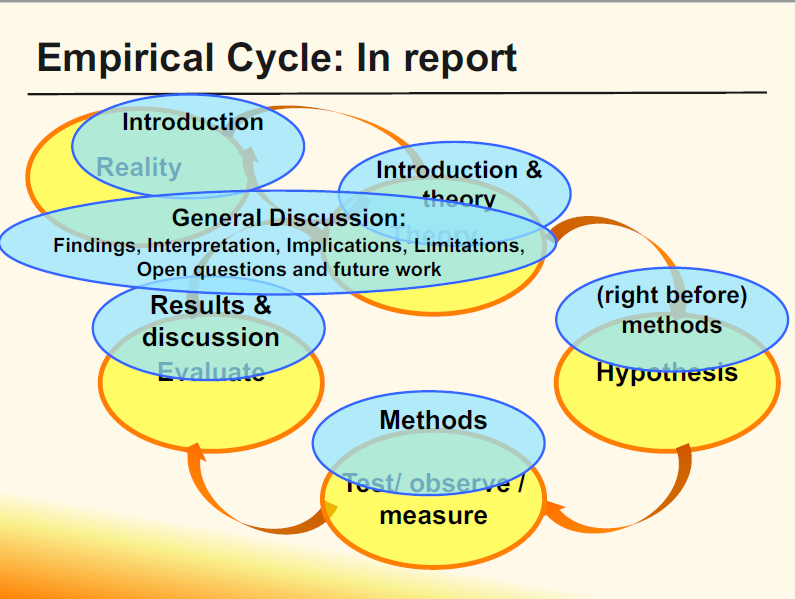
- 2What sections are typical for an empirical report? How do these tie to the stages of the empirical cycle?Introduction - Reallity
Introduction and theory - Theory
(right before) methods - Hypothesis
Methods - Test/observe/measure
Result & discussion - Evaluate
General discussion: Find info, interpretation, implications, limitations, open questions and future work - 3What sections are there typically in an (empirical) methods section?Introduction, hypothesis, meyhods, results, analysis/discussion
- 4Why are empirical studies important for science and practice? Why is this more than just for psychologyMaking experiments are something that drives science forward and grounding theories in reality. Valuable in creating new ideas
- 5Why is early writing important?Writing shapes the scientific process,
is essential, integral part of it
(‘final version’ can be rewritten,
so it is not “set in stone”)(according to Cairns) - 6Why is it often incorrect to “start” with data analysis (e.g., as in some big data approaches)There has to be a question of why before. A hypothesos about how things may be. Just looking at data is more of a exploration activity
- 7What are: manipulation, causality, validity (4 types), confounds & control, (in-)dependent variable, factor, condition, level, withinand between-subjects, counterbalancing…...
- 8What are the “three pillars” that underpin good experiments? And why is each pillar important and relevant?(Cairns)Empreimental design - basically the description of what exactly will go on in an experiment.
Statistical analysis
Experimental write-up - 9What is the main idea of “new experimentalism”?(Cairns)sometimes experiments exist because of an idea but not necessarily one which has support from any existing theory and in some cases, quite the opposite. Faraday on electricity and magnetism
- 10What is the role of experiments beyond testing theory (see text around Hacking, 1983 quote)(Cairns)A severe test of an idea
- 11Why is prediction central to good experiments?(Cairns)..
- 12Why is causality important? And how is this achieved in experiments?(Cairns)To be able to predict something, expect an outcome of an experiment
- 13What is meant with “GIGO”?(Cairns)Garbage In, Garbage Out, to describe the output from programmes based on poor quality data. So it is with experiments: the data from an experiment cannot be any better than the experimental design that produced it.
- 14What is (in-)dependent variable?(Cairns)one thing should influence another. In HCI-style experiments, this is also expressed as seeing the effect of the independent variable on the dependent variable. The independent variable is what is in the experimenters’ control and the experimenter explicitly manipulates it. The dependent variable is the numerical measure of what the outcome of the manipulation should be: the data that the experimenter gathers.
- 15What are 4 types of validity and why is each important? What are compromises for each type?(Cairns)Construct validity - is about making sure that you are measuring what you think you are measuring
Internal validity - If an experiment is set up to severely test whether influence X really does affect outcome Y then it needs to be clear any systematic changes in Y (now that we know we really are measuring Y thanks to construct validity) are wholly due to the change in X.
External validity - Experiments naturally reduce from a general question with wide applicability to the specifics of the experiment actually done. The question then becomes to what extent the results of the experiment do have the intended wider applicability. This is the external validity or generalisability of the experiment.
Ecological validity - concerned with the extent to which the experimental findings would have relevance in the real world in which people find themselves using interactive systems as part of their daily life. - 16What are ways to control for confounds?(Cairns)here are two general approaches to removing confounds. The first is to randomize participants between conditions of the experiment. The second is to experimentally control for potential confounds. Danger of making new confounds in removing other
- 17How do high ecological validity and experimental control relate?(Cairns)Higher ecological validity means that more unknown factors may be introduced into the experiment
- 18There are more questions on Cairns on the slides...
Información
- Descripción
- El usuario ha eliminado su información de asignaturas Fichas sobre Experimentation 1, creado por Usuario eliminado el 03/11/2018.
- Creado por
- Usuario eliminado · nov 2018
- Actualizado
- 3 nov 2018
- Visitas
- 99
- Historial
-
- Creado por August Edström · 29 oct 2018
- Copiado por August Edström · 3 nov 2018
- Valoración