
Fichas sobre Computer hardware and software, creado por Althea Baptiste el 24/11/2014.

|
Creado por Althea Baptiste
hace casi 12 años
|
|
Cerrar
|
|
Creado por Althea Baptiste
hace casi 12 años
|
|
A network is a set of connected computer and devices to allow the sharing of resources and data.
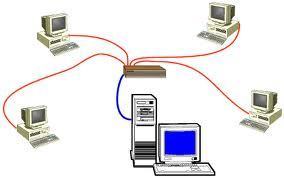
Networks can be classified by:
SCALE:
L A N
LOCAL AREA NETWORK
WAN
WIDE AREA NETWORK
Backup
to back up a file means
information theft
ENCRYPTION
unauthorized access
unauthorized use
Computer virus
worm
Trojan horse
ROOT KIT
COMPUTER
SECURITY
RISK
CYBER CRIME
SECONDARY
STORAGE
STORAGE MEDIUM
Capacity
storage device
Why use Secondary Storage?
Hard Disk
Cylinder concept
Formatting
Fixed Hard Drive
Portable Hard Drive
RAID
redundant array
of
independent
disks
network attached storage
(NAS)
Access Time
Access time = Rotational Delay + Seek Time
optical disc
Optical Discs
CD-ROM
CD-R
CD-RW
magnetic tape
Magnetic Tape
Magnetic tape is a large capacity,
Types of Access
Sequential Access
Types of Access:
Random Access
Types of Access
Devices can also be classified as sequential access or random access
Advantages of a Network:
Networks may be classified by
SCALE:
Personal Area Network
(PAN)
SCALE;
Local Area Network
(LAN)
scale:
Campus Area Network
(CAN)
scale:
Metropolitan Area Network
(MAN)
scale:
Wide Area Network
(WAN)
Networks:
collection methods
Ethernets
Network Topology
Classification of Networks –
Network Topology
Classification of Networks –
Communication Standards & Protocol
Classification of Networks –
Communication Standards & Protocol
TCP/ IP
Computer communications
A communications device is
Communications software consists
bandwidth
Latency
Transmission media
Broadband media
inter
network
three variants of
inter network,
Intranets and extranets may or may not have connections to the Internet.
An intranet
An extranet is a network or
inter network
Internet
Classification of Networks:
Ethernet
Classification of Networks:
Standards and Communication
Token Ring


