
Apuntes
WEEK 2: THE PSYCHOLOGY OF SELF-PRESENTATION AND PERSUASION
Contenido del apunte (1)
Página 1
WEEK 2: The Psychology of Self Presentation and Persuasion
Attribution Theory: The Whys and Wherefores of Behavior
Some Twists and Turns When Explaining Behavior
Is the Attitude Bone Connected to the Behavior Bone?
Cognitive Dissonance and Self-Perception
Two Flavors of Dissonance: Vanilla and Earthworm
How to be persuasive
Secrets from the Science of Persuasion
The Ins and Outs of Social Influence
1. Attribution Theory
theory about how people interpret behavior - how people make causal attributions/explanations for their behavior or other people's behavior
important because the explanation for the behavior determines what you do about it
coined by Fritz Heider - The Psychology of Interpersonal Relations
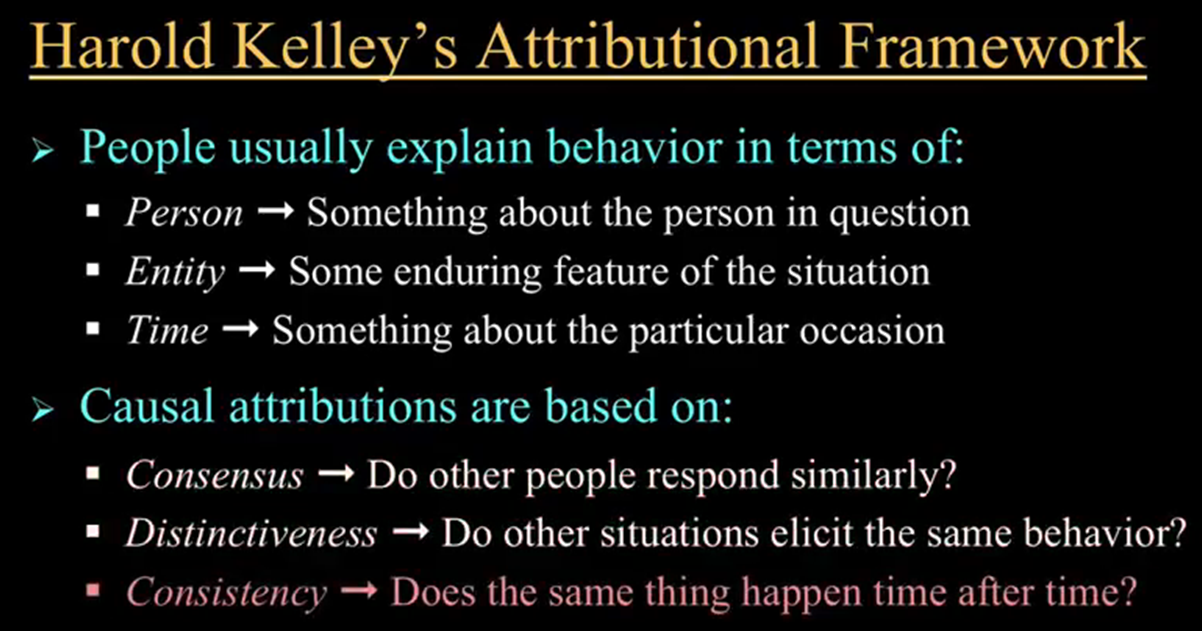
Harold Kelly's Attribution Framework
>>people usually explain behavior in terms of people (something about that person), entity (something enduring about the situation) and time (something about the occasion)
>>causal attribution is based on consensus (do other people respond similarly), distinctiveness (do other situations elicit the same behavior) and consistency (does the same thing happen time after time)
salience - salient stimuli tend to be viewed as more causal - perceptions of causality are partly a function of where one's attention is directed - attention is in turn a function of salience - Taylor and Fiske studies
attribution is a matter of logical deduction as well as sensory perception
2. Some Twists and Turns When Explaining Behavior
when making attributions, consensus is often not a factor, while distinctiveness and consistency are a big factor
The fundamental attribution error is the tendency for people to
underestimate the impact of situational factors and overestimate the role of
dispositional factors (people related factors) in controlling behavior - it is a true error
example of FAE - "Being Sane in Insane Places" reading
East Asians are less likely to make this error
Actor-Observer Differences in Attribution - actors are more likely to explain their behavior as a function of situational factors than are observers - this is simply a bias, not an error - differs if behavior is positive or negative due to salience
visual orientation can make a big difference when describing situational or dispositional explanations.
3. Attitude Bone vs Behavior Bone
behavior is not that connected to attitude as one might think! - e.g. environment and our actions
Chinese US tour example and Seminary students with the Good Samaritan lecture
Can be closely related when they closely match each other, attitude is strong, attitude is easy to recall, when people of aware of themselves, when outside influences are kept to a mimimum
4. Cognitive Dissonance and Self-Perception
does attitude shape behavior or behavior shape attitudes?
Theory of Cognitive Dissonance - most people assume that attitudes shapes behavior, but Leon Festinger showed with Dissonance Theory that it is the other way around
Cognitive Dissonance - inconsistent motivation - simultaneously hold 2 thoughts that are psychologically incompatible
e.g. Jewish Folklore - giving harassers a penny for calling him a Jew - created inconsistent motivation
e.g. Students doing boring task lied for $1 but not really for $20 - students who lied for $1 tried to convince themselves that the task was actually quite fun to reduce the dissonance, but those who lied for $20 didn't need to reduce the dissonance, they had a reason for lying - they got paid $20!
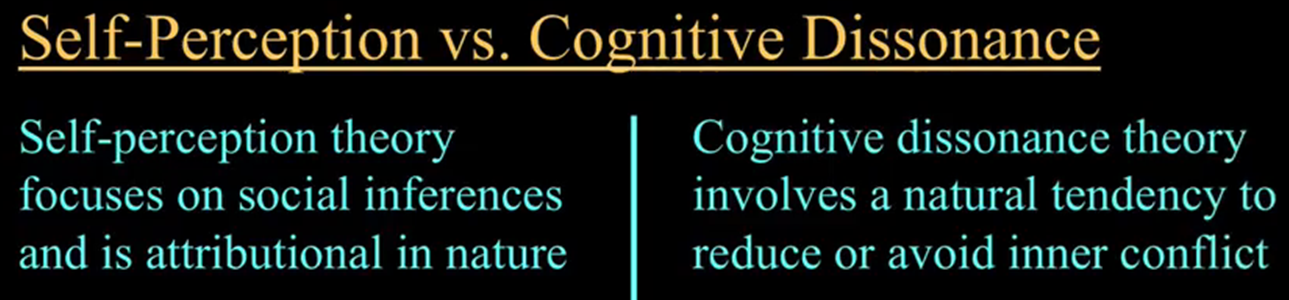
2 main prongs - the act of holding 2 incompatible thoughts creates a sense of internal discomfort (dissonance) and people try to reduce or avoid these feelings of dissonance wherever possible.
Daryl Bem developed Self Perception Theory to explain cognitive dissonance findings
Self Perception 1 - individuals come to know their own attitudes, emotions and other
internal states partially by inferring them from observations of their own behavior and the circumstances in
which their behavior occurs.
Self Perception 2 - to the extent that internal cues are weak, ambiguous or uninterpretable, the individual is
functionally in the same position as an outside observer
e.g. students who saw themselves tell others that the task was enjoyable for only $1 inferred that they must have enjoyed the task - they behaved as an outsider
5. Two Flavors of Dissonance
Pre-decisional
dissonance (dissonance influences decisions) vs post-decisional dissonance (follows a
choice already made and efforts to reduce dissonance affect later judgements)
pre-decisional dissonance - worm experiment - influences later decisions
post-decisional dissonance (vanilla) - horse betting experiment - people try to convince themselves that their decision is good/correct
west vs east - west concerned about incompetence but east concerned about social rejection
6. How to be Persuasive - Attitude Change
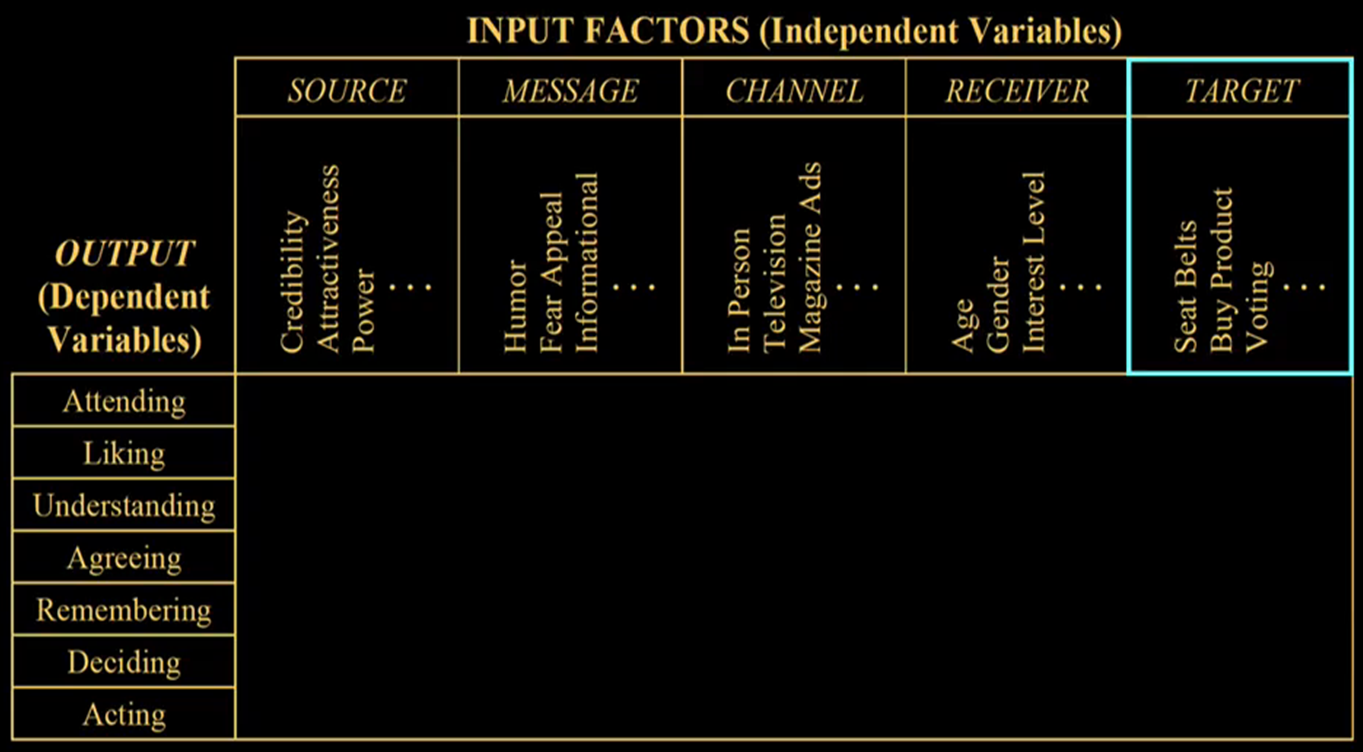
see McGuire matrix summarizing the input and output variables influencing persuasiveness
if you want to be persuasive should you...
discuss counter arguments to your position? - better to acknowledge and refute counter arguments before presenting your own when the counter is made salient or when the receiver is highly intelligent and/or opposed to your position - here you present a 2-sided appeal.
Attitude inoculation - similar to a 2-sided appeal but you only raised mild criticism of the counter position and the receiver generates the counter arguments
use a central (fact-filled, stats, arguments) versus peripheral route to persuasion? - central works best when people are highly involved in the argument
scare the receiver with a fear-based appeal? - yes! as long as you give people specific steps to avoid the threat.
7. The Science of Persuasion - Cialdini & Martin
factors that influence us to say YES!
6 shortcuts that we take due to the overload: reciprocity, scarcity, authority, consistency, liking and consensus
Reciprocity - the obligation to give when you receive - be the first to give and make it personalized and unexpected
Scarcity - people want more of the things they can have less of - e.g. cancelling the Concorde flight - don't just state benefits of your products, also show how unique it is and what they stand to lose if they don't get it
Authority - people will follow the lead of credible, knowledgeable experts - can't do it yourself, rather get someone else to even if they are connected to you and will profit where you profit - must be ethical
Consistency - people like to be consistent with the things they have previously said or done - activated by looking for and asking for small initial commitments that can be made - change agent must look for voluntary, active and public commitments and ideally get these commitments in writing
Liking - people prefer to say yes to those that they like - we like people who are similar to us, who pay us complements and who co-operate with us
Consensus - people will look to the actions of others to determine their own - e.g. reuse of towels - environmental benefits vs saying that 75% of people reuse their towels
8. The Ins and Outs of Social Influence
announcing that a bad action is being performed by many people - theft of wood - normalizes it and tacitly condones the behavior
effective social influence techniques - ask people to imagine or predict they will do something, tell a stranger your name before making a request, engage people is dialogue rather than monologue
"Even a Penny Will Help" technique - simple message when
"The Foot in the Door" technique - people are more likely to comply with a large request after a small one - people become in their own eyes the "type of people who does this sort of thing" - consistent with Bem's self-perception theory - technique is most effective when the person is labelled helpful or a supporter or when the large request is seen as a continuation of the smaller one
"The Door in the Face" technique - a smaller request that follows a large one is persuasive, people more likely to say yes to second smaller one - most effective when the same person makes the request, the requests are face to face with no delay and requests are pro-social with the same beneficiary
"The Low-Ball" technique - when people commit to a request, they are more likely to comply with a subsequent low-ball
New Page
Información
- Descripción
- Post Graduate Intro to Social Psychology Apunte sobre WEEK 2: THE PSYCHOLOGY OF SELF-PRESENTATION AND PERSUASION, creado por Brian Nichol el 18/08/2013.
- Creado por
- Brian Nichol · ago 2013
- Actualizado
- 3 nov 2016
- Visitas
- 526
- Etiquetas
- Valoración