
3. Chromatin and Nuclear Structure
Diapositivas del conjunto (29)
-
- Understand the structure of chromosomes and the diversity of interphase chromatin
- Know about modifications that affect access and function
- Have an overview of the mechanisms for maintenance and change
- Appreciate the complex organization of a eukaryotic cell nucleus
-
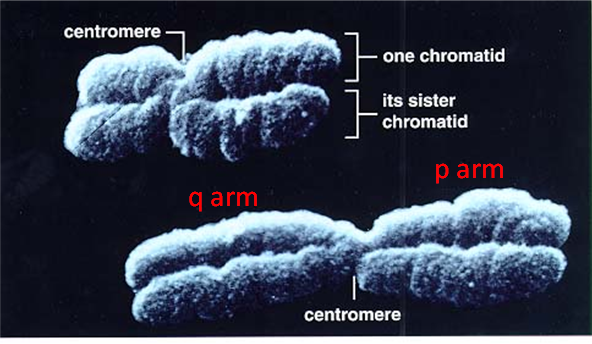
- Chromatin is condensed to form a transmissable unit in mitosis = chromosome
- Every gene has a postcode on a chromosome eg CIZ1 is at 9q34.2
- Chromosome 9, q arm, position 34.2
-
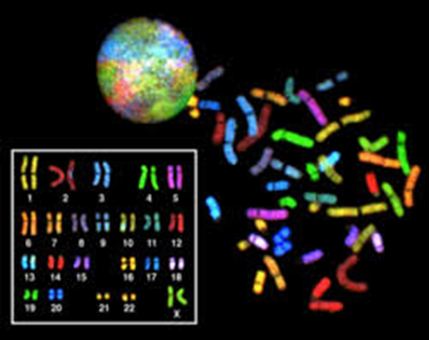
- Chromosome probed and identified using specific DNA in situ hybridisation probes that are chromosome specific
- Identify each chromosome in a different colour
- Or use probe specific for genes and used to locate a gene on a chromosome
-
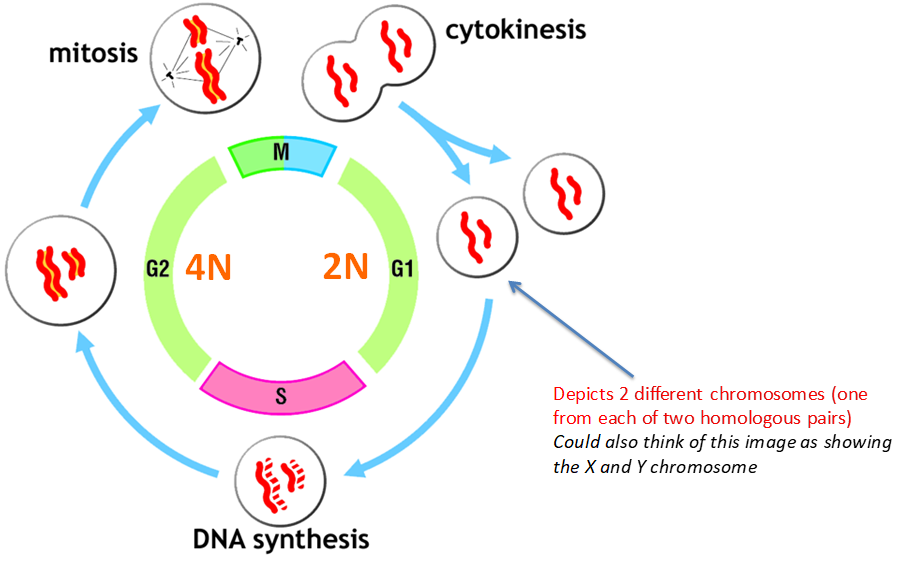
- Every cell cycle chromosomes are condensed and decondensed
-
-
DNA Packing: Beads on a String
- DNA is the string and the beads are nucleosomes
- Nucelosome= octameric complex, 2 molecules each of H2A, H2B, H3, H4
- DNA is wound twice around each nucleosome core particle
- Intervening DNA= linker
-
DNA and Histones Made for Eachother
- 1. Toplogy
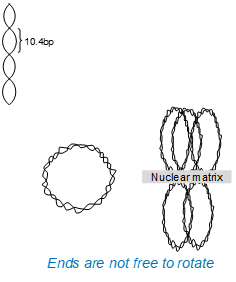
- 10.4bp of DNA per helical turn (twist)
- 146 nucleotides of dsDNA wrapped around each nucleosome in a relaxed state
- In vivo (bacterial cells with circular chromosomes or eukaryotic with linear), chromosomes are attached at intermediate locations to the nuclear matrix
- So that DNA molecules are tethered and are not free to add supercoils so remain in a relaxed, fixed state
-
DNA and Histones Made for Eachother
- 1, Topology
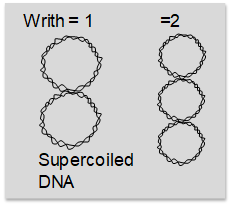
- Supercoiled DNA is the stressed state of DNA and occurs if a molecule has sufficient coils to create another twist (1 twist= writh of 1, 2 twists = writh of 2)
- More twists = positively supercoiled
- Less twists= negatively supercoiled
- DNA in the nucleus is thought to be negatively coiled however wrapped around a nucleosome it is a relaxed molecule- the process of unwinding the DNA form the nucleosome creates negative supercoils which is seen in DNA that is extracted from the nucleus (underwound DNA)
-
DNA and Histones Made for Eachother
- 2. Spacing
- A 5th linker histone (H1) seals the core particle - seals the 2 loops of DNA wrapped around to stabilise
- Linker DNA between nucleosomes is ~10-90bp long
- Nucleosome spacing is ~200bp
- Can visualise spacing between nucleosomes by using nucleases
- Extract chromatin from nucleus and digest with nuclease
- Fragments are separated according to size and DNA is fluorescently labelled so only see DNA and not nucleosomes
- See a 'nucleosome ladder'- pattern of DNA every 200bp
- 3. Charge
- Negative charge of DNA neutralised by positive charge of histones
- Chromatin complex= neutral, relaxed state complex
-
Topology Problems in Replication + Txn
- Processes that require access to the genome disrupt the relaxed state of chromatin:
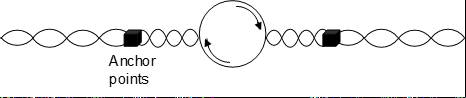
- Create positive supercoils ahead of the replication fork/transcription complexes until they reach an anchor point (where attached to nuclear matrix)
- Topoisomerases relieve the stress to create a relaxed state
- They are highly enriched at anchor points
- Type I- cuts one strand, passes the other through then ligates it
- Type II- cuts both strands then passes an unbroken strand through - problem is that causes ds break
-
Topology Problems in Replication + Txn
-
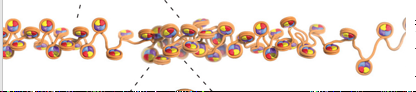
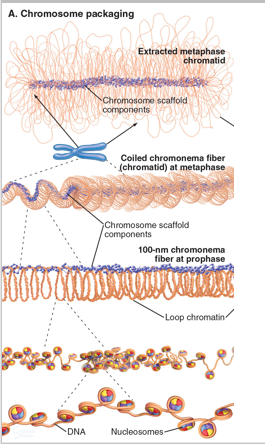
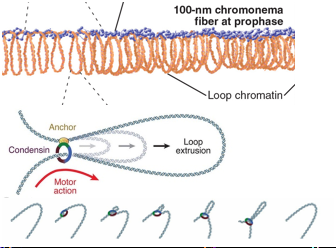
- Beads on a string further compact (stack up) to make solenoid (30nm fiber)
-
- 100nm
- At base of loops is anchor points where topoisomerases are
- Loops generated via structural maintenance of chromosomes (SMC) complex
- Condensin protein is part of the SMC complex and functions as a motor protein to extrude DNA loops
- DNA translocating motor functions moves DNA at a rate of 1500bp/s
- Moves DNA relative to itself, condensins fixed
- Uses ATPase activity
- Condensin like proteins present in yeast, humans and bacteria
-
-
DNA Packaging: Mitotic Chromosome
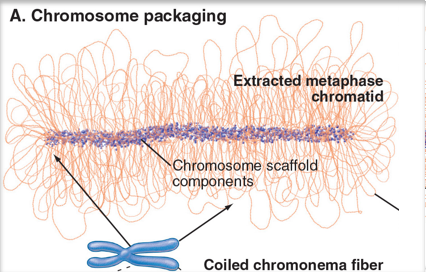
- Chromosome core structure is chromosome scaffold
- Loops going back and forth from scaffold
-
DNA Packaging: Mitotic Chromosome
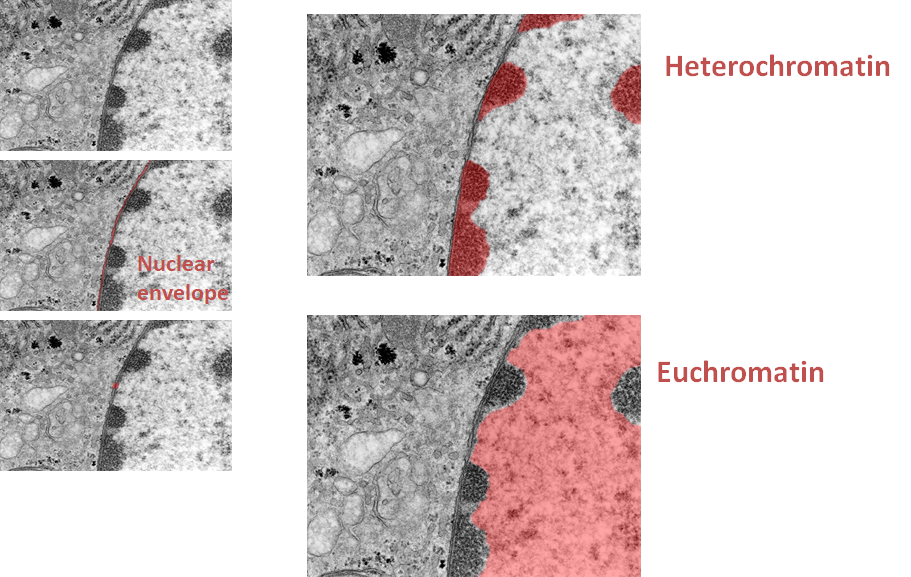
- Interphase nucleus chromatin organisation
- Heterochromatin:
- Highly compact
- Generally inactive (eg genes of a particular cell type that is not that specific cell)
- Gene poor
- often located at periphery of nucleus
- Usually replicated in late S- not necessary
- Euchromatin:
- Less compact
- Gene rich
- Contains active genes
- Usually replicated in early S
-
DNA Packaging: Mitotic Chromosome
- How is compaction modulated?
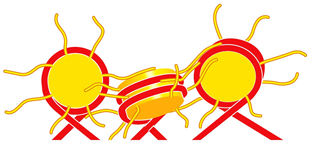
- When DNA wraps around nucleosome core particles, histone tails stick out beyond the DNA
- This effects how nucleosomes interact with eachother (compaction) and other proteins eg TFs
- Histone tails are accessible to enzymes and can be chemically modified which change the properties of histone tails eg charge
- Allows for much variation and potential for complex information (epigenetic)= histone code
- Each cell type will have a different variation of its own histone code
- Common modifications: Acetylation, phosphorylation, methylation, ubiquitination
- Modifications usually occur to amino acids: arginine, lysine, serine
- Eg H3K27Me3- three methyl groups(M) to lysine (K) at amino acid position 27 in histone H3
- Reversible, pushes chromatin towards heterochromatin state, supressive
-
Histone tails stick out past DNA
-
DDR and Chromatin Modification
- The H2AX histone variant is part of the DDR
- It is incorporated all over the genome at low frequency
- Once near a ds break is gets phosphorylated by protein kinase on its serine and marks the location of the ds break to attract repair proteins
-
DDR + Chromatin Modification of Histones
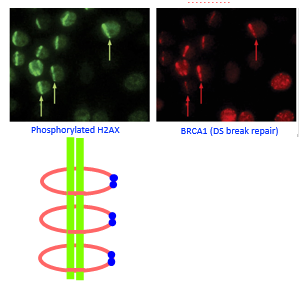
- H2AX commonly used to visualise cells undergoing DDR
- UV light creates stripe of damage
- H2AX phosphorylated locally at damage
- Phosphorylated H2AX helps attract repair factors eg BRCA1 which is involved in recruiting other proteins to repair ds break
- Also recruits cohesin which fucntions during mitosis to keep chromatids together- helps prevent chromatids from separating to promote HR repair
-
Another Role of Histone Modifications
- Modulation of transcription
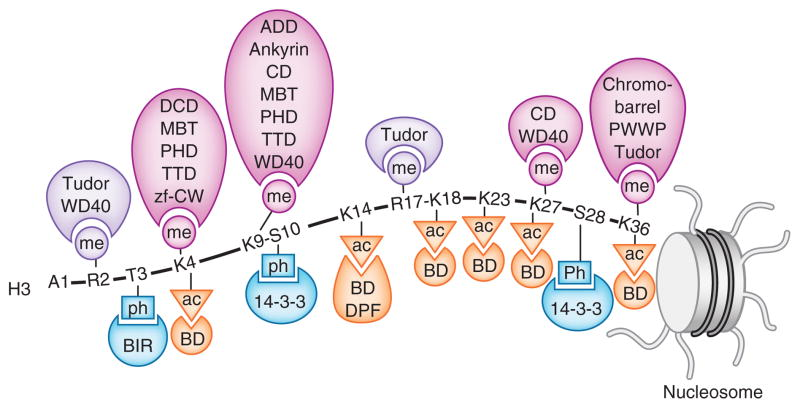
- There are many readers with different specificity that bind to histone tails
- Each modification of histone tails causes the binding of these
- Readers recruit or stabilizes other proteins, influencing transcription, recombination, replication and repair
- Influence transcription by determining chromatin accessibility to TFs
- Readers are released at mitosis by protein phosphorylation
-
Copying Epigenetic Info: reader-writer
- Each cell cycle has an opportunity for change (differentiation)
- Mostly the histone code is maintained in daughter cells, receive the same epigenetic profile (pattern of modifications of histones), unless differentiates
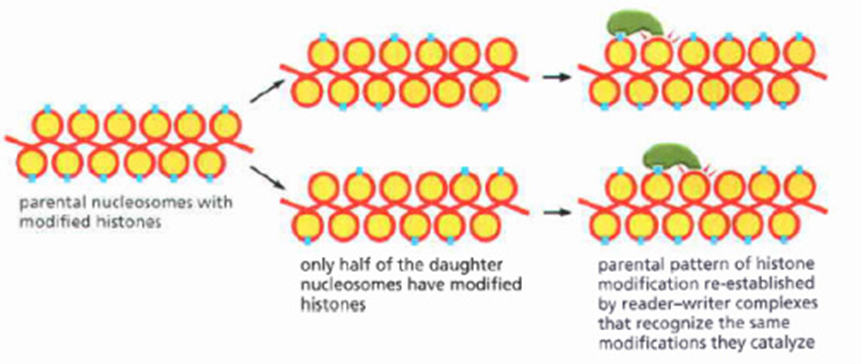
- Modified histones are shared in daughter cells so that half of the daughter nucleosomes recieve parental modified histones
- Reader-writer complexes re-establish the histone parental pattern
- They recognise the same modifications that they catalyse, bind the modifications on the daughter nucleosomes and recapitulate the modifications on others
-
Copying Epigenetic Info: reader-writer
-
DNA Methylation: Epigenetic Info
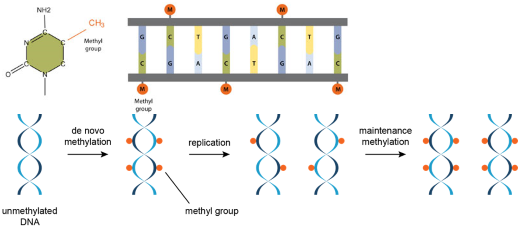
- DNA methylation is a type of DNA modification by DNA transferase (DNMTs) at CG dinucleotides (CpG)
- Promoters have CpG islands (runs of CpGs), methylation at these islands is reversible
- CpGs and their metyhlation have to be copied into daughter cells
- Upon replication half goes into daughter molecules
- CpG islands have symmetry (palindromic sequence) so if a pair retains methylation on cytosine, recognised by enzyme and methylation added to the other strand= recapitulation of original pattern
-
DNA Methylation: Epigenetic Info
-
Nuclear Organisation: Epigenetic Info
- Spatial organisation of chromosomes in a nucleus
- Chromosomes have preferred locations relative to others and their position is heritable
- Genes on different chromosomes can be part of the same megacomplex and regulated together which is related to their proximity in the nucleus
- Can visualise whole chromosomes or specific genes via fluorescence in situ hydribisation
-
Nuclear Organisation: Epigenetic Info
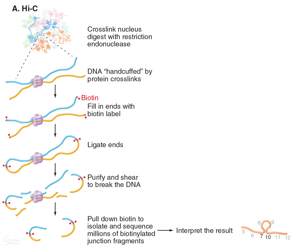
- Sequence proximity can be measured using proximity ligation
- Intact nucleus, apply chemical agent that cross links genes within particular protein complexes they are part of
- Fragment whole genome- bits in close proximity are crosslinked
- Add flags to loose ends and ligate ends
- Fragmentation to break up the bound parts and the flagged parts are isolated and sequenced
- Maps the frequency of the interaction of regions within a chromosome that are frequently associated with one another and regions associated with other chromosomes - not random
-
-
- DNA packaging is not uniform in the nucleus or in the cell cycle
- Nucleosomes are the basic unit of DNA packaging
- DNA modification (methylation) adds a layer of heritable information
- Complex patterns of histone modification enable or restrict access to other factors
- Epigenetic information is read and copied by dedicated enzymes
- Chromosomes and genes display characteristic spatial arrangements in the nucleus
Información
- Descripción
- MBBB L8
- Creado por
- Chloe Cavarretta · may 2019
- Actualizado
- 17 may 2019
- Visitas
- 1
- Valoración