
4. Transcription and Regulation of Bacterial Gene Expression
Diapositivas del conjunto (44)
-
- Familiarizing with the basic process of transcription
- Gaining a knowledge of the transcription machinery
- Understanding the steps of the transcription reaction
- Becoming aware of the role of s factors
- Gaining an understanding of transcription regulatory sequences (promoters, terminators)
- Becoming familiar with transcription termination mechanisms
- Familiarizing with the mechanisms of positive and negative regulation of gene expression
- Understanding the concept of ‘operon’
- Gaining a knowledge of cis-acting sequences
- Understanding the molecular mechanisms that underpin the regulation of the lac operon
- Appreciating the role of repressors and activators in regulation of gene expression
- Understanding how components of the lac system are used in biotechnological applications
-
- Distinguish between basal and regulated transcription
- Know how RNA Polymerases II initiates transcription and know DNA elements and the factors required for transcription of genes
- Know that there are three RNA polymerases in eukaryotes RNA polymerase I, II, and III
- Understand that promoters are modular in nature and transcriptional activators have distinct DNA binding and transcriptional activation domains
- Know some of the methods used in studying transcription
-
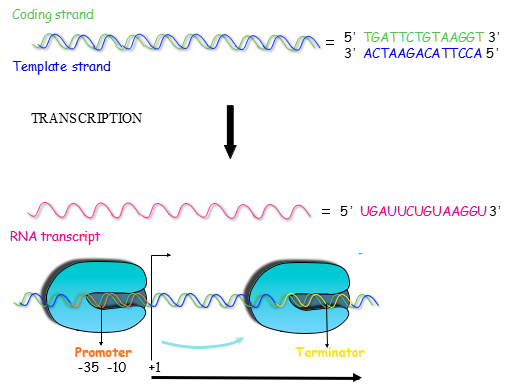
- Process of transcription= dsDNA transcribed to mRNA
- mRNA is identical to the coding strand and complementary to the template strand of DNA
- A transcription unit is a sequence of DNA transcribed into a single mRNA, starting at the promoter and ending at the terminator
- Can have single gene or multiple genes (operon)
-
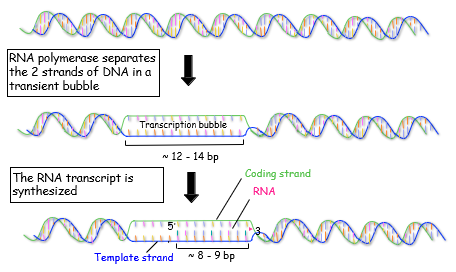
- The transcription bubble:
- Unwinding= RNA pol separates DNA strands to form a transient bubble to access template strand
- Add ribonucleosides to template in 5' to 3' direction (complementary base pairing)
- Hybrid of DNA and RNA produced (8-9bp)
-
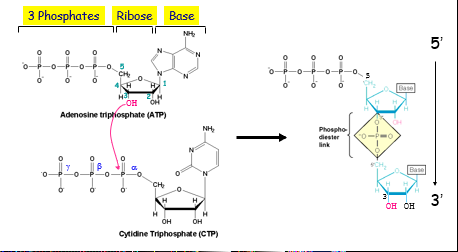
- RNA pol has 2 different nucleotide binding pockets
- 1= binds only purines- GTP and ATP, used for first nucleotide incorporated into the RNA transcript
- 2= binds any of the 4 ribonucleosides
- RNA has catalytic function of forming phosphodiester bond between the 2 nucleotides in the 2 binding pockets
- 3' OH mediates Nu attack on alpha phosphorus of second nucleotide to form bond and release 2 phosphates
-
RNA Polymerase in Different Domains
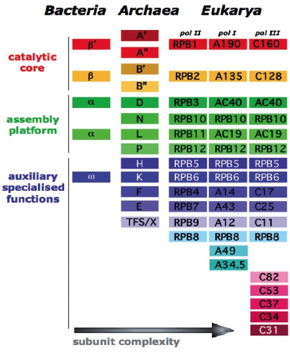
- Has different complexities in different domains of life
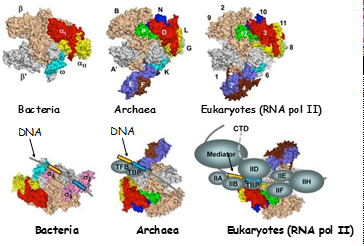
- In each column= the subunits that make up polymerases
- Subunit number and complexity increases throughout domains
-
RNA Polymerase in Different Domains
- Shape of polymerases (claw with channel) has been retained because all perform same function
- But have differences in their associated initiation and elongation factors when bound to DNA
- Yellow and blue= specific conserved motifs found in DNA at binding sites of RNA pol
- Pink subunit on bacteria= sigma factor
- Recognises and binds promoter on DNA
- Euk/archaea dont have subunit to recognise promoters and rely on other proteins to bind DNA promoter
-
RNA Polymerase in Different Domains
-
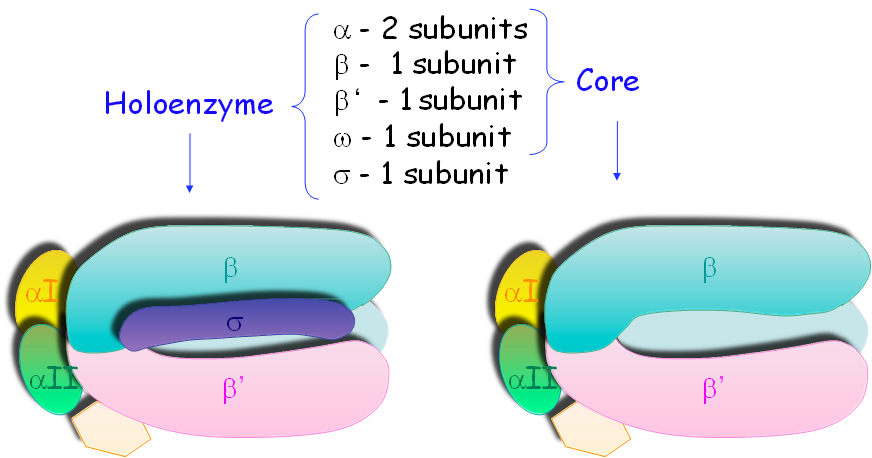
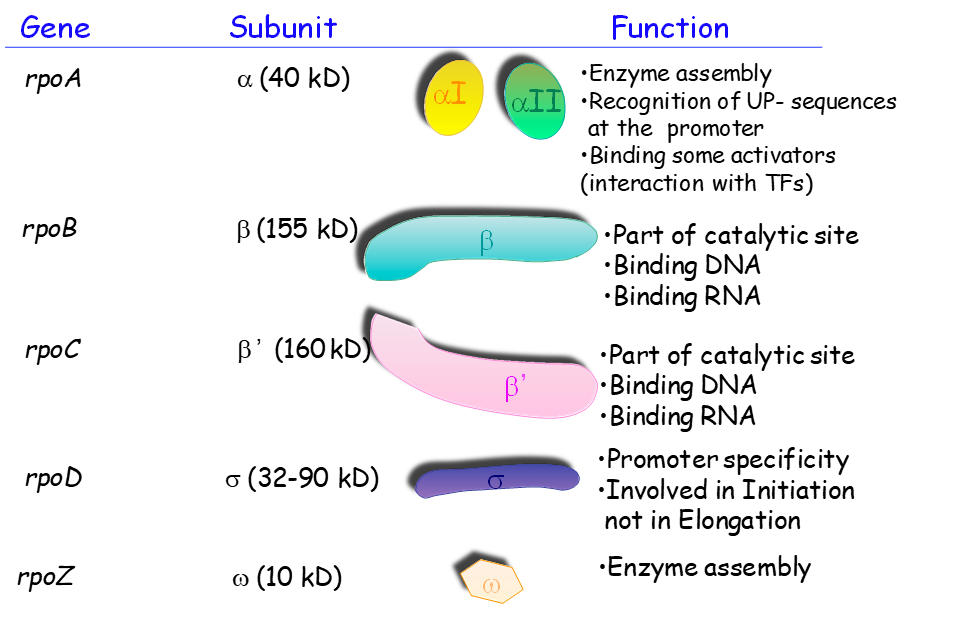
- Multi-subunit enzyme
- Contains channel/groove that could be region where DNA is accomodated
- Length of groove holds 16bp and groove is lined with positively charged aa's
- Exists in 2 forms: core and holoenzyme
- Holoenzyme contains extra subunit (sigma) to bind specifically at promoters
- Core can still bind stably to DNA but cant recognise promoter
- RNA pol is a good target for antibiotics
-
-
- Initiation:
- Includes all steps of transcription up to synthesis of first bond in RNA
- RNA pol finding promoter and binding
- Melting of DNA to form transcription bubble
- Elongation:
- RNA transcript extended by addition of ribonucleosides
- Elongation rate is alot slower than DNA polymerase- For DNA pol, polymerisation happens in few sites of genome, RNA pol can bind, transcribe and start again- one gene can be transcribed multiple times
- Termination:
- Ends transcription by stopping addition of ribonucleosides
- Causes dissociation of RNA pol from DNA and releases transcript
-
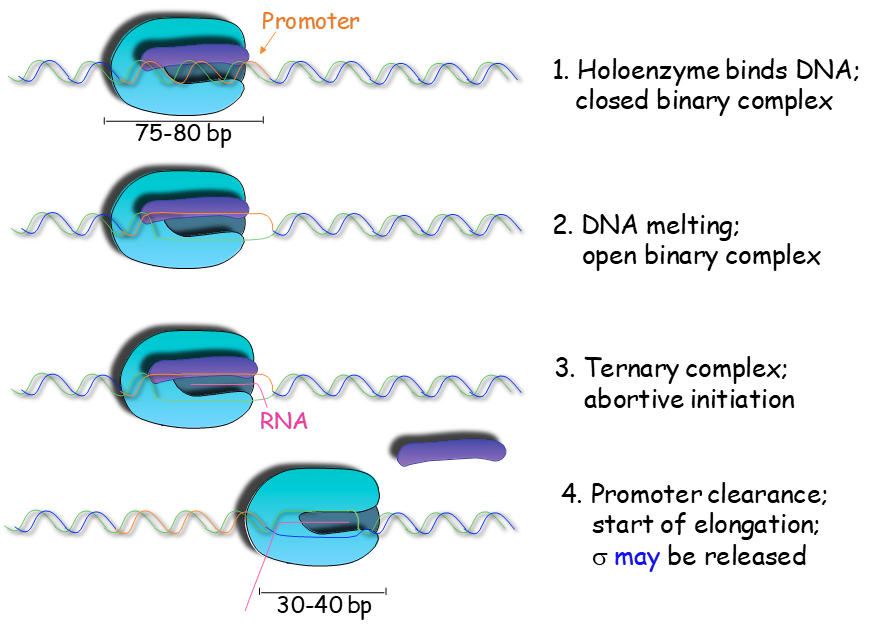
- 1. Holoenzyme binds DNA and forms closed binary complex (closed when DNA not yet denatured)
- 2. DNA melting, form transcription bubble= open binary complex
- 3. Uses template strand to incorporate ribonucleosides= ternary complex (RNA pol, RNA, DNA)
- Abortive initiation is common in bacteria
- 4. Promoter is cleared and sigma subunit may be released (not always)
-
Initiation: Abortive Initiation
- When RNA pol produces and releases a short transcript (8-10 nucleotides)
- But promoter has high affinity for RNA pol, RNA pol stuck and transcribes same section of DNA
- Eventually RNA pol extends one mRNA transcript and moves on downstream promoter- clears promoter to transcribe rest of genome
-
- A sequence of DNA upstream a gene, key for transcription of that gene
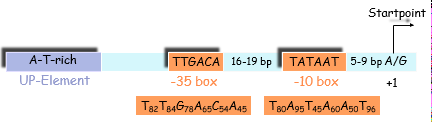
- Promoter consensus sequence is constructed by aligning all known examples of bacterial promoters and defining which is the predominant base at each position
- Conserved features of bacterial promoters are:
- Start point- usually a purine
- -10 TATA box= A 6bp motif centred around the -10
- -35 box= A 6bp sequence centred about the -35
- Some promoters contain A-T rich sequence upstream of -35 = UP element (contacted by alpha subunit)
-
-
Example Promoters Recognised by E.coli
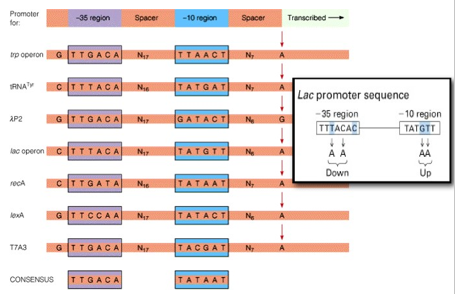
- Changing one conserved base can change the activity of the promoter
- Either up or down regulated
-
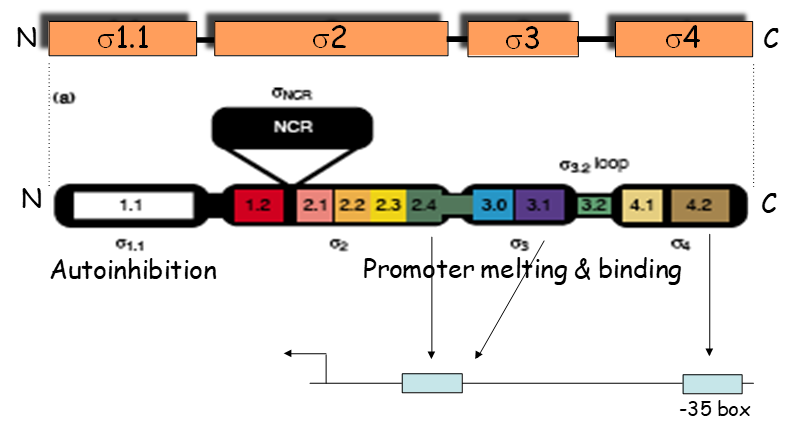
- Directly contact the DNA
- Functions:
- Promoter recognition
- Promoter melting
- Decreasing affinity of RNA pol holoenzyme for random sequences of DNA
- Sigma 1.1= involved in autoinhibition
- Sigma 2 and 3 involved in binding -10 box
- Have trp, tyr, phe aa's which are involved in denaturing and opening up DNA
- Sigma 4 makes contact with -35 box
-
Sigma Factors: Elongated Shape
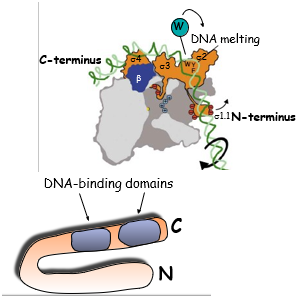
- Bound to RNA pol, sigma factor is spread over the surface
- When free in cytosol, is not able to bind DNA due to autoinhibition (allosteric control)
- N- region binds and occludes DNA binding domains in C-
- Upon binding, N- swings over 20A and unblocks domains
-
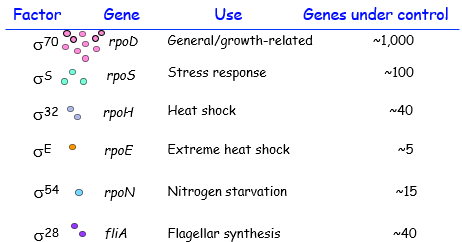
- Each bacterial cell contains more than one type of sigma factor
- Each specific for transcribing a different set of genes
- σ70 is the primary (housekeeping) sigma factor in E.coli
- Transcribes most genes
- In emergencies specialised sigma factors replace housekeeping
- eg σ32 heat shock factor- when exposed to high T E.coli needs specialised proteins
- In Bacillus subtilis a cascade of sigma factors regulate sporulation
-
- RNA polymerase moves along the DNA template until it meets a terminator sequence
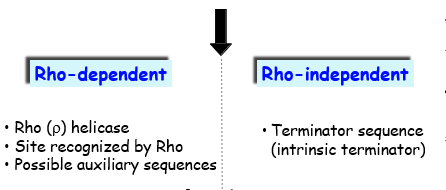
- 2 different types of termination mechanisms in bacteria: Rho-dependent and Rho-independent
-
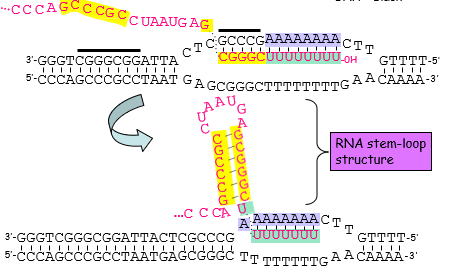
- Intrinsic terminator sequence possess:
- 2 symmetrical GC rich segments
- Downstream run of 4-8 A residues
- When RNA transcribes the GC rich regions it pauses- more energy needs to break the 3 bonds
- Allows time for transcript to form stem and loop structure (GC regions= stem)
- RNA pol transcribes downstream A's, RNA pol falls apart due to steric hindrance in the ternary complex due to stem and loop
- Releases transcript
-
- Requires:
- Rho protein, hexameric helicase and ATPase
- Rut site sequence- sequence on RNA transcript recognised by Rho
- Possible auxillary sequences
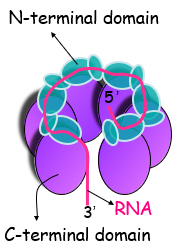
- Rho protein structure:
- ATPase activity in each subunit in C- domain
- N-terminal domain (green) is responsible for binding RNA
- Start of RNA transcript (5') bound to internal site
- Rho is a gapped ring before binding RNA transcript, closed ring upon binding
-
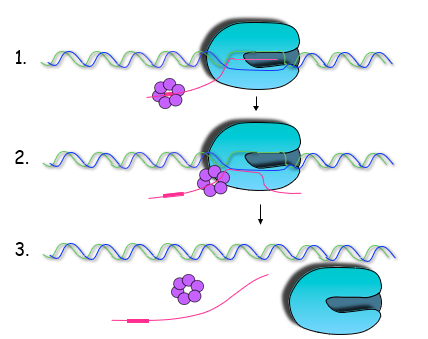
- 1. RNA pol transcribes DNA
- 2. Rho binds Rut on RNA transcript
- 3. Using ATPase activity rho translocates on the RNA transcript until reaching RNA pol
- Unwinds the DNA/RNA transcript and release transcript
- RNA pol falls apart and ternary complex disassembled
-
Transcriptional Regulation Terms
- Cis-acting sequences- Sequences on DNA that only affect DNA regions attached to them (cis), eg promoter/terminator, do not encode gene product
- Trans-acting factors/products- Proteins that move away from the site of synthesis and act anywhere in the cell
- Repressor- Protein that binds sequences on DNA and prevent transcription, block RNA pol accessing the promoter
- Operator- cis sequence on gene to which repressor binds
- Transcription factor- proteins that directly interact with RNA pol and help start transcription
-
Basics of Regulating Transcription
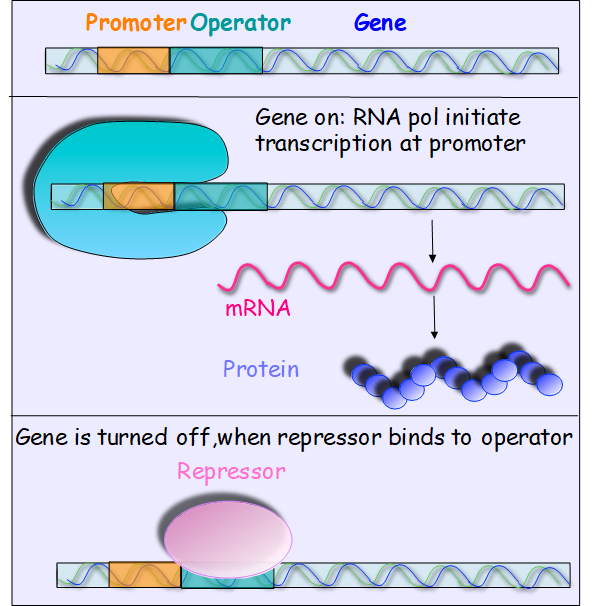
- Negative regulation:
- A trans-acting repressor binds to the cis-acting operator to turn off transcription
- RNA pol cannot access promoter
- Operators always downstream of promoters
-
Basics of Regulating Transcription
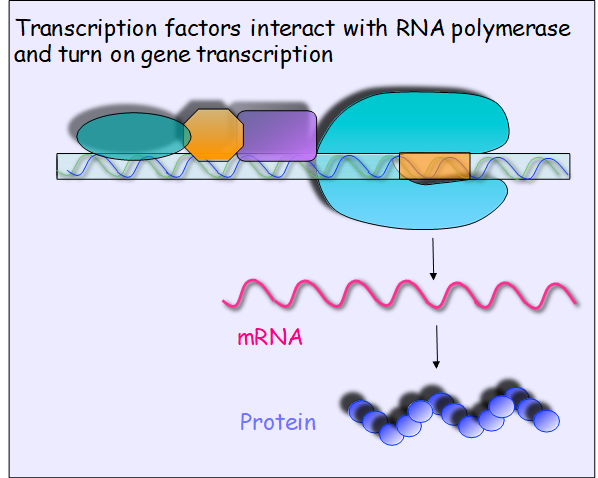
- Positive Regulation:
- Trans-acting factors must bind to cis-acting sites in order for RNA pol to initiate transcription at the promoter
- One or several proteins
-
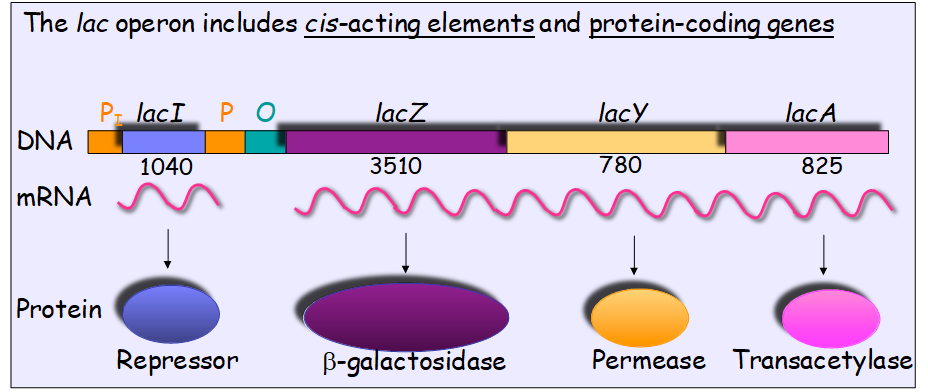
- Genes coding for proteins that function in the same pathway may be located adjacent to one another and controlled as a single transcription unit, transcribed as a single polycistronic mRNA:
- Co-regulation of these genes
- The lac operon includes cis-acting elements and protein-coding genes
- LacZ = B-galactosidase, cleaves lactose into glucose and galactose
- LacY = permease membrane protein responsible for uptake og lactose into bacterial cells
- LacA = transacetylase, transfers acyl group from acetyl coA onto B-galactosides (sugars)
- Upstream is an independent transcriptional unit containing promoter and lacI gene that encodes the repressor of the lac operon
-
-
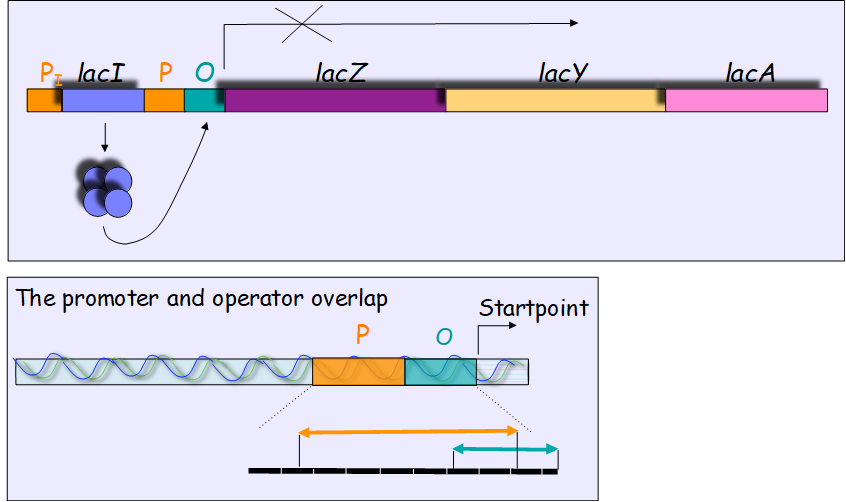
- Expression controlled by repressor protein encoded by lacI gene
- Repressor binds operator, operator overlaps the promoter
- In the absence of lactose bacteria dont need to make enzymes to uptake and metabolise lactose:
- Repressor binds operator
- RNA pol cant access promoter
-
Expression of Lac Operon can be Induced
- Induction= synthesis of enzymes in response to appearance of a specific substrate in the cell
- Small molecules that induce the operon are identical to or related to the substrate for its enzymes (gene products)
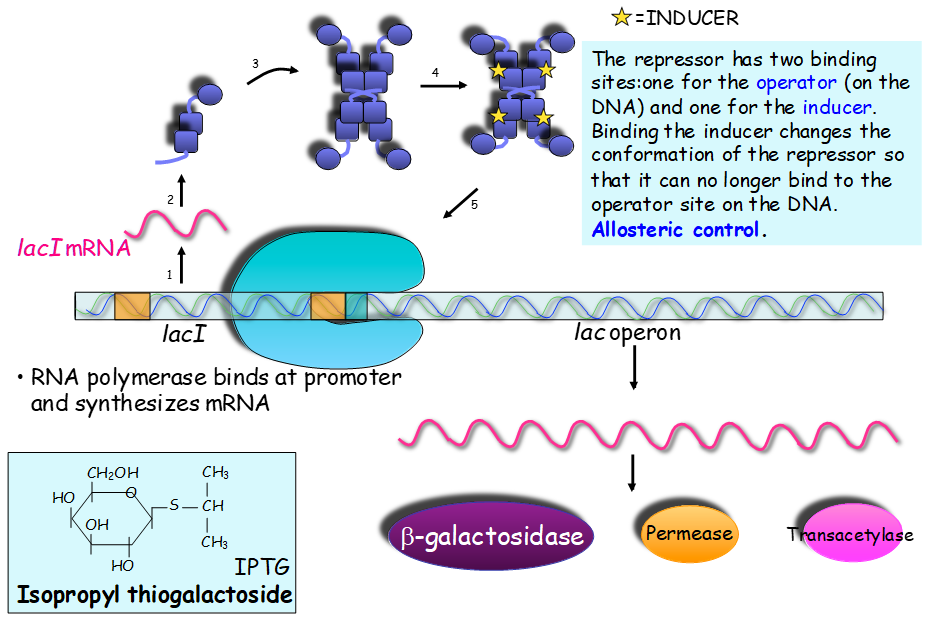
- B-galactosidases are substrates for the enzymes encoded by lacZYA genes (eg lactose, IPTG)
- Absence of B-galactosidases= lac operon expressed at low (basal) level
- Presence of specific B-galactosidases= induces transcription of all 3 genes
-
Expression of Lac Operon can be Induced
- When lactose/IPTG (inducers) bind repressor, repressor undergoes conformational change and can't bind the operator
- Repressor (tetramer) contains binding site for the DNA operator and for the inducer
- Binding of one side effects the binding on the other side= allosteric control
-
Identifying Operator: Cis-acting Mutations
- Cis-acting constitutive mutations in the operator caused constitutive expression of all 3 lac genes
- Mutation in operator= repressor cant recognise or bind operator
- RNA pol can bind promoter
- Constitutive= lac operon always transcribed whether lactose present or not because repressor can never bind operator
- Mutations are cis-acting and only affect those genes on the contiguous stretch of DNA (adjacent to the operator) - ONLY AFFECT THAT SPECIFIC OPERATOR
-
Identify Repressor:Trans-acting Mutations
- Trans-acting mutations in the lacI gene:
- Effect expression of all lacZYA clusters in bacterium
- Mutation in lacI gene on chromosome, leads to production of defective repressor that wont bind operator where lactose present or not
- Constitutive expression of lac operon
- Partial diploidy of Lac genes- in plasmid as well as on chromosome:
- When there are no mutations lacI repressor will repress transcription of lac genes in both plasmid and chromosome
- In a situation of diploidy the WT (non mutant) lacI gene would win over the mutant (non-functional gene) so mutants are reccessive
-
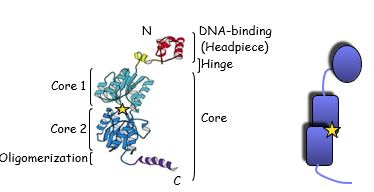
- Repressor monomer contains several domains:
- N-terminal DNA binding domain: contain 2 short α-helical regions that bind major groove of DNA
- Hinge: connects DNA binding domain to core
- Core domain: inducer binding site in a pocket between core subdomains 1 and 2
- Helix at C-terminal: Involved in oligomerisation (assembly of dimers/tetramers)
-
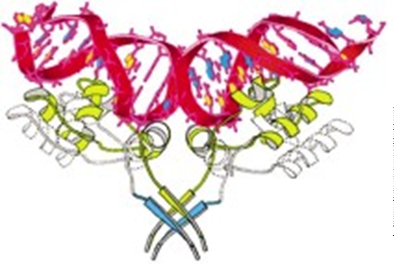
- The DNA binding domain of each monomer (helix) within a dimer inserts into the adjacent major groove of DNA
- The hinge helix inserts into the minor groove of operator DNA
-
Allosteric Control Regulates DNA Binding
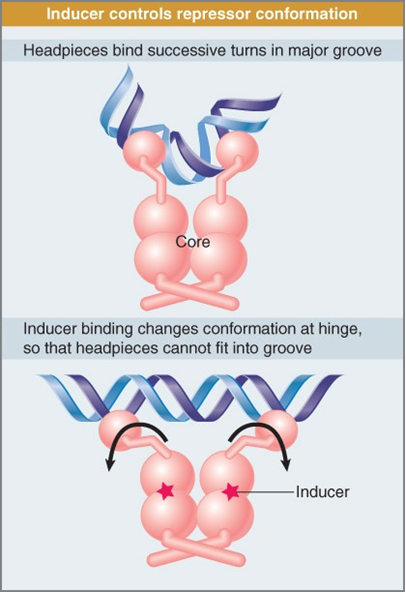
- Active Repressor Conformation:
- The 2 DNA binding domains of a dimer can insert into successive turns of the helix
- Inducer binding:
- Disrupts hinge= change conformation
- 2 DNA binding sites not in right geometry to make simultaneous contact with the DNA
-
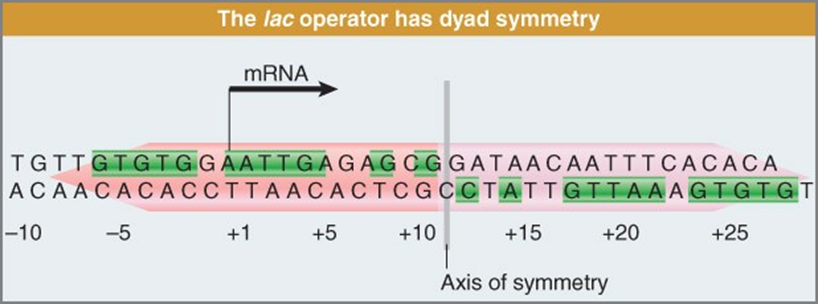
- Repressor binds dsDNA sequence on operator
- The operator consists of 2 inverted repeats= palindromic sequence of 26bp
- Each monomer of repressor contacts one half site
- Palindromic sequence= reads the same on each strand of DNA when read in 5' to 3' direction
-
Lac Operon has More than One Operator
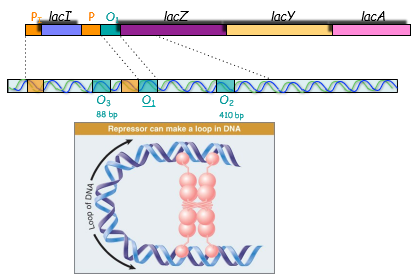
- Full repression requires the repressor to simultaneously bind:
- O1- operator at lacZ promoter
- Additional operator downstream or upstream
- Each dimer in the repressor binds one operator causing DNA looping which loops around region of promoter and turns off expression of lac genes
-
Crystal Structure of Repressor Bound
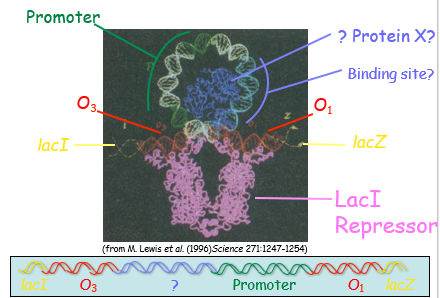
- Protein X is CRP activator which binds to target sequence adjacent to the promoter region
-
Positive Regulation of Lac Operon
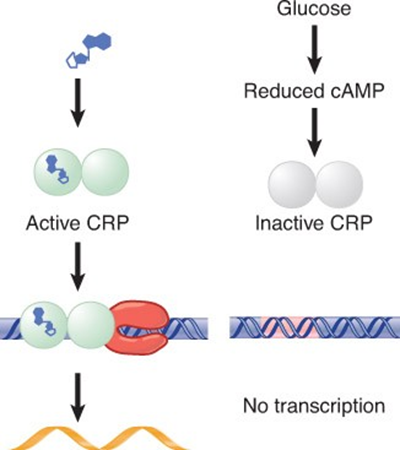
- Mediated by CAP(or CRP) activator protein that binds to a target sequence (cis-site) adjacent to the promoter
- CAP dimer is activated by single molecule of cAMP
- When active it binds target sequence upstream promoter and introduces a 90 degree bend into DNA at its binding site
- CRP makes physical contact with RNA pol and assists transcription of lac genes
-
- cAMP produced in cell from ATP by Adenylate cyclase
- Inverse correlation between glucose and cAMP
- Glucose inhibits production of AC
- High Glu= low cAMP
-
Biotechnology Applications of Lac Operon
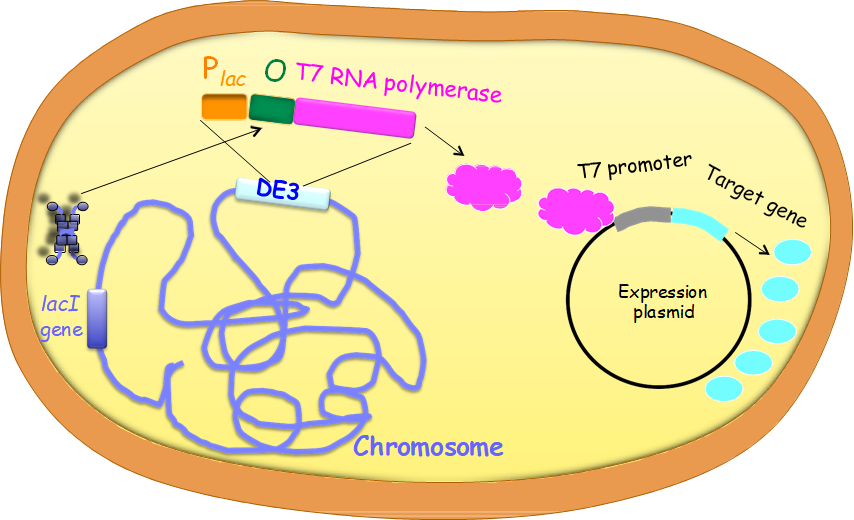
- Expression Vectors: the T7 expression system
- E.coli bacteria host that contains:
- Host genome with integrated segment of DNA (bacteriophage)
- DE3 bacteriophage contains stretch of DNA with P lac promoter, operator and T7 RNA pol (polymerase of T7 phage and is a single polypeptide not multisubunit)
- Within host genome is also LacI repressor
- Expression vector with target gene is transformed into host
- Target gene is expressed under control of T7 promoter which is recognised by specific T7 RNA pol
-
-
- Absence of IPTG/lactose:
- Repressor binds operator and prevents transcription of T7 RNA pol
- Presence of IPTG/lactose:
- Repressor becomes inactive
- E.coli RNA pol will access the lac promoter and transcribe gene encoding T7 RNA pol
- T7 RNA pol binds T7 promoter in expression plasmid and abundantly transcribes target
Información
- Descripción
- L9-10 MBBB- beginning involves general transcription which applies to both bacterial and eukaryotes
- Creado por
- Chloe Cavarretta · may 2019
- Actualizado
- 17 may 2019
- Visitas
- 8
- Valoración