
Fichas
Textiles
Fichas del conjunto (80)
- 1What kinds of colour and design equipment are there?Batik
Screen printing
Fabric crayons and pens
Transfer printing
Embroidery - 2What is a carbon footprint?A measure of the amount of carbon dioxide produced directly or indirectly by an individual or a product.
- 3What PHYSICAL finishing processes are there?Brushing
Calendering (Passing fabrics between heated rollers to give them a smooth finish)
Laminating - 4What BIOLOGICAL finishes are there?Biostoning (to give a worn look)
Biopolishing (to soften and give a polished look) - 5What CHEMICAL finishes are there?Mercerising (fabric is placed in sodium hydroxide solution so it swells and becomes more shiny, absorbent and strong)
Waterproofing
Flame-proofing
Anti-static/Anti-felting finish
Crease/shrink resistant
Bleaching - 6Problems with dying and finishing processes that use lots of chemicalsIt produces lots of chemical waste
Requires energy to drive the machinery
Uses and contaminates large volumes of water - 7Solutions to using dying and finishing process that use lots of chemicalsUse natural and cold water dyes (as they require less energy in processing) also reduce the need for very dark dyes
Use renewable sources of energy e.g wind
Use naturally coloured yarn (to eliminate dying processes)
Develop finishing processes so that they do not require as much energy
Use fabrics that already have the fabric needed e.g. lyocell is resistant to shrinking - 8What is design obsolescence?The fashion industry encourages people to continuously update their wardrobe with the latest trends (even though their clothes are still in good conditions). This can be called planned obsolescence or design obsolescence and it generates a vast amount of waste.
- 9What is primary recycling?The product can be recycled in its current state e.g. taken to a charity shop.
- 10What is secondary recycling?The product is torn/shredded/melted/ground before being reused e.g woollen garments can be shredded and be reused as stuffing for bedding
- 11What is tertiary recycling?Products can be broken down and reformulated e.g. PET plastic bottles can be broken down into fibers and then spun into polyester to make fleeces to make duvets.
- 12What are the befits of recycling?Save energy
Save raw materials
It reduces the need to manufacture new products - 13What are the 6 R's?Recycle
Re-use
Reduce
Refuse
Rethink
Repair - 14—FSC
Forestry Stewardship Council
Applies to wood and other wood products (e.g. paper) to assure the customer that they meet the social, economical and ecological needs of present and future generations. - 15—European Eco Label
Applies to to products and services where where steps have been taken to minimise the environmental impact of their whole life cycle.
- 16—The European Energy Label
Showing the energy consumption of appliances.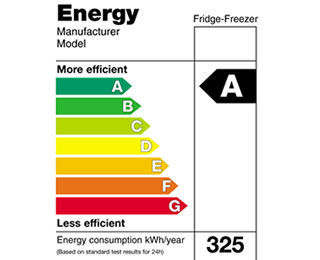
- 17—Confidence in Textiles/ The Oeko-Tex Label
Fabrics that are free from harmful substances (tested against the Okeo-Tex Standard 100).
- 18—Fairtrade mark
Provides a better deal for developing countries. Gives a guarantee to consumers that farmers and workers have been paid a fair and stable price.
- 19—Mobius loop
The number in the middle indicates what % of the product is made from recycled materials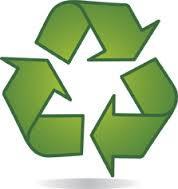
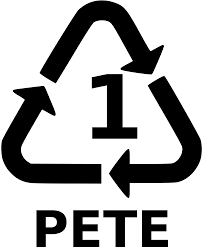
- 20—This label identifies the type of recyclable plastic used (this example represents PET)
- 21What are fabrics made from?Fibres
- 22What are staple fibers?Short fibers
- 23What are filament fibers?Long fibers
- 24Where do natural fibers come from?Animals e.g. wool, silk, camel hair etc.
Plants e.g. Cotton, linen, hemp etc - 25What are synthetic fibers?They are man made fibers made from the by products of oil.
- 26How are individual weak fibers made stronger?Multiple fibers are twisted together (SPINNING).
- 27—S twist (fibers)

- 28—Z twist (fibers)

- 29—WEFT KNITTED FABRIC
Horizontal (left to right) rows to knitting
V-shaped loops on the face
Interlocking loops above and below each other which hold the fabric togther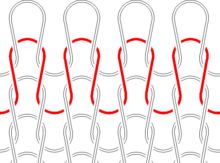
- 30—WARP KNITTED FABRIC
Interlocking loops that run vertically (up and down) the fabric
Less elastic/ firmer fabric
Keep their shape well
Lightweight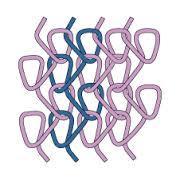
- 31—WOVEN FABRICS
Fray easily
strongest along grain of fabric
Stronger closest to the weave
Selvedge doesn't fray
Lacks elasticity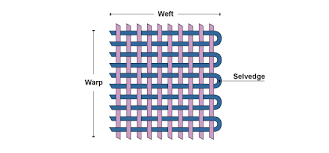
- 32What are the properties of latex/rubber?Can be formed/shaped into seamless clothing.
- 33What are the properties of cotton?Cheap, strong, cool, easily creases.
- 34What are the properties of wool?Soft, hard wearing, insulating, warm
- 35What are the properties of silk?Expensive, smooth texture, good drape, cool, strong, elastic, absorbent, warm
- 36What are the properties of viscose?Cheap, light, not very strong, very versatile, very absorbant
- 37What are the properties of polyester?Crease resistant, elastic, hard wearing, good material to make a blend
- 38What are the properties of Elastane (lycra)?Elastic, crease resistant, hard wearing, durable
- 39What are the properties of Kelvar?Extremely hard wearing (5x stronger than steel), can be stiffened of softened using chemicals, used in protective clothing or bullet-proof vests
- 40What are the properties of Nomex?Insulating, heat and flame resistant, used in firefighter uniforms
- 41What are smart materials?Materials that can respond to external stimuli e.g. temperature.
OR
Be activated by internal or external power sources. - 42If materials are sewn with photochromic threads or dyed with photochromic dyes, how does the material respond?The material changes colour with light.
- 43If materials are dyed with thermochromic dyes, how does the material respond?The product changes colour with heat intensity.
- 44Name a way smart technology can be applied to textilesPhotochromic threads and thermochromic dyes.
Embroidered images and text combined with electronics to create a pillow, cushion etc. that has a function e.g. a keyboard or remote control.
Fabrics on car seats that are embedded with interactive panels, memory features and embroidered or printed controls. - 45What are the categories into which smart textiles can be divided into? (4)Conductive textiles
Power assisted textiles
Communication textiles
Medical textiles - 46What is block printing?A wooden block with a design cut in relief (standing out) to it. Then a the design is 'stamped' onto the fabric.
Block printing is suitable for any type of fabric. - 47What is stencilling?The design is cut out of the card and then using a paint brush or sponge paint is applied to the fabric through the card. The paint is only applied to the parts of the fabric where the card was cut out.
- 48What is screen printing or silk-screen printing?A stencil of the design is placed a the nylon screen on a wooden frame.
The dye is put on top of the screen then pushed through using a squeegee.
This technique uses a different stencil and different screen for each colour.
Machine screen printing uses all the same principals. - 49What is engraved roller printing?A series of metal rollers have a design engraved onto them.
Dye or pigment solution is pushed through a fine mesh on each roller, this produces a design where the size of the design is determined by the circumference of the roller. - 50What is sublimation printing?A design is printed onto sublimation paper.
HEATED ROLLERS transfer the design onto the fabric.
This only works on fabrics that have 50% or more synthetic content. - 51What is computer transfer printing?An image is created/designed on a computer then printed onto transfer paper.
The design is then transferred onto the fabric by applying HEAT using an iron or heat press to the back of the image. - 52What is digital printing?The whole process is completed using a computer (design and printing).
You can create complex designs easily and quickly.
Used in industry for sampling and to make bespoke (one-off) fabrics/garments. - 53What is the tool used to apply the hot wax in batik?Tjanting tool
- 54How is felt made?The fibers are matted together using soap and water.
- 55What are 4 temporary methods of construction?Pinning
Tacking
Basting
Tailors tacking - 56Types of machine stitchingStraight stitch (lock stitch)
Single step zigzag
Double step zigzag
Chain stitch
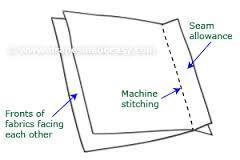
Overlock - 57What is a plain seam?It is one of the flattest seams and is suitable for all fabrics. However the edges of the fabric need to be finished/neatened to stop them fraying.
- 58What is a double stitched seam?Self neatening seam.
Strong - used a lot on shirts, trousers, overalls and hard wearing garments.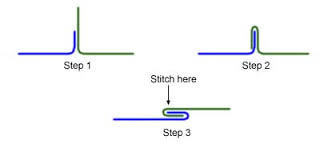
- 59What is a french seam?For lightweight clothing, lingerie and children's nightwear (best suited for lightweight fabrics such as chiffon).
Strong
All edges are enclosed (no finishing is required).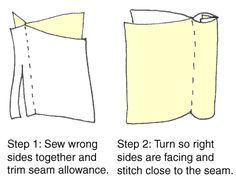
- 60What is overlock stitch?It can be a 2, 3, or 4 thread overlocked seam.
Trims and neatens the edge whist also stitching.
Requires overlocker machine.
Can be used on inside of garment for neatness or on the outside for decoration.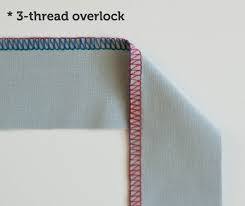
- 61What is COSHH?Control of Substances Hazardous to Health
- 62What does a gantt chart show?The timeline for a project
The seperate stages/tasks that need to be completed
The time allocated for each stage
The order work (the stages) should be completed in
They can be used to compare estimated and actual timings. - 63What is CAA?Computer Aided Administration
- 64What is CAD?Computer Aided Design
- 65What is CAM?Computer Aided Machinery
- 66What is CIM?Computer Integrated Manufacture
- 67What information is usually found on a textiles label?Fibre content
Chemical names
Country of origin
Product details
Safety advice
Care instructions - 68What is the trade descriptions act?It is illegal to make false claims about a product
- 69What is the Sales of Goods Act?Products must match their description, be of satisfactory quality and be fit for purpose.
- 70What is the Weights and Measures Act?It is illegal to sell products that are short-measured i.e. weigh less than the amount on the label.
- 71What is the 'Textiles Products (Identification of Fibre Content) Regulations' Act?It is a legal requirement to state the fibre content of a fabric on a label, in descending order using chemical names.
- 72What do all of these symbols mean?1) (3 dots) Wash at 50c
2) (2 lines) Delicate/Gentle, wash at 30c
3) Hand wash
4) (1 Line) Permanent press, wash at 40c
5) Wash at 60c
6) Do not wash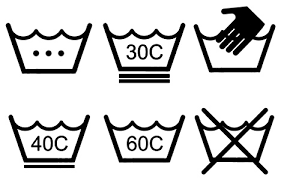
- 73What are these symbols?1) Any bleach can be used
2) Only non-chlorine bleach can be used
3) Do not bleach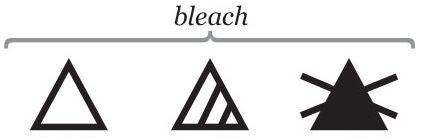
- 74What are these symbols?1) Drying
2) Drip dry
3) Normal tumble dry
- 75What are these symbols?1) Line dry/ Hang to dry
2) Tumble dry on high heat
3) Do not tumble dry
- 76What are these symbols?1) In the shade (added to drip dry, line dry or dry flat)
2) Tumble dry on medium heat
3) Do not dry (used with do not wash)
- 77What are these symbols?1) Dry flat
2) Tumble dry on low heat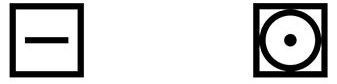
- 78What are these symbols?1) Iron on low heat
2) Iron on medium heat
3) Iron on high heat
4) Do not iron with steam
5) Do not iron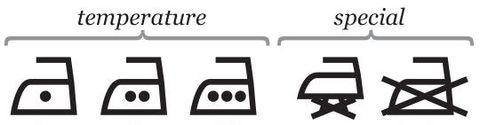
- 79What are these symbols?1) Dry clean
2) Dry clean using any solvent
3) Dry clean using petroleum solvent only
4) Dry clean using any solvent except Trichloroethylene
5) Do not dry clean
- 80What do these symbols mean?1) Short cycle
2) Reduced moisture
3) Low heat
4) No steam finishing
Información
- Descripción
- OCR Texiles 2015 flash cards
- Creado por
- Usuario eliminado · may 2019
- Actualizado
- 23 may 2019
- Visitas
- 8
- Etiquetas
- Historial
-
- Creado por Heidi C · 24 abr 2015
- Copiado por bill fingleton · 23 may 2019
- Valoración