
Mapa mental
“The Thirty-eighth Year” by Lucille Clifton
Contenido del mapa
“The Thirty-eighth Year” by Lucille Clifton
Author Background
- Lucille Clifton, b. 1936, DePew, NY; d. 2010.
- She grew up in Buffalo, New York.
- Her poetry was discovered by Langston Hughes.
- In 2007, she won the Lilly Poetry Prize.
- She wrote many books of poetry, as well as children’s books.
- Served as Poet Laureate for the state of Maryland.
- She wrote many books of poetry, as well as children’s books.
- In 2007, she won the Lilly Poetry Prize.
- Lucille Clifton, b. 1936, DePew, NY; d. 2010.
Poem Themes
- Connection to the Past
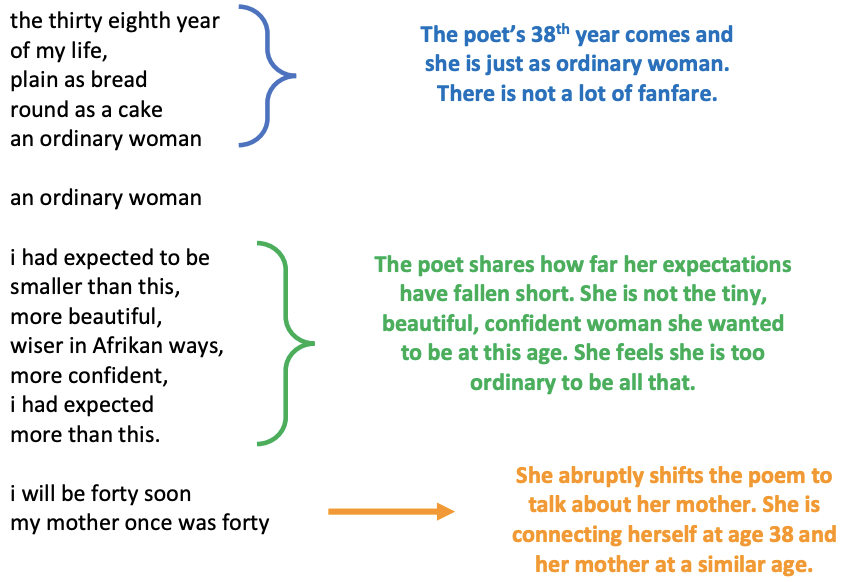
- There is a parallel made between the poet at the age of 38 and her mother, who died at the age of 44.
- Clifton offers this poem as a meditation on her mother’s life and her own life.
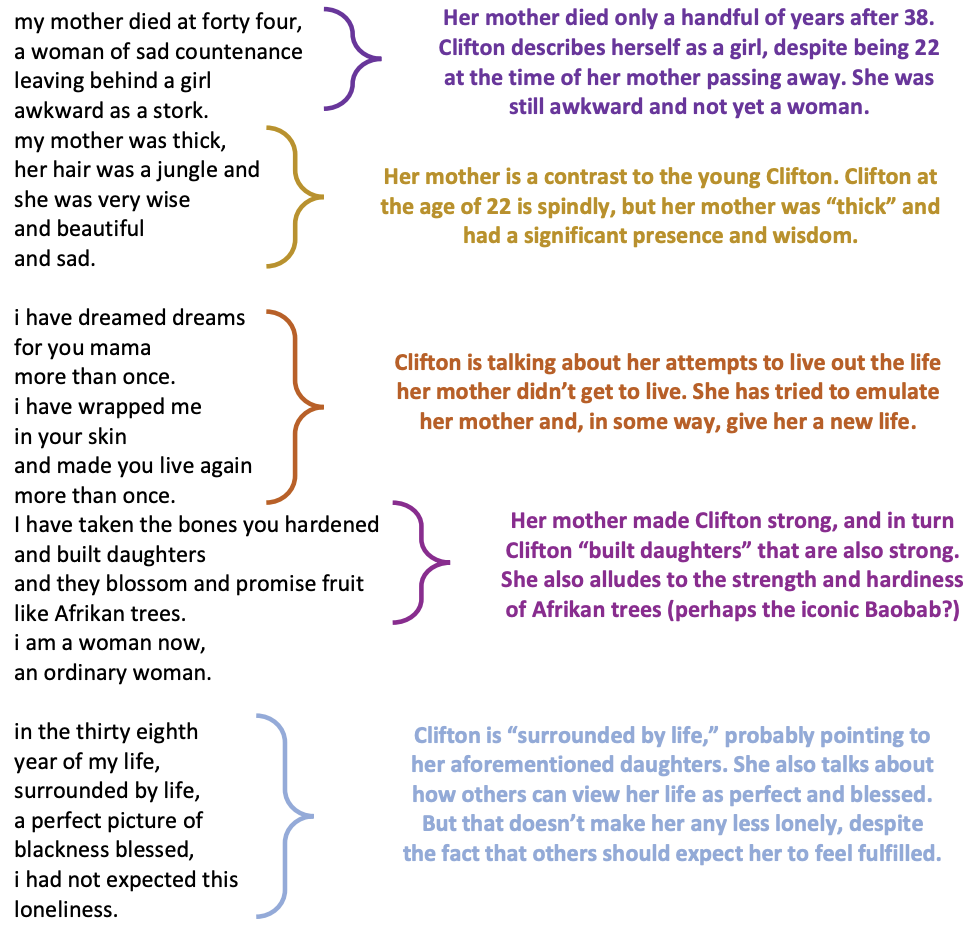
- Clifton talks about trying to live out dreams for her mother, who died too young.
- Clifton is approaching 40, and soon after that 44. So, she is feeling the impending burden of living past the age her mother died at.
- There is a parallel made between the poet at the age of 38 and her mother, who died at the age of 44.
- Ordinariness
- Clifton doesn’t capitalize the word I (it is always written like this: i)
- Example: “i had expected more than this”; This emphasizes how ordinary a woman she is at this age.
- Ordinariness isn’t necessarily a bad thing for Clifton.
- However, she talks about expecting more for herself.
- This is perhaps in connection with her mother. Clifton expected to live up to more than what her mother was able to in life.
- However, she talks about expecting more for herself.
- Ordinariness isn’t necessarily a bad thing for Clifton.
- Example: “i had expected more than this”; This emphasizes how ordinary a woman she is at this age.
- Clifton doesn’t capitalize the word I (it is always written like this: i)
- Connection to the Past
Poem Analysis
- Structure
- Irregular stanzas
- No rhyming
- Free-verse
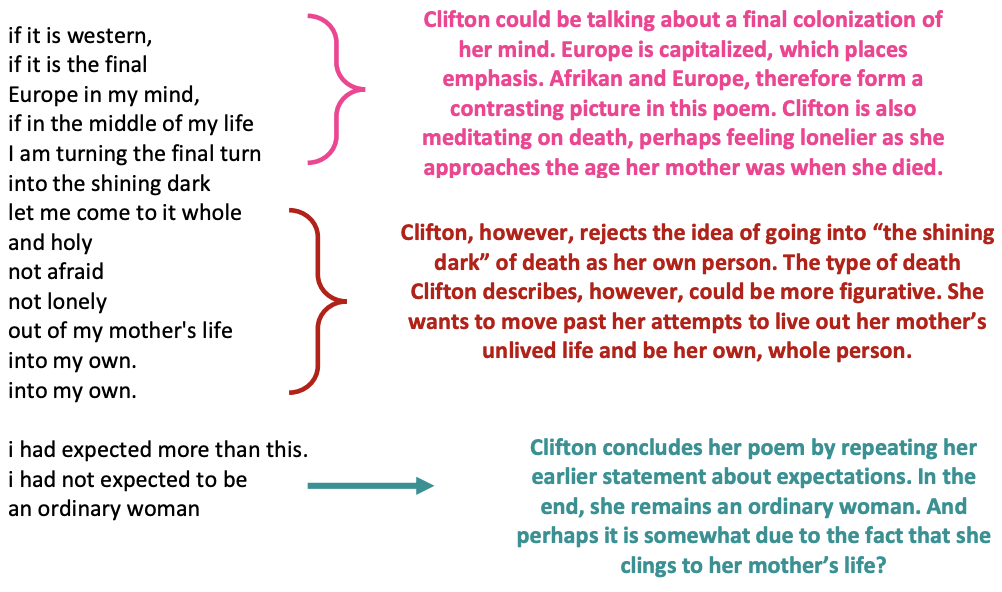
- Structured w/o capitalization except for 2 words: Afrikan & European.
- Also, poem ends without punctuation.
- Clifton leaves the poem open-ended. What will the rest of her life look like after the thirty-eighth year?
- Also, poem ends without punctuation.
- Structured w/o capitalization except for 2 words: Afrikan & European.
- Free-verse
- No rhyming
- Irregular stanzas
- Perspective
- This poem is written from the poet’s perspective.
- She is looking back at her own life at the age of 38.
- This poem is written from the poet’s perspective.
- Poetic Devices
- Imagery
- “a woman of sad countenance”
- “and they blossom and promise fruit”
- “the shining dark”
- “and they blossom and promise fruit”
- “a woman of sad countenance”
- Metaphor
- “her hair was a jungle”
- “i have wrapped me in your skin”
- Clifton has attempted to adopt characteristics she relates to her mother. It’s almost like Clifton wears her mother’s persona/life for a while.
- “the bones you hardened and built daughters”
- Clifton’s mother made her strong and that is how she was able to “build” or “raise” strong daughters.
- “the bones you hardened and built daughters”
- Clifton has attempted to adopt characteristics she relates to her mother. It’s almost like Clifton wears her mother’s persona/life for a while.
- “i have wrapped me in your skin”
- “her hair was a jungle”
- Alliteration
- “a perfect picture of / blackness blessed”
- This use of alliteration sounds kind of quaint. Clifton is emphasizing how great her life is when others see it.
- “a perfect picture of / blackness blessed”
- Unusual Capitalization
- Only Afrikan and Europe are properly capitalized.
- Even the word “I” is always lowercase in this poem.
- Only Afrikan and Europe are properly capitalized.
- Simile
- “plain as bread” and “round as a cake”
- Images used to compare the poet to very ordinary items. Clifton likes to use food/cooking imagery when talking about women.
- “Awkward as a stork”
- Clifton compares herself to a stork at the time of her mother’s passing. This gives the reader the image of Clifton as young and not yet grown into herself or her body at the age of 22.
- “and they blossom and promise fruit / like Afrikan trees.”
- Clifton’s daughters are growing into strong women with lots of potential. The connection to Afrikan trees perhaps relates Clifton’s daughters more closely with Afrikan ways than Clifton finds herself.
- “a perfect picture of / blackness blessed”
- Clifton’s daughters are growing into strong women with lots of potential. The connection to Afrikan trees perhaps relates Clifton’s daughters more closely with Afrikan ways than Clifton finds herself.
- “and they blossom and promise fruit / like Afrikan trees.”
- Clifton compares herself to a stork at the time of her mother’s passing. This gives the reader the image of Clifton as young and not yet grown into herself or her body at the age of 22.
- “Awkward as a stork”
- Images used to compare the poet to very ordinary items. Clifton likes to use food/cooking imagery when talking about women.
- “plain as bread” and “round as a cake”
- Homphone
- Clifton writes “whole and holy.” Wholly and holy are homophones (two words that sound the same but mean different things).
- Imagery
- Structure
Poem Breakdown
Poem Background
- Published in 1974 in the volume "An Ordinary Woman".
- She said in an interview when asked how she would like to be remembered: “I would like to be seen as a woman whose roots go back to Africa, who tried to honor being human. My inclination is to try to help.”
- Her work was heavily influenced by the Black Arts Movement in the 1960s and 1970s.
- Clifton’s mother suffered from a type of epilepsy. Clifton helped take care of her mother before she died.
- She said in an interview when asked how she would like to be remembered: “I would like to be seen as a woman whose roots go back to Africa, who tried to honor being human. My inclination is to try to help.”
- Published in 1974 in the volume "An Ordinary Woman".
Imágenes y archivos del mapa

Información
- Descripción
- El usuario ha eliminado su información de asignaturas Mapa Mental sobre “The Thirty-eighth Year” by Lucille Clifton, creado por Usuario eliminado el 06/02/2021.
- Creado por
- Usuario eliminado · feb 2021
- Actualizado
- 6 feb 2021
- Visitas
- 16
- Historial
-
- Creado por Joseph Gianotti · 27 ene 2021
- Copiado por Joseph Gianotti · 6 feb 2021
- Valoración