
Apuntes
C.4 World History, Skill #1- Notes
Contenido del apunte (6)
Página 1
C.4 World History, Skill #1
Identify characteristics of prehistoric cultures and early civilizations (e.g., Mesopotamian, Egyptian, Indus Valley, Chinese).
Página 2
Identify Characteristics of Prehistoric Cultures and Early Civilizations
prehistory
before writing
non-written records, pottery shards, buildings, tool.s, etc.
early humans
homo sapiens (Africa/ Southwest Asia)
homo erectus (Africa)
homo neanderthalensis (Europe)
Multi-regional Continuity Model
homo sapiens evolved from a group of homo erectus and dispersed all over the world, creating different races
Out of Africa model
homo erectus left Africa and mingled with other populations, but homo sapiens developed in Africa and took over without interbreeding
Página 3
Stone Age
period of time when humans made tools from Stone
Paleolithic (Old Stone Age): 2.5 million years ago
Europe/ Asia/ Africa
first hominids, homo sapiens
hunter gatherers; nomads
crude tools, fire, art
work divided among gender lines
Mesolithic (Middle Stone Age): 10,000- 8,000 BCE
shortest period in Stone Age
people develop smaller, more refined tools and start to develop agricultural practices
Neolithic Revolution
shift from food-gathering to food-producing/ farming
laid foundation for rise of civilization
farming= less nomadic lifestyle = larger population
domestication of animals; people able to relate to one another
more diseases, narrowing of diet to what could be produced, food supplies less reliable because people depended on a small range of farmed areas
Neolithic Period
more developments in domesticating plants/ animals
agricultural villages rather than being nomadic
early cities/ villages
institutions such as family/ religion/ state government
crafts such as pottery/ knitting/ spinning/ weaving
development of Bronze-age tools at the end of this period
rise in trade among groups
Página 4
Bronze Age & Iron Age
developed at different times in different areas, blur together depending on location
Página 5
River Valley Civilizations
civilization
developed as people transitioned toward communal living, advanced farming/ herding techniques, turned toward production of pottery/ textiles
characterized by existence of law/ government, economic growth, military, religion
early communities emerged along rivers
water needed for survival
good source of food
fish, attraction to other animals
fertile land for farming
transportation
main characteristics of river valley civilizations
cities/ large dense settlements
separation of population into specialized occupational groups
people could have jobs unrelated to food sourcing such as artisans, merchants, healers, etc.
social hierarchy, including elite population exempt from substance labor
elite class dominated lower class
elite class didn't have to do blue collar work
elite able to tax lower class
monumental public buildings
writing
long distance trade
rule of law
non- kin-based society
Mesopotamia (Tigris & Euphrates rivers)
"land between two rivers"
history and culture dependent on ebb/ flow of rivers
flooding threatened towns but rivers were still beneficial in that they nourished soil, enabling people to produce surplus food
evolved into independent city-states with little interest in unification
Sumer
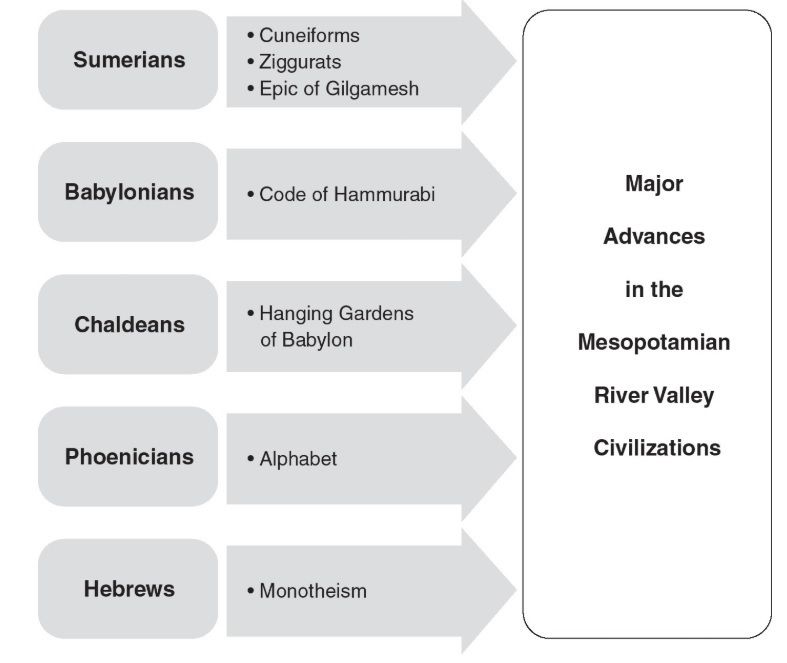
cuneiform
first group to develop system of writing
conveyed concepts and sounds
led to creation of new social class (scribes)
scribal schools centers of learning/ culture
math system based on 60
explains why there are 60 minutes in 1hr; 360 degrees in circle
geometry
applied math to construction of buildings/ irrigation
calendar based on lunar phases
invented wheel and plow, used bronze to make tools
medical advances related to religion, basic surgery
polytheistic religion
gods represented almost everything
ziggurat
step-shaped pyramid temple in heart of cities
priests controlled some government early on
farmers relied on priests as a go-between with gods to oppose them
priests began to lose control when cities needed military protection
military leaders became full-time rulers, passing control onto children, which led to the creation of dynasties
Epic Giglamesh
details the organization of Sumerian society
explains creation of Universe
explores morality/ immorality, loyalty, friendship
social hierarchy
king (kingship is hereditary)
nobles (held most of the land's wealth)
commoners
slaves (foreigners, prisoners of war, criminals/ debtors)
women could pursue most occupations, even priesthood
demise
location (no geographical protection/ predictable flooding)
overthrown by 1700 BCE
Akkadians (2331 BCE)
led by King Sargon I
created permanent army, became world's 1st empire
lasted about 140 days
Babylonian Empire (1792)
led by Hammurabi
united all of Mesopotamia
code of Hammurabi
instituted different laws and punishments by class/ gender
punishment should fit the crime
Hittites (1595)
overthrew Babylon
use of iron tools in agriculture and war, ultimately leading to their success, as their enemies were still using Bronze
horse-drawn chariots
defeated in 1200 BCE by Lydians
Assyrians
capital in Niveveh
army= war chariots, foot soldiers, cavalry
masters at siege warfare
allowed kings to rule through local leaders who collected taxes, enforced laws, raised troops
constructed roads that linked parts of empire
Chaldeans
Babylon as capital
Nebuchadnezzar II
fought Egyptians and Jews, captured Jerusalem, rebuilt Babylon into city of splendor
Hanging gardens of Babylon
Phoenicians
wealthy trading society
Phoenician alphabet
more flexible/ easier to use than pictures/ cuneiform
22 letters, all consonants
adapted by Greeks who added vowels and then modified by Romans into modern alphabet
Hebrews
monotheism
Yahweh
migrated from Egypt to Palestine
originally nomadic, settled when cities emerged
Philistines
settled in Canaan
knew how to use iron (Hebrews eventually learned)
defeated by David and the Jews
Jerusalem
King Solomon
built large temple home to the Arc of the Covenant; 12 districts of Israel (unified Israel)
after Solomon's death, Israel was split in 2
North destroyed (Israel) by Assyrians
South becomes center of Judaism until Babylonian Control
After the fall of Babylon, the Persian king allowed Jews to return to Jerusalem and rebuild Solomon's temple
Egypt (Nile River)
Egypt split in two areas, named after the direction of the Nile
Upper (southern) Egypt
valley of the Nile
Lower (northern) Egypt
triangular Delta region
characteristics
social
peasants make up the majority of the population
women had more freedom than in Mesopotamia
Slavery is limited
advancement in math/ science/ engineering largely attributed to obsession with afterlife (i.e. pyramids)
religion/ government
pharaohs- divine kinds
ma'at- set of principles from pharaoh enforced by bureaucracy
vizier- leader of bureaucracy, hereditary position
Old Kingdom
political unification under theocracy
pyramids
used hieroglyphics to keep track of land, labor, products, people, taxes
men and women have equal rights
social hierarchy
royal family --> priests --> admin --> regional government --> military commanders --> free workers
art and literature displayed interest in maintaining social order and relationship with the gods
Book of the Dead
rituals and spells to protect journeying spirit
Middle Kingdom
capital in Thebes
pride in military defense
demise
invaders from Hyksos/ climate change (flooding)
New Kingdom
Egypt's first permanent army
expanded its rule South; increased trade
Queen Hatshepsut
queen mother
focused on trade rather than war
murdered by stepson Thutmose (more interested in war, destroyed paintings of her)
Akhenaton (Amenhotep III)
changed Egypt to monotheistic-based society, worshiping Aten
Tutankhamon
restored traditional gods, moved capital back to Thebes
Ramses the Great (Ramses II)
settled conflict with Hittites by marrying Hittite princess
India (Indus River)
Khyber Pass
allowed trade/ contact with other lands
skilled builders focused on practical aspects of city
brick walls, streets, waste management, writing
Aryans
conquered Indus but chose to live alongside them
brought agriculture and class system
priests, warriors, peasants/ traders
added new class of non-Aryan workers; limited contact with non-Aryans
caste system ranked people by occupation color, ritual purity
language --> Sanskirt
Vedas
sacred literature consisting of 4 collections of prayer, magical spells, and instructions for rituals
most of the info on Aryans come from the Rigveda
China (Yellow River)
Xia
1st Chinese dynasty
formation of authoritarian Central government
Shang
1st historic dynasty
introducing irrigation and flood control systems
major cities constructed of wood, highly stratified
upper class (Anyang) lived inside the city; lower class lived outside
production of silk cloth, pottery (kaolin), bronze casting
calendar, written language
used religion to bolster ruling position in society
prominent burial sites for rulers
massive building projects, in particular walls
rulers depended on large bureaucracy
limited contact w. outside world, trade with Mesopotamia
ethnocentric
patriarchal society, most power to oldest male
Zhou
developed concept of ruler as divine son of heaven who ruled with Mandate of Heaven
gods pleased = wars won, plentiful harvests
justification for overthrowing Shang dynasty
water projects to control rivers and irrigation
manufacture/ trade of silk
caravan routes
established schools of ancient philosophies
decentralized government
feudal system --> land given to nobles who overtime become less dependent on king
warring states --> regional lords undermined aristocracy and became more powerful
Kongfuzi (confucius)
offered advice and wisdom
Hundred schools of thought --> yin/ yang; 5 elements
analects --> followers
family important to the state
Daoism
people should withdraw from hierarchy/ formality
Laozi --> created the Dao De Jing (foundational text)
Página 6
Mesopotamia
Información
- Descripción
- FTCE Social Science 6-12 test notes covering Competency #4- World History, Skill #1: Identify characteristics of prehistoric cultures and early civilizations (e.g., Mesopotamian, Egyptian, Indus Valley, Chinese).
- Creado por
- Usuario eliminado · feb 2021
- Actualizado
- 11 feb 2021
- Visitas
- 15
- Etiquetas
- Historial
-
- Creado por Jasmine M. · 28 jul 2020
- Copiado por Jasmine M. · 11 feb 2021
- Valoración