
Test
Fall 2021 Exam 1
Este test tiene tipos de pregunta que se abren en el reproductor de siempre.
Preguntas del test (78)
1Fill in the abbreviation meanings:
SID: [blank_start]Source to Image receptor distance[blank_end]
CR: [blank_start]Central ray[blank_end]
DR: [blank_start]Digital radiography[blank_end]
IR: [blank_start]Image receptor[blank_end]
OID: [blank_start]Object to Image receptor distance[blank_end]
RAO: [blank_start]Right anterior oblique[blank_end]
mAs: [blank_start]milliamperage per second[blank_end]
kVp: [blank_start]kilovoltage peak[blank_end]- ASource to Image receptor distance
- BCentral ray
- CDigital radiography
- DImage receptor
- EObject to Image receptor distance
- FRight anterior oblique
- Gmilliamperage per second
- Hkilovoltage peak
2The four basic types of body habitus:
Average, normal sized patient: [blank_start]Sthenic[blank_end]
Smaller than average sized patient: [blank_start]Hyposthenic[blank_end]
Abnormally small patient: [blank_start]Asthenic[blank_end]
Larger than average sized patient: [blank_start]Hypersthenic[blank_end]- ASthenic
- BHyposthenic
- CAsthenic
- DHypersthenic
3How do radiographers help reduce the risk of imaging involuntary motion?
- AUse immobilization
- BAppropriate patient instructions
- CClear communications
- DUse the shortest possible exposure time
4List two organs found in each of the following cavities:
Thoracic: [blank_start]Lungs[blank_end] and [blank_start]Heart[blank_end]
Abdominal: [blank_start]Stomach[blank_end] and [blank_start]Intestines[blank_end]
Pelvic: [blank_start]Urinary bladder[blank_end] and [blank_start]Reproductive organs[blank_end]- ALungs
- BStomach
- CUrinary bladder
- DHeart
- EIntestines
- FReproductive organs
- GLungs
- HStomach
- IUrinary bladder
- JHeart
- KIntestines
- LReproductive organs
- MLungs
- NStomach
- OUrinary bladder
- PHeart
- QIntestines
- RReproductive organs
5Name the plane of the body which divides the body into equal right and left halves: [blank_start]midsagittal plane[blank_end]
- Amidsagittal plane
6List the categories of structures found in the axial skeleton:
A. [blank_start]Skull[blank_end]
B. [blank_start]Neck[blank_end]
C. [blank_start]Thorax[blank_end]
D. [blank_start]Vertebral column[blank_end]- ASkull
- BShoulder girdle
- CPelvic girdle
- DScapula
- ENeck
- FPelvic girdle
- GClavicles
- HScapula
- IThorax
- JClavicle
- KCarpals
- LScapula
- MVertebral column
- NClavicles
- OPelvic girdle
- PShoulder girdle
7List the three functional classifications of the joints in the human body:
1) [blank_start]Synarthrotic[blank_end]
2) [blank_start]Amphiarthrotic[blank_end]
3) [blank_start]Diarthrotic[blank_end]- ASynarthrotic
- BFibrous
- CAmphiarthrotic
- DCartilaginous
- EDiarthrotic
- FSynovial
8Which term refers to the study of the diseases of the human body?
- AAnatomy
- BOsteology
- CPathology
- DPhysiology
9What are the four fundamental body planes?
- ASagittal , coronal, horizontal, and oblique
- BSagittal , coronal, midaxillary, and transverse
- CMidsagittal , midcoronal, horizontal, and oblique
- DMidsagittal , midcoronal, midaxillary, and transverse
10Which are the two great cavities of the torso?
- APelvic and pleural
- BPelvic and abdominal
- CThoracic and pleural
- DThoracic and abdominopelvic
11In which quadrant of the abdomen is the appendix located?
[blank_start]Right lower quadrant[blank_end]- ARight lower quadrant
12Excluding small sesamoid and accessory bones in the skull, how many bones comprise the human skeleton?
[blank_start]206[blank_end]- A206
13In which quadrant of the abdominal cavity is the stomach located?
[blank_start]Left upper quadrant[blank_end]- ALeft upper quadrant
14Which of the following bones is NOT classified as a flat bone?
- ARib
- BRadius
- CSkull
- DSternum
15Which bone classification does the vertebrae belong to?
[blank_start]Irregular[blank_end]- AIrregular
16Which term specifically refers to the study of the structures of the body?
- AAnatomy
- BOsteology
- CArthrology
- DPhysiology
17Which structural classification of articulations are cranial sutures?
- AFibrous
- BCartilaginous
- CSynovial
- DSymphysis
18Which type of movement occurs in a hinge joint?
- ARotational
- BGliding or sliding
- CFlexion and extension
- DAbduction and adduction
19Name two hinge joints found in the body:
A. [blank_start]Elbow joint[blank_end]
B. [blank_start]Knee joint[blank_end]- AElbow joint
- BAC joints
- CShoulder joint
- DKnee joint
- EHip joint
- FWrist joints
20Which term refers to a hole in a bone through which blood vessels and nerves pass?
- ASinus
- BFissure
- CGroove
- DForamen
21Which term refers to a body part located on the same side of the body, ie right hand and right wrist?
- ALateral
- BPosterior
- CIpsilateral
- DContralateral
22Which term refers to a type of fracture in which a broken bone projects through the skin?
- AOpen
- BClosed
- CDisplaced
- DNondisplaced
23Which term refers to the direction of the central ray as it passes though the patient's body?
- AView
- BMethod
- CPosition
- DProjection
24Which term refers to the movement of a body part toward the central axis of the body?
- AFlexion
- BInversion
- CAbduction
- DAdduction
25Write out the meaning for the following abbreviations:
RPO: [blank_start]Right posterior oblique[blank_end]
LUQ: [blank_start]Left upper quadrant[blank_end]- ARight posterior oblique
- BLeft upper quadrant
26What is the name for the space between the two pleural cavities which contain the heart and great blood vessels?
- AHilum
- BMediastinum
- CPleural space
- DThoracic cavity
27Which structure separates the thoracic cavity from the abdominal cavity?
- ALiver
- BTrachea
- CHeart
- DDiaphragm
28What structure consists of 16-20 C-shaped cartilaginous rings?
- ATrachea
- BRight pulmonary bronchus
- CDiaphragm
- DAlveolus
29Write the standard SID that should be used for chest radiography in inches and cementers. Show your math calculation.
[blank_start]72[blank_end] in x [blank_start]2.5[blank_end] = [blank_start]180[blank_end] cm- A72
- B2.5
- C180
30The left lung has _____ lobes, while the right lung contains _____ lobes.
- A2,3
- B3,2
- C10,20
- D20,10
31The primary reason to roll the shoulders forward for the PA projection of the chest it to:
- APlace the heart in contact with the IR
- BRemove the scapulae from the lung fields
- CPlace the diaphragm at the lowest level on expiration
- DSeparate lung tissue from the ribs
32The trachea bifurcates and forms the:
- ARight and left bronchi
- BRight and left hilum
- CCostophrenic angles
- DPulmonary arteries
33Which of the following chest projections places the heart closest to the image receptor?
- ALeft lateral
- BRight lateral
- CAP
- DPA
34Standard chest radiography should be performed on what phase on respiration?
- AFull expiration
- BFull inspiration
35Taking a chest x-ray at full inspiration moves the diaphragm [blank_start]up[blank_end] and [blank_start]expands[blank_end] the lung field.
- Aup
- Bdown
- Cexpands
- Dcondenses
36The number or rib pairs to be demonstrated in a PA projection of the chest in order to provide maximum demonstration of lung volume is:
- A4
- B8
- C6
- D10
37A supine radiographic projection of the abdomen is commonly referred to as a KUB. What do the letters stand for?
K= [blank_start]Kidneys[blank_end]
U= [blank_start]Ureters[blank_end]
B= [blank_start]Bladder[blank_end]- AKidneys
- BUreters
- CBladder
38The standard SID for a KUB would be _____ inches.
- A20
- B60
- C40
- D72
39The phase of respiration to employ for abdominal imaging is:
- AFull inspiration
- BFull expiration
40An abdominal image is taken during full expiration to move the diaphragm [blank_start]up[blank_end] making the abdominal space more [blank_start]open[blank_end].
- Aup
- Bdown
- Copen
- Dclosed
41The average KVP to be employed for an upright chest radiography should be:
- A60-70 kVp
- B80-90 kVp
- C90-100 kVp
- D110-120 kVp
42Which of the following projections best demonstrates air-fluid levels in the abdominal cavity?
- AAP supine
- BPA
- CAP upright/erect
- DRight lateral
43Which decubitus position is routinely taken when the patient is unable to stand for an erect abdominal projection?
- AVentral decubitus
- BDorsal decubitus
- CRight lateral decubitus
- DLeft lateral decubitus
44The condition in which air fills the potential space between the layers of the pleura is called:
- APneumothorax
- BHemothorax
- CAtelectasis
- DEmphysema
45Besides kVp, what additional exposure factor must be set for each radiographic image?
[blank_start]mAs[blank_end]- AmAs
46Which of the following is an effective way to detect rotation of the patient with the PA projection of the chest?
- AThe number of ribs demonstrated above the diaphragm
- BThe asymmetrical appearance of the sternoclavicular (SC) joints
- CThe amount of apical area demonstrated above the clavicles
- DThe appearance of the lateral border of the scapulae outside the lung fields
47With reference to the placement of the IR, how are the midsagittal plane and the midcoronal planes positioned for the PA projection of the chest?
- Amidsagittal parallel and midcoronal parallel
- Bmidsagittal parallel and midcoronal perpendicular
- Cmidsagittal perpendicular and midcoronal parallel
- Dmidsagittal perpendicular and midcoronal perpendicular
48Why should chest images be performed with a 72" SID?
- ATo blur involuntary heart motion
- BTo minimize magnification of the heart
- CTo maximize magnification of the heart
- DTo project the clavicles above the apices
49Using a lateral decubitus projection for patients who are unable to stand upright best demonstrates which of the following pathologic conditions of the chest?
- ARib fractures
- BCardiomegaly
- CCollapsed lung
- DAir or fluid levels
50Which radiographic position requires that the patient be placed supine with the IR placed vertically against the patient's right side and a horizontal central ray directed to the center of the IR
- AVentral decubitus
- BDorsal decubitus
- CRight lateral decubitus
- DLeft lateral decubitus
51Which radiographic position requires that the patient be lying prone?
- AVentral decubitus
- BDorsal decubitus
- CRight lateral decubitus
- DLeft lateral decubitus
52The liver, stomach, and pancreas are located in the:
- AAbdominal cavity
- BPelvic cavity
- CDigestive system
- DRetroperitoneum
53Which evaluation criteria pertains to the AP axial (lordotic) projection of the chest?
- AThe ribs should appear distorted
- BThe clavicles should lie below the apices
- CThe sternum should be lateral (not rotated)
- DThe thoracic intervertebral disc spaces should be open
54The abdomen is divided into two cavities. The inferior cavity is called the:
- AAbdominal
- BPelvic
- CGonadal
- DRetroperitoneal
55Which three projections usually comprise the acute abdomen series for ambulatory patients?
- ASupine KUB, AP upright abdomen, and PA chest
- BSupine KUB, right lateral decubitus, and PA chest
- CLeft lateral decubitus, dorsal decubitus abdomen, and PA chest
- DRight lateral decubitus, left lateral decubitus, and dorsal decubitus abdomen
56To which level of the patient should the CR be directed for an AP supine projection of the abdomen?
- AT 10 vertebral body
- BL 3 vertebral body
- C2" above the iliac crest
- DThe level of the iliac crest
57Refers to the back part of the body or an organ: [blank_start]Posterior[blank_end]
Refers to the palm of the hand: [blank_start]Palmar[blank_end]
Refers to nearer the feet or situated below: [blank_start]Caudad[blank_end]
Refers to parts farthest from the point of attachment: [blank_start]Distal[blank_end]
Refers to parts far from the surface of the body: [blank_start]Deep[blank_end]
Refers to parts away from the median plane of the body or away from the middle of a part: [blank_start]Lateral[blank_end]- APosterior
- BPalmar
- CCaudad
- DCephalad
- EDistal
- FProximal
- GDeep
- HSuperficial
- ILateral
58Write the word that means the opposite from the term given:
Caudad: [blank_start]Cephalad[blank_end]
Posterior: [blank_start]Anterior[blank_end]
Lateral: [blank_start]Medial[blank_end]
Deep: [blank_start]Superficial[blank_end]
Distal: [blank_start]Proximal[blank_end]- ACephalad
- BAnterior
- CMedial
- DSuperficial
- EProximal
59For the AP upright abdomen image of an adult of average size, why should the centering be slightly higher than the centering level used for the supine image?
- Ato include the bladder
- Bto include the diaphragm
- Cto visualize gall stones
- Dto visualize kidney stones
60Which projection does not demonstrate free air levels within the abdominal cavity?
- AAP projection with the patient supine
- BAP projection with the patient upright
- CLateral projection, dorsal decubitus position
- DAP projection, left lateral decubitus position
61An acute abdominal series may be ordered for all of the following reasons except to:
- ACheck for a pneumoperitoneum
- BEvaluate the presence of free fluid in the abdominopelvic cavity
- CCheck for the presence of kidney stones or gallstones
- DRule out bowel obstruction or infection
62Which evaluation criterion pertains to the PA projection image of the cheat?
- AThe ribs should appear distorted
- BThe clavicles should lie superior to the apices
- CThe scapulae should be projected outside the lung fields
- DThe ribs posterior to the vertebral column should be superimposed
63Which pathologic condition(s) of the lungs is best demonstrated with the left lateral decubitus position, which results in a PA projection?
- AFree air in both sides of the chest
- BFluid levels in both sides of the chest
- CFree air in the left side or fluid levels in the right side
- DFluid levels in the left side or free air in the right side
64Which PA oblique position of the chest may be used to evaluate the left lung?
- A45 degree RAO
- B45 degree LAO
- C45 degree LPO
- D45 degree RPO
65Write the plural form of the following words:
Apex: [blank_start]Apices[blank_end]
Alveolus: [blank_start]Alveoli[blank_end]- AApices
- BAlveoli
66What classification of joint movement occurs from this joint? [blank_start]Pivot[blank_end]
List the name of the joint: [blank_start]c1-c2[blank_end]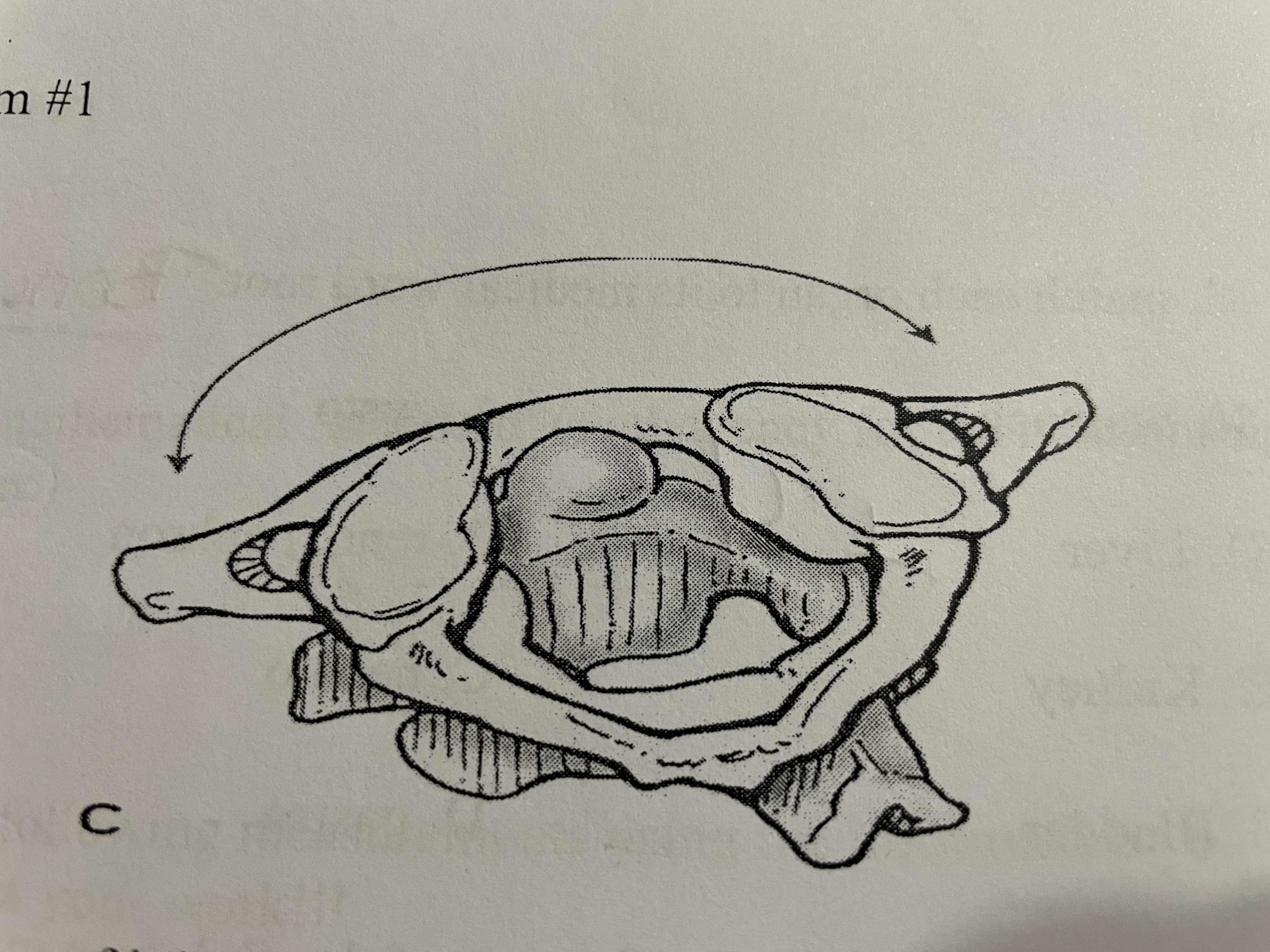
- APivot
- Bc1-c2
67What classification of joint movement is demonstrated in the diagram? [blank_start]Gliding[blank_end]
The name of the joint demonstrated is: [blank_start]Intercarpal[blank_end]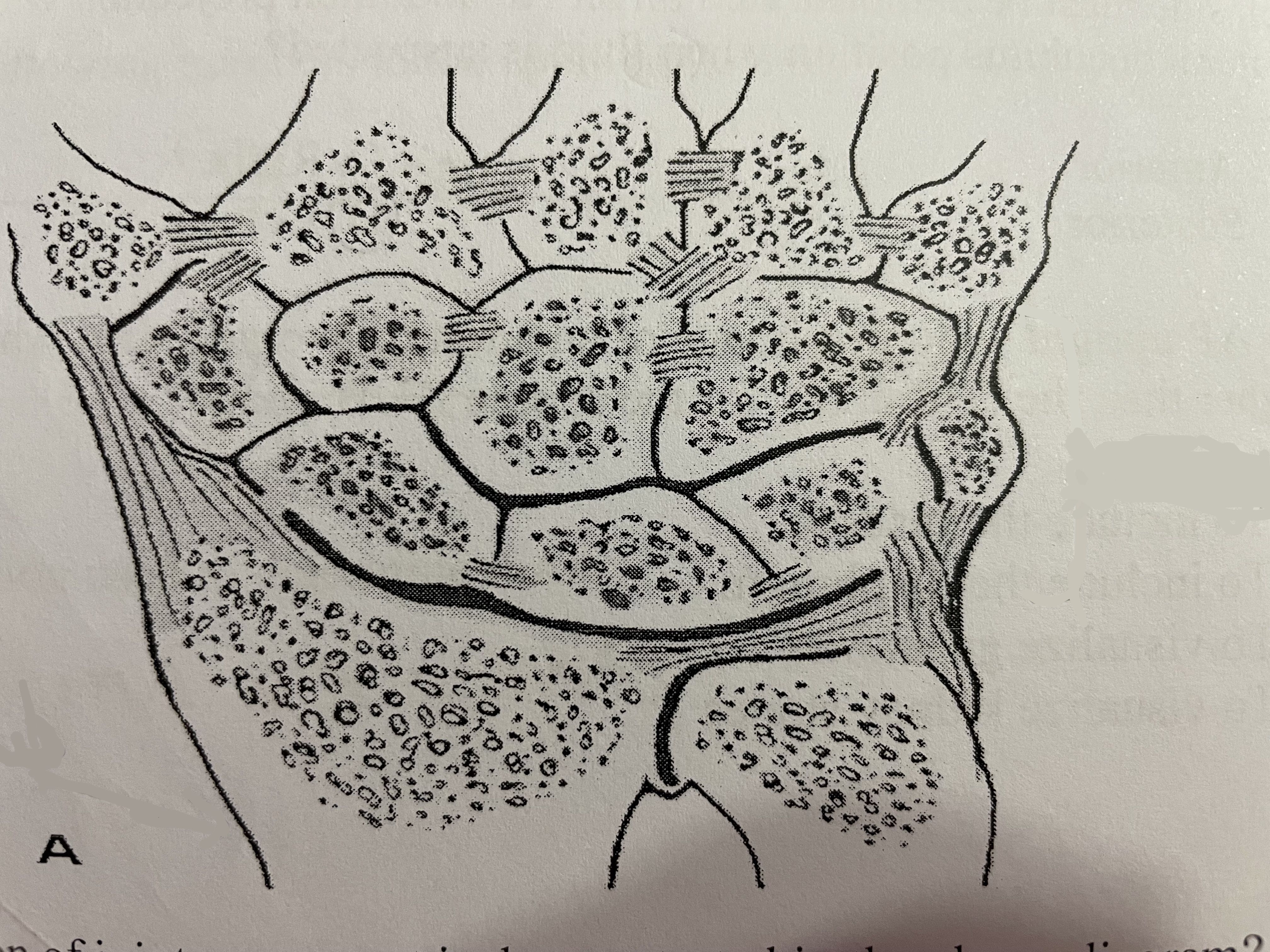
- AGliding
- BIntercarpal
68Match each organ to it's medical word root:
Cysto: [blank_start]Bladder[blank_end]
Reno, nephron: [blank_start]Kidney[blank_end]
Hepato: [blank_start]Liver[blank_end]
Gastro: [blank_start]Stomach[blank_end]- ABladder
- BKidney
- CLiver
- DStomach
69What is the major advantage of the PA projection of the abdomen over the AP projection of the abdomen?
- AThe PA projection magnifies gallstones fro better visualization
- BThe PA projection demonstrates the pubic rami below the urinary bladder
- CThe PA projection reduces exposure to the gonadal tissue
- DThe PA projection reduces the OID of the kidneys
70Which side must be demonstrated on an AP abdomen projection with the patient positioned in a left lateral decubitus position when fluid is suspected?
- AAnterior
- BPosterior
- CRight
- DLeft
71Convert the following:
80 in = [blank_start]200[blank_end] cm
90 cm = [blank_start]36[blank_end] in
97 kVp = [blank_start]97,000[blank_end] volts
300 mA = [blank_start]0.3[blank_end] amperage
Write the following as a decimal:
40 ms = [blank_start]0.04[blank_end] s
300 ms = [blank_start]0.3[blank_end] s- A200
- B36
- C97,000
- D0.3
- E0.04
- F0.3
72What projection is demonstrated by the image?
[blank_start]AP Axial[blank_end]
Identify the structures labeled by the image:
A: [blank_start]Clavicle[blank_end]
B: [blank_start]Apex of the lung[blank_end]
You can tell that the image is correctly labeled for the right side of the body because the patients [blank_start]heart[blank_end] shadow points towards the [blank_start]left[blank_end].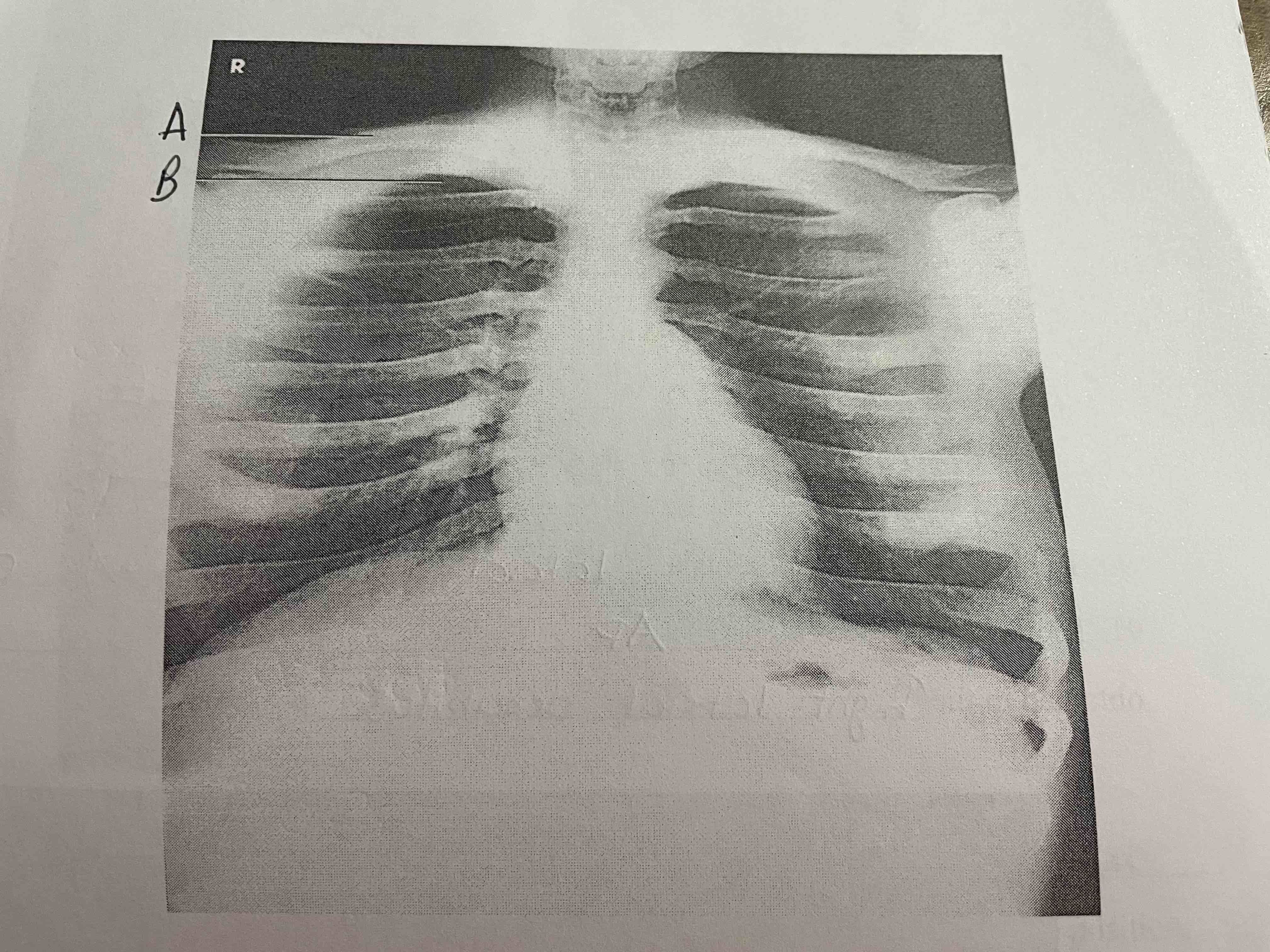
- AAP Axial
- BClavicle
- CApex of the lung
- Dheart
- Eleft
73The image represents a [blank_start]lateral[blank_end] projection of the [blank_start]chest[blank_end].
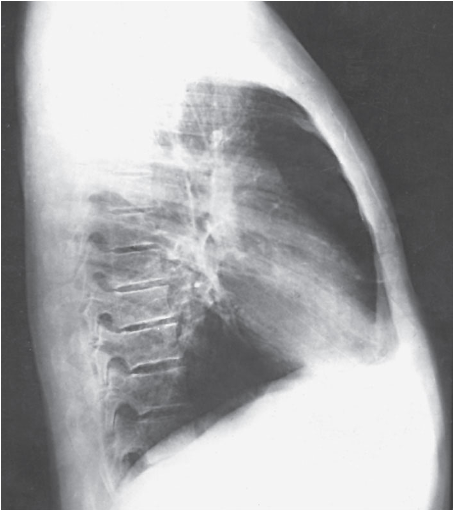
- Alateral
- Bchest
74The image is a [blank_start]AP[blank_end] projection obtained in the [blank_start]right lateral decubitus[blank_end] position.
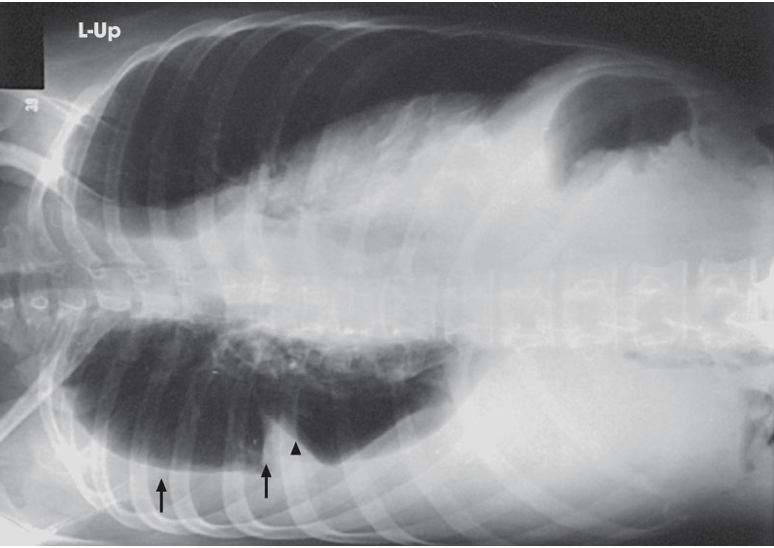
- AAP
- Bright lateral decubitus
75The image is a [blank_start]AP[blank_end] projection of the [blank_start]Abdomen[blank_end] (body part/ region), obtained with the patient in a/an [blank_start]upright[blank_end] position.
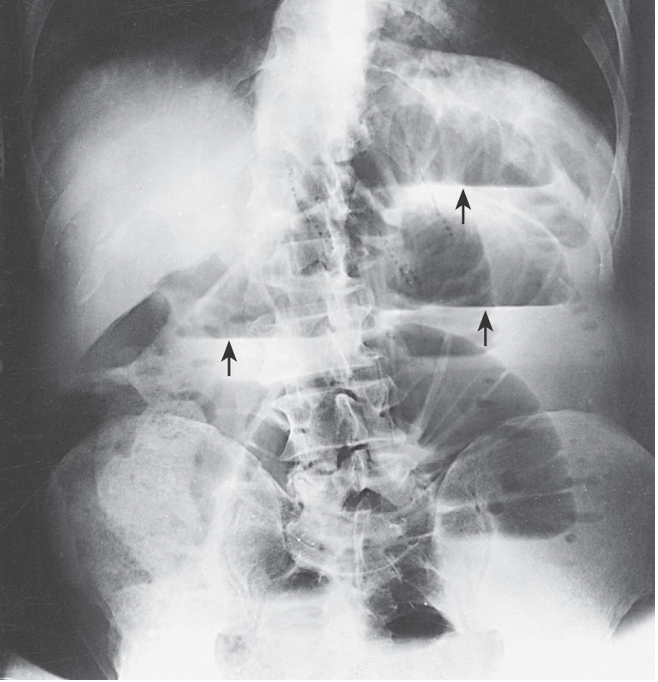
- AAP
- BAbdomen
- Cupright
76The image represents a [blank_start]PA[blank_end] projection of the [blank_start]Chest[blank_end]
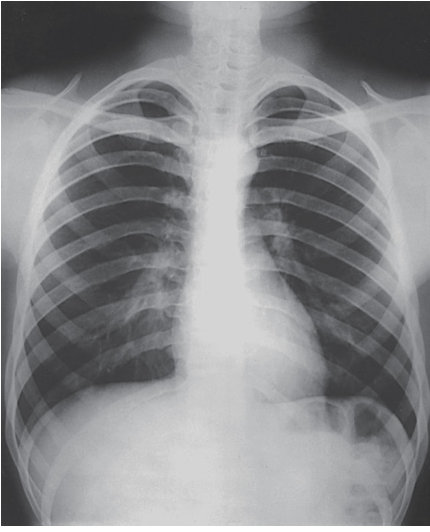
- APA
- BChest
77Label the following:
- ADiaphragm
- BRib
- CIliac crest
- DVertebral body
78Label the following:
- ATrachea
- BClavicle
- CScapula
- DAortic arch
- E7th rib
- FHeart shadow
Información
- Descripción
- El usuario ha eliminado su información de asignaturas Test sobre Fall 2021 Exam 1, creado por Usuario eliminado el 31/01/2022.
- Autor
- Usuario eliminado
- Idioma
- English
- Visitas
- 12
- Historial
- Creado el 31 ene 2022 · actualizado el 1 feb 2022
- Etiquetas
- Valoración
- Aún sin valoraciones Valora este test