
Apuntes
Topic 4b: fluids
Contenido del apunte (9)
Página 1
Fluids: any substance that flows, describes both liquids and gases. Yield to shearing forces, unlike solids. Since they possess inertia defined by their density, they are subject to the same physical interactions as solids.
Properties of fluids -->
Density: ρ = mass/volume = m/V, represents the fluid equivalent of mass
units of kg/m^3, g/cm^3, or g/mL.
It is a property unique to each substance, independent of shape or quantity, but dependent on temperature and pressure.
homogeneous substance: density is constant throughout the object, such as in a bar of iron
heterogeneous substance: density is not constant throughout the object, if a sample were taken, it may not have the same density as the average density of the object; ex: swiss cheese
gases are the least dense
specific gravity: ratio of density of the substance to the density of water. Can also be expressed in terms of weight if equal volumes are chosen. useful to compare densities of objects as SG is unitless
Archimedes principle: anything immersed in a fluid is subjected to a buoyant force, which is equal in magnitude to the weight of the fluid displaced.
Buoyant force= weight of displaced fluid
if the buoyant force is greater than the weight of the object, then object floats
if the buoyant force is less than the weight of the object, then the object sinks.
if the buoyant force is equal to the weight of the object, then the object suspended at that depth
ALWAYS POINTS UPWARDS, because the magnitude of fluid pressure increases as the object depth increases
the fraction of an object's volume that is submerged is determined by --> ρ(object)/ρ (fluid)
Hydrostatic pressure
Página 2
Pressure: a force acting perpendicular to a surface area of an object. P= F/A
A scalar quantity, expressed in units of N/m^2.
atmospheric pressure: Patm, average pressure exerted by the earth’s atmosphere, 1atm= 760mmHg= 1.01x10^5 pascals (Pa).
Hydrostatic pressure: the fluid pressure exerted by fluids at rest at any point in the medium, assuming the fluid is incompressible. Increases with depth, points in the same direction at all places in the medium, due to the fluid assumed to be in static equilibrium. Hydrostatic pressure= density of fluid * gravitational acceleration * depth of object -->

Total pressure exerted on an object within a contained fluid is the sum of the atmospheric and hydrostatic pressures, P = Patm + Phyd = Patm + ρgh
Pascal’s principle: a pressure applied to confined fluid is transmitted equally to all points within the fluid -->
can be applied to use the pressure of the fluid as energy to do work, ex: hydraulic presses

Dalton's law: the total pressure exerted by a mixture of non-reactive gases is equal to the sum of the partial pressure of individual gases.
The total pressure of a mixture depends solely on the number of moles of gas, and not the kinds of molecules. Pressure can also be dependent on height.

Mole fraction (xi): a way of expressing the relative proportion of one particular gas within a mixture of gases.
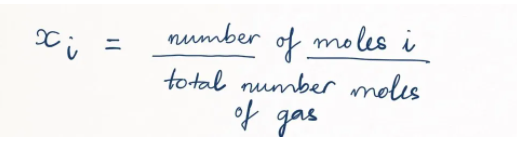
Partial pressure-->
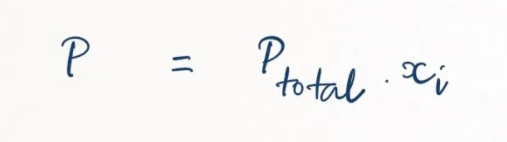
Página 3
Fluids in motion:
Viscosity (η): a measurement of the resistance/frictional force exerted by a fluid in motion; ex: flow of syrup (high viscosity) vs flow of juice (low viscosity)
expressed in units of poise (P); 1 poise = 0.1 N*s/m^2 (Newton seconds per square meter)
defined on the basis of laminar flow
laminar flow: fluid flows as continuous layers stacked one upon another within a smooth tube, with the layers moving past one another with some velocity. As the velocity of the fluid increases, fluid particles move between the ordered layers, causing random motion.

Turbulent flow occurs when the fluid's velocity exceeds the threshold, the critical velocity. The layers mix together and flow in eddies and swirls. Caused by obstruction and high speed.
Reynold's number: a dimensionless quantity that describes flow as turbulent or laminar; Nr>3000, flow is turbulent; Nr<2000 flow is laminar; 2000<Nr<3000, flow is chaotic and oscillates between laminar and turbulent, easily disrupted by small obstructions

Poiseuille’s law (Q): describes pressure-induced laminar fluid flow through a pipe
expressed in units of cm^3/s (centimeters cubed per second).


Página 4
Flow rate (Q): volume of fluid which passes through a surface in a given unit of time
Q=Av; fluid flow = area x velocity of fluid
Also Q= v/t, velocity over time
Continuity equation: an expression of the conservation of mass for moving fluid.
Fluid maintains constant density despite changes in pressure and temperature
flow measured at one point along the vessel is equal to the flow at another point in the vessel regardless of the area of the vessel.
Q1=Q2, A1V1=A2V2; essentially, flow in equals flow out
DOES NOT APPLY TO GASES AS THEY ARE NOT INCOMPRESSIBLE
explains why fluid flow decreases in areas of greater area and increases in narrower areas
Surface tension: the tension, or force per unit length generated by cohesive forces of molecules on the surface of a liquid acting toward the interior. In units of Newton per meter.
γ= F/d; surface tension equals the ratio of the surface force F to the length d along which the force acts
explains why liquids form bubbles and droplets and why immiscible liquids have a curvature where they meet

Página 5
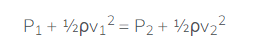
Bernoulli's principle: the fluid equivalent of conservation of energy. States that the energy of fluid flow through a rigid vessel by a pressure gradient is equal to the sum of the pressure energy, kinetic energy, and the gravitational potential energy.
applies to an incompressible fluid in the absence of friction


Applications of Bernoulli's principle is important for vessels that have a change their geometry, such as with obstruction
Bernoulli's principle assumes a smooth transition between Two regions in a vessel and no turbulence in the flow. However this is not always the case and the altered equation can be applied to situations such as obstruction or plaque in a vessel.
fluid is static --> pressure increases with depth
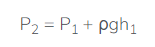
fluid moves, but its depth is constant-> speed and pressure are inversely related at constant depth


Venturi effect: reduction in fluid pressure when the fluid flows through a constricted section; seen through the use of a venturi meter. The venturi meter contains a pitot tube.
A venturi tube is a device that measures velocity of the fluid flowing within the tube.
As the fluid moves from the entrance of the pipe, the fluid pressure increases to its maximum while its velocity is at its minimum.
This causes a greater push and reduced height of the fluid in the U-tube attachment of the meter.
The fluid continues through the pipe and encounters a constriction.
The area at the narrowed region is decreased; as a result, the velocity is increased and the fluids pressure is decreased.
This is observed as an increase in the height of the fluid in the U-tube attachment.
The fluid flow velocity through the constriction of the pipe is determined by the following relationship-->


pitot tube: a L shaped, tubular device used to measure the velocity of fluid flow as it passes by the tube.
The tube has two small holes; the first one encounters fluid with a velocity of 0, and the pressure at this opening is equal to the static pressure exerted by the fluid.
The 2nd hole encounters moving fluid and the pressure at this opening is equal to the total pressure exerted by the fluid.
Dynamic pressure (ΔPdynamic), the difference between the stagnation and static pressure values, is recorded at the end of the perpendicular segment of the tube. The dynamic pressure can be used to calculate the velocity of air flow using Bernoulli’s equation.
Thus, Bernoulli's equation is simplified to P1-P2=ΔP
Página 6
Pressure and fluid flow in human circulatory system:
blood circulation is influenced by resistance, flow, and pressure
resistance must be overcome to push blood through the system. If resistance increases, pressure must increase to maintain flow, or flow rate must decrease to maintain pressure.
resistance can be altered by vessel length, vessel radius, and blood viscosity

arterioles and capillary networks generate the most resistance d/t their small radius. However arterioles can overcome resistance via vasodilation/vasoconstriction
veins have low resistance but rely on valves to prevent backflow
blood pressure is an indicator of circulatory health because it increases with impairment in flow 2/2 increased resistance
arteries tend to have higher pressure because they are closer to the heart and muscle tissue producing contractions
Flow is the movement of blood through the circulatory system, and it is maintained at a relative constant by altering conditions (pressure and resistance). Too-high flow can damage vessels and too-low flow can result in insufficient oxygen being provided to surrounding tissues
blood is pumped through the aorta at a pressure of ~120mmHg, however this pressure declines as the blood moves through the rest of the circulatory system.
In the larger arteries pressure is ~110mmHg, in the medium arteries ~75mmHg, in the smaller arteries/arterioles ~40mmHg.
In the capillary beds, blood enters at a pressure of ~30mmHg and exits at a pressure of ~16mmHg.
In medium sized veins, blood pressure is <12mmHg and in large veins it is 4mmHg before returning to the heart.
Velocity of blood flow as blood exits the heart also decreases as it moves through smaller vessels.

Página 7
Gases:
volume, pressure, and temperature of gases are all related and these variables influence behavior of gases.
Temperature: a physical property of a body that reflects its warmth or coldness; It is a scalar quantity measured by a thermometer, with units dependent on the scale of measurement used.
absolute zero: the theoretical temperature where all thermal motion ceases
KNOW THE CONVERSIONS!!!!


Pressure: A force per unit area. Expressed in various units, including pounds per square inch (psi), Pascal (Pa), torr.
manometer: measures the pressure a gas exerts on the walls of its container
Atmospheric pressure: the pressure exerted by particles in the atmosphere as they collide with objects. Measured using a mercury barometer.
A barometer is an evacuated tube in a dish of mercury. The atmospheric pressure pushes the mercury into the tube. 1 atmosphere= 760 mmHg
atm pressure is dependent on weather conditions. Lower atmospheric pressure is present at high altitudes, which results in decreased [O2] which is why mountain climbers must bring O2 with them
Avogadro’s law: one mol (6.022 x 10^23 particles) of any gas occupies the same volume at a given temperature and pressure.
This is where Avogadro’s number comes from--> 6.022 x 10^23 particles= 1 mole of any gas occupies 22.4L of volume at standard conditions
Kinetic Molecular theory of Gases:
A series of assumptions that directs the model of gas behavior.
the volume of each gas particle is negligible compared to the volume of the gas itself
this assumption is explained by Boyle’s law. When volume is decreased, the particles are more crowded and they will have more collisions. This results in an increase in pressure.
there are no intermolecular attractive forces between the gas particles (because its particles are so far apart that they do not exert any attractive forces upon one another).
Gas particles are in constant, random motion, and move in straight lines until they collide with one another or with the walls of the container in which they are enclosed.
Each particle has an inherent kinetic energy dependent upon temperature only. The average kinetic energy of each gas particle is proportional to the temperature
This assumption is explained by Avogadro's law. The number of collisions increases as the number of particles increases. Pressure and temperature are constant, this volume must increase to contain the particles.
Gas particle collisions are completely elastic; when the gas particles collide with a body, there is no net gain or loss of kinetic energy
This assumption is explained by Charles law. Particles move faster when the temperature is increased, resulting in more collisions when the particles are moving faster. increase temperature requires greater volume to maintain pressure at a constant.
Ideal gases:
there are no intermolecular attractive forces between the gas particles (because its particles are so far apart that they do not exert any attractive forces upon one another).
Real gases may model the behavior of ideal gases at high temperatures and low pressures, making the ideal gas law a useful approximation In such situations.
The ideal gas law -->

A series of laws combine to make up the ideal gas law.
Boyle's law: P1V1= P2V2; states that pressure is inversely related to the volume of a given mass of a gas at constant temperature. *APPLICABLE ONLY WHEN n AND T ARE CONSTANT*
Charles' law: V1/T1= V2/T2; states that the volume of a gas is directly related to temperature in kelvins at constant pressure. *APPLICABLE ONLY WHEN n AND P ARE CONSTANT*
Avogadro's law: V1/n1= V2/n2; States that when temperature and pressure of a gas are constant, the volume and number of particles are directly related; equal volumes of all gases contain the same number of particles. *APPLICABLE ONLY WHEN T AND P ARE CONSTANT*
Heat capacity (C): quantity unique to a substance, measures the amount of heat energy required in joules to raise the temperature of 1 gram of a substance by 1 degree Celsius.
Q= mCΔT
ΔT= change in temperature
Q= heat energy
m= mass
There's an exception to this relationship for a gas is under constant volume or under constant pressure.
enthalpy, the flow of heat, for a gas under constant pressure can be determined by --> Q = ΔH = mC(p)ΔT
Q= heat energy
ΔH= enthalpy
m= mass
C(p)= heat capacity of a gas at constant pressure
ΔT= change in temperature
Gases under constant volume cannot expand, so the heat energy applied is transferred to the internal energy of the gas --> ΔU = mC(v)ΔT
ΔU= internal energy of the gas
m= mass
C(v)= heat capacity of a gas at constant volume
ΔT= change in temperature
adiabatic index: ratio of specific heat at constant pressure to specific heat at constant volume
Boltzmann's constant (k): can be used to replace the R constant to describe a gas in terms of the number of particles of the gas instead of the number of moles. k= 1.40 x 10^-23 J/K. Relates the average kinetic energy of gas particles to temperature of the gas.
Página 8
Real gases:
behavior deviates from ideal model in 2 situations-->
high pressure, where volume does not approach 0
low temperatures where intermolecular interactions become significant
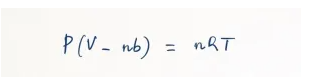
the van der Waals equation modifies the ideal gas law to account for excluded volume, where (V-nb) is volume - number of particles * b, a constant specific to each gas
Página 9
Información
- Descripción
- Apunte sobre Topic 4b: fluids, creado por 000 000 el 21/02/2022.
- Creado por
- 000 000 · feb 2022
- Actualizado
- 28 feb 2022
- Visitas
- 0
- Valoración