
Fichas
BISC 100 - Lecture 26 & 27: Genetics
Fichas del conjunto (33)
- 1Hereditytransmission of traits
- 2Geneticsscientific study of heredity
- 3Mendel created- purebred (what does that mean?) varieties of pea plants
and
– crossed two different purebred varieties. - 4Hybridsare the offspring of two different purebred
varieties.
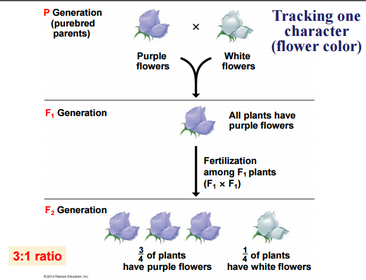
– The parental plants are the P generation.
– Their hybrid offspring are the F1 generation.
– A cross between the F1 plants forms the F2 generation.
– F stands for “filial” - 5characterheritable feature that varies among
individuals - 6A traitvariant of a character.
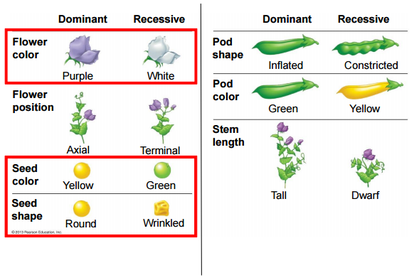
- 7The seven characters studied by Mendel
- 8Tracking one character (flower color)
- 9Mendel’s four hypotheses (1 & 2)1. The alternative versions of genes are called alleles
(previously termed traits).
Example: Gene for flower color
- P allele = purple color
- p allele = white color
2. For each inherited character, an organism inherits two
alleles, one from each parent.
– An organism is homozygous (pure breeding or true
breeding) for that gene if both alleles are identical.
– An organism is heterozygous for that gene if the
alleles are different (Hybrid).
– Example: Flower color (P = purple; p = white)
» PP and pp = homozygous
» Pp = heterozygous - 10Mendel’s four hypotheses (3 & 4)3. If two alleles of an inherited pair differ,
– then one determines the organism’
s appearance is
called the dominant allele and
– the other has no noticeable effect on the organism’
s
appearance and is called the recessive allele.
– Example: Flower color in pea plants
» P = dominant allele (purple color)
» p = recessive allele (white color)
» PP and Pp = purple flower; pp = white flower
4. Gametes (haploid) carry only one allele for each
inherited character.
– The two alleles for a character segregate (separate)
from each
inherited character.
– The two alleles for a character segregate (separate)
from each other during the production of gametes.
– This statement is called the law of segregation.
– Example: Flower color (P = purple; p = white)
» PP parent produces only P gametes
» Pp parent produces P or p gametes
» pp parent produces only p gametes - 111. Mendel’s Law of SegregationThat organisms have two genetic
elements which separate when
gametes are formed.
The fusion of gametes at fertilization
pairs these elements once again
Occurs during meiosis I: homologous
chromosomes separation in anaphase I - 122. Mendel’s Law of Independent AssortmentFactors for different characteristics
(different gene pairs) are inherited
independently from one another
Occurs during meiosis I: Independent
assortment of homologous chromosomes
in metaphase 1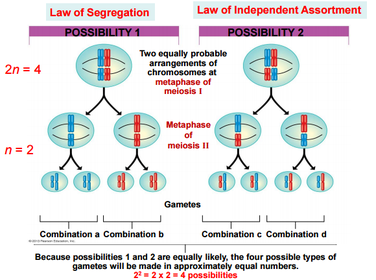
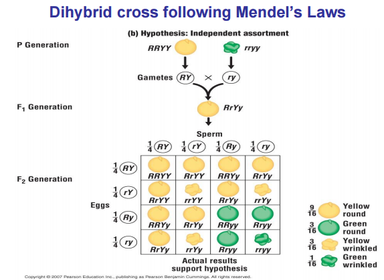
- 13What is a Dihybrid cross?
- 14Incomplete dominanceMANY ALLELES SHOW
INCOMPLETE DOMINANCE
In monohybrid crosses
in some cases outcome
was different
Ex 1. SNAPDRAGONS
(red X white = PINK) - 15CodominanceBoth alleles express together in the heterozygotes
- 16EpistasisOne gene may alter the effect of (expression)
of another gene
Ex 1. Mice have TWO GENES fur coat colour
B and C
B = BLACK
b = brown
C = COLOUR
If cc (homozygous recessive) is present the mouse
will be white regardless of which B gene it has
One gene may alter the effect of (expression)of
another gene - 17EnvironmentCan modify the expression of the gene
Coat colour of animals
Can modify the expression of the gene - 18Polygeneic inheritanceMost characteristics are determined more than one
gene
Height and Skin color - 19Pleiotropy and sickle cell disease– Pleiotropy is when one gene influences several
characters.
– Sickle-cell disease exhibits pleiotropy
• results in abnormal hemoglobin proteins, and causes
disk-shaped red blood cells to deform into a sickle
shape with jagged edges.
• causes multiple symptoms:
weakness, pain,
organ damage
and paralysis - 20Multiple allelesMany genes have more than two alleles in the population
– In a population Multiple alleles often exist for
a characteristic - 21Human ABO blood groups are an example of multiple alleles and codominanceBlood cells have either A or B type surface
carbohydrates, or none (O)
• The immune system produces blood proteins called antibodies
that bind to foreign carbohydrates.
• If a donor’
s blood cells have a carbohydrate (A or B) that is
foreign to the recipient, the blood cells may clump together,
potentially killing the recipient.
– The clumping reaction is the basis of a blood-typing lab test.
– The human blood type alleles IA and IB are codominant,
with both alleles expressed in heterozygous individuals
who have type AB blood. - 22Multiple alleles for the ABO blood groupsAlleles are alternative
forms of a gene that arose
by mutation.
Each gene (100s or 1000s
of base pairs long) can
have multiple alleles.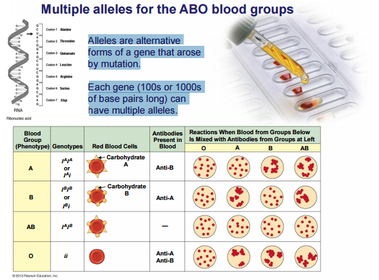
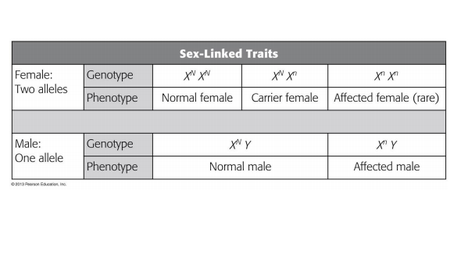
- 23Sex chromosomes and sex-linked genesSex chromosomes influence the inheritance of certain traits.
Human sex chromosomes: XX = female; XY = male - 24genetic abnormalityrare version of an inherited
trait - 25genetic disordernherited condition that causes
medical problems - 26Inheritance patterns in humans are often studied bytracking inheritance patterns of genetic disorders
through generations - 27Pedigreeis a chart showing the pattern of inheritance of a
trait in a family - 28SyndromeThe set of symptoms that characterize a genetic
disorder - 29Any gene located on a sex chromosome is calledsex-linked gene.
• Most sex-linked genes are found on the X chromosome.
• Red-green colorblindness is a common human sex-linked
disorder and caused by a malfunction of light-sensitive cells in
the eyes - 30Sex-linked traits
- 31HYPERTRICHOSISSevere hypertrichosis is quite rare, almost certainly due to unknown
genetic defects, and can result in excessive or animal-like hair on
both face and body. Unfortunately, some of these people have been
displayed in carnival sideshows with names such as "dog-boy"
or the "bearded lady." - 32Linked genesLinked genes are located close together on a
chromosome and tend to be inherited together.
– Thomas Hunt Morgan (early 1900s)
• used the fruit fly Drosophila melanogaster and
• determined that some genes were linked based on the
inheritance patterns of their traits.
• Example: Body color gene and wing length gene are linked - 33Genetic recombination: crossing overCrossing over can
– separate linked alleles,
– produce recombinant gametes with new combinations of alleles,
and
– produce offspring with recombinant phenotypes.
• The percentage of recombinant offspring among the total is
called the recombination frequency.
Crossing over can produce recombinant gametes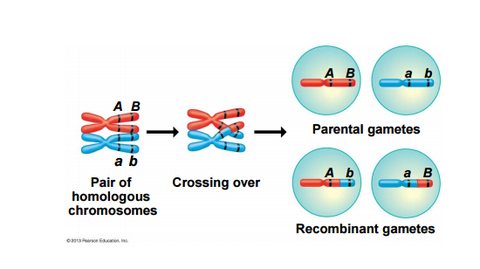
Información
- Descripción
- El usuario ha eliminado su información de asignaturas Fichas sobre BISC 100 - Lecture 26 & 27: Genetics, creado por Usuario eliminado el 10/08/2016.
- Creado por
- Usuario eliminado · ago 2016
- Actualizado
- 2 dic 2016
- Visitas
- 36
- Historial
-
- Creado por Chelsi Souch · 10 ago 2016
- Copiado por Chelsi Souch · 10 ago 2016
- Valoración