
Fichas
BISC 100 - Lecture 28, 29, 30: Evolution
Fichas del conjunto (52)
- 1WHAT IS BIOLOGICAL EVOLUTON?Changes in the genetic makeup of a population of
organisms over time
• It is the central theme biology
• All species arise from other, pre-existing species.
However, through time they accumulate differences such
that ancestral and descendant species are
NOT IDENTICAL.
• Darwin used the phrase “Descent with modification” to
explain this concept - 2Historical development of evolutionary thought• Early Greek philosophers:- Anaximander
(about 2500 years ago) Life arose in water and
simpler forms preceded more complex
forms.
• Aristotle believed that species were fixed
and did not evolve.
• Judeo-Christian tradition:- All species were
created in a single act of creation about
6000 years ago!
• Buffon (mid 1700) Observed similarities between
fossils and living species.
He suggested that earth was much older and
raised the possibility that different species arose
from common ancestors. He also believed in
catastrophism.
• Lamark (early 1800) was the first to support
the idea of evolution strongly, but he believed the
mechanism for change was the inheritance of
acquired characteristics. - 3LAMARCK’S TRANSFORMATION THEORYsuggested that organisms
evolved by the process of adaptation.
Also suggested some erroneous ideas
such as the inheritance of acquired
characteristics.
i.e. Effects of unique events
get passed on to offspring. - 4FATHERS OF THEORY OF NATURAL SELECTION• Charles Darwin (Born 1809)
(200th B’day 2009)
• Alfred Russell Wallace
• Patrick Matthew - 5Charles LyellPrinciples of Geology
- 6The Voyage of the BeagleIn December 1831, Darwin left Great Britain on the
HMS Beagle to explore the world.
– On his journey on the Beagle, Darwin Collected
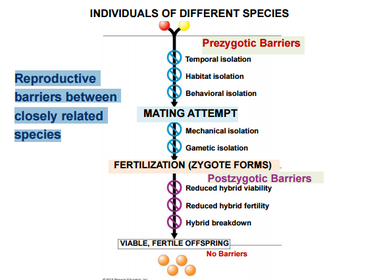
thousands of specimens.
Observed various adaptations in organisms.
Darwin’s finches
• Are an excellent example of Natural
Selection and Adaptive Evolution. - 7Descent with ModificationDarwin made two main points in
The Origin of Species:
• Organisms inhabiting earth today descended
from ancestral species.
• Natural selection was the mechanism for
descent with modification. - 8REMEMBER…….•When we speak of evolution, we mean
change across but not within generations.
• The latter is referred to as ontogeny.
•Ontogeny can reveal phylogeny - 9Darwin based his theory of natural selection on two key observations...Observation 1: Overproduction
• All species tend to produce excessive numbers
(got the idea from the economist Malthus)
• This leads to a struggle for existence
(also from Malthus).
A fungus: Puff Ball producing large
number of spores (reproductive units)
Observation 2: Individual variation
• Variation exists among individuals in a
population.
• Much of this variation is heritable. - 10WHAT IS ADAPTATION?Adaptation is a universal
characteristic of living things.
• Definition:
Properties of an organism
that allow it to survive and
reproduce. - 11FossilsAre preserved remnants or impressions left
by organisms that lived in the past which are often
found in sedimentary rocks.
Paleontologists (scientists who study fossils) have
discovered many transitional forms that link past
and present.
• Have traits common to an ancestral group
and its presumed derived descendants.
– Transitional fossils imply that
• birds descended from one branch of dinosaurs (light-boned,
evolved to hop, and gradually to fly)
• whales descended from four-legged land mammals. - 12The chronological order of which different vertebrate groups appear in fossil recordsFishes
Amphibians
Reptiles
Birds
Mammals - 13Biogeography• Is the study of the geographic
distribution of species.
• First suggested by Darwin that
today’s organisms evolved from
ancestral forms.
• Many examples from biogeography
support evolutionary theory. - 14Comparative anatomy• Is the comparison of body structure between
different species.
• Confirms that evolution is a remodeling process
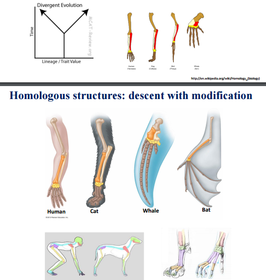
(Editing but NOT a Creating process). - 15Homology vs Analogy• Homology: Is the similarity in structures due to
common ancestry
• Analogy : Similarity in structures but NOT from
common (recent) ancestry - 16Comparative anatomy – Divergent evolutionHomologous structures have a similarity due to common
ancestry
• Evolved by divergent evolution: divergence from a
common ancestral structure or function.
– e.g., remodeling of the pattern of bones forming
the forelimbs of mammals for different functions. - 17Comparative anatomy – Convergent evolutionAnalogous structures have a similar form or function
but evolved independently of each other.
• Evolved by convergent evolution:
independent evolution of similar features in
species of different lineages.
– e.g., Flying insects, birds, and bats have
all evolved the capacity of flight independently.
They have "converged" on this useful trait (formation of
wings).
» Birds (feathers attach to forelimb bones)
» Insects (outgrowth of exoskeleton)
» Bat wing membranes (webbed digits)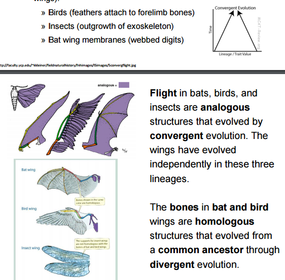
- 18Analogous StructuresDifferent ancestry but have the same or almost the
same form and function: Convergent evolution - 19Comparative anatomy: Adaptive radiationAdaptive radiation is the rapid evolutionary diversification of a single
ancestral lineage, resulting in speciation (many species evolve from
a single lineage).
It occurs when members of a single species occupy different niches
with different environmental selection pressures, resulting in
morphological adaptations as a result of natural selection. - 20Comparative anatomyVestigial structures: are remnants of features that served
important functions in an organism’ s ancestors and - 21______ & _______ bones evident in ancient whale fossilsPelvis and rear leg bones
- 22Comparative EmbryologyComparative embryology is the comparison of structures
that appear during the development of different organisms.
– Comparative embryology of vertebrates supports
evolutionary theory. (Oncogeny reveals phylogeny)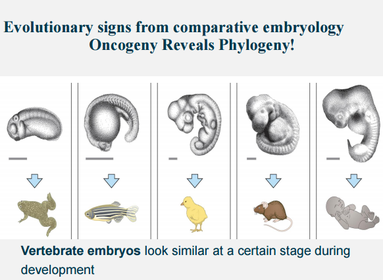
- 23Molecular BiologyEvolutionary relationships (Phylogenetic reletionships)
among species
Leave signs in DNA and proteins (immunology).
– Can be determined by comparing genes and
proteins of different organisms.
Universality of the
genetic code is the
strongest evidence
that all life is related
Similarities in
amino acid sequences
Antigen antibody
reactions - 24Darwin: Evolutionary treesDarwin saw the history of life as analogous to a tree.
– The first forms of life on Earth form the common trunk.
– At each fork is the
last common ancestor to
all the branches extending
from that fork.
– The tips of millions of twigs
represent the species
living today.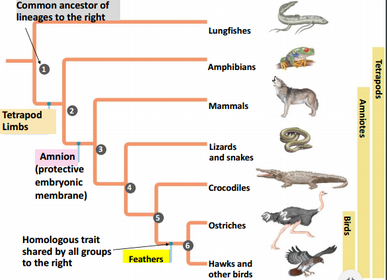
- 25Darwin's theory and the modern synthesisThe science of genetic changes in populations,
in 1920 was an important turning point for the
theory of evolution.
Genetics provided the missing links of how traits
were inherited from one generation to the next.
A theory of evolution that includes genetics was
developed in 1940s.
It focuses on POPULATIONS as the units of
evolution - 26A population is a...group of individuals of the same species,
living in the same place at the same time - 27Garter snake evolution in response to predators: Remember spotted vs stripesNatural selection can affect an individual’s survival and
reproductive success, but the evolutionary impact is only
apparent in the heritable genetic changes in a population
over time - 28WHAT IS MICROEVOLUTION?Microevolution is change in a population’s gene pool over time
A population’s gene pool consists of all the alleles in all the
individuals making up the population. - 29Genotype frequencyProportions or percentage of a
genotype in a population. - 30Allele frequency:Proportions or percentage of an allele in
a population. - 31Microevolution is the changes in allele frequencies that occur over time within a population, due toGene mutation and sexual recombination
– Gene flow
– Genetic drift (random change, bottleneck effect,
founder effect)
– Selection (natural and artificial) - 32Five factors which cause populations to evolve are1. Mutation
2. Non-random mating
3. Gene flow
4. Genetic drift
5. Natural Selection - 33Sources of genetic variationmutations: changes in the nucleotide sequence of
DNA
sexual recombination: the shuffling of alleles during
meiosis and fertilization - 34Genetic drift is achange in the frequency of an allele
in a small population due to:
– random change, bottleneck effect, founder
effect
- decreases the overall genetic variability
- results in a loss of individual variation and
hence loss of adaptability - 35Gene flowis genetic exchange with another population, that
may result in the gain or loss of alleles, and tends to
reduce genetic differences between populations.
– Can occur between species (hybridization; horizontal
gene flow)
Microevolution: Gene flow
Examples:
• Pollen (gamete) dispersal
between populations
• Global movements of
humans - 36Natural selection IN TERMS OF MICROEVOLUTION*Of all causes of micro evolution, only natural selection
promotes adaptation due to unequal reproductive success
of individuals. - 37Three general outcomes of natural selectionDirectional selection shifts the overall makeup of a
population by selecting in favor of one extreme phenotype.
Disruptive selection can lead to a balance between two
or more contrasting phenotypic forms in a population
3. Stabilizing selection favors intermediate phenotypes,
occurs in relatively stable environments, and is the most
common - 38Sexual dimorphismis a distinction in appearance between
males and females. - 39Sexual selectionis a form of natural selection in which
individuals out-reproduce others in a population because they
have greater success in securing mates. - 40The origin of speciesThe diversity of life evolved through speciation, the
process in which one species splits into two or more
species - 41The biological species concept defines a species as“A group of populations whose members have the
potential to interbreed with one another in nature to
produce fertile offspring - 42Prezygotic barriersprevent mating or fertilization
between species. - 43The species concept is based onreproductive compatibility
rather than physical similarity. - 44Reproductive barriers between speciesTemporal Isolation
Habitat Isolation
Behavioral Isolation
Mechanical Isolation
Gametic Isolation - 45Postzygotic barriersoperate if interspecies mating
occurs and hybrid zygotes form. - 46Reduced Hybrid ViabilityFrail or partially developed hybrid salamander offspring
do not survive long enough to reproduce. - 47Reproductive barriers between closely related species
- 48Mechanisms of speciation– A key event in the potential origin of a species occurs when a
population is somehow cut off from other populations of
the parent species.
– Species can form by
• Allopatric speciation, due to geographic isolation, or
• sympatric speciation, without geographic isolation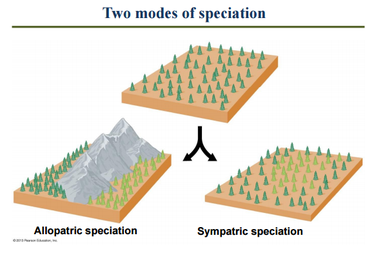
- 49Allopatric speciation of antelope squirrelsGeological isolation of squirrel populations
on opposite rims of the Grand Canyon
Speciation occurs with the evolution of reproductive
barriers between the isolated population and its parent
population.
– Even if the two populations should come back into
contact at some later time, the reproductive barriers
will keep them as separate species.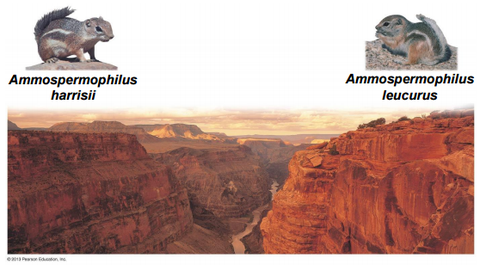
- 50Sympatric speciationSympatric speciation occurs in populations that live in the
same geographic area.
– An accident during cell division (mitosis or meiosis) that
results in an extra set of chromosomes is a common
route to sympatric speciation in plants.
– Many polyploid species arise from the hybridization
of two parent species.
Domesticated species: oats, potatoes, bananas, peanuts,
apples, sugarcane, coffee, wheat - 51Sympatric speciation: PolyploidyPolyploidy (e.g., 4n) can arise by meiotic failure
and self-fertilization resulting in
fusion of unreduced gametes (e.g., 2n instead of n).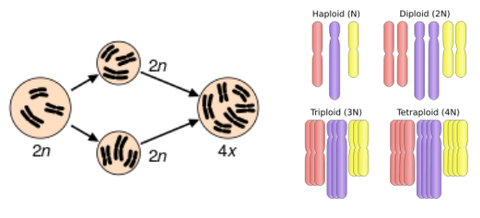
- 52—
Información
- Descripción
- El usuario ha eliminado su información de asignaturas Fichas sobre BISC 100 - Lecture 28, 29, 30: Evolution , creado por Usuario eliminado el 10/08/2016.
- Creado por
- Usuario eliminado · ago 2016
- Actualizado
- 2 dic 2016
- Visitas
- 34
- Historial
-
- Creado por Chelsi Souch · 10 ago 2016
- Copiado por Chelsi Souch · 10 ago 2016
- Valoración