
Fichas
Th1L05 Lipids and membrane structure
Fichas del conjunto (63)
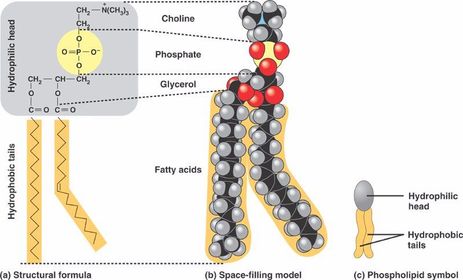
- 1Hydrophilic component of a phospholipidpolar head group
- 2Examples of a polar head group found in phospholipids (4)serine, choline, ethanolamine, inositol
- 3Polar head groups of phospholipids attach to what via whatbackbone of glycerol through a phosphate group
- 4Hydrophobic component of a phospholipidTwo fatty acyl side chains
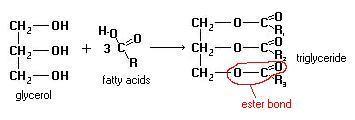
- 5The two fatty acyl side chains attach to what via whatthe glycerol backbone via ester bonds
- 6Hydrophobic and hydrophilic components make phospholipids whatamphipathic
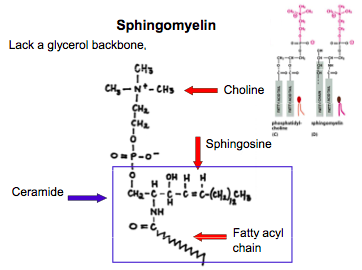
- 7Sphingomyelin is whatComponent of neural membrane of myelin
- 8What makes sphingomyelin uniqueit lacks a glycerol backbone
- 9What is the polar head of sphingomyelincholine
- 10In sphingomyelin, the phosphate groups attach to what and whatceramide, a single fatty acyl chain
- 11Components of a glycerol backboneCH2, CH, CH2 (across), two O down which attach to the fatty acid chains via an ester bond
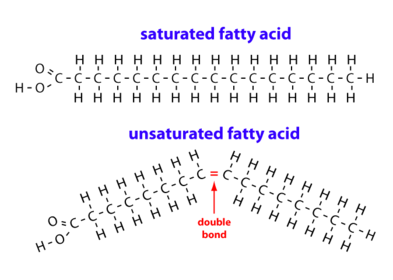
- 12Fully saturated FAs have how many double bondsnone
- 13Stearic acidFully saturated, 18:0
18 carbon atoms in fatty acid, no double bonds - 14Palmitic acidFSFA; 16:0
16 carbon atoms in fatty acid, no double bonds - 15Myristic acid14:0
14 carbon atoms in fatty acid, no double bonds, SFA - 16Mono-unsaturated FA has how many double bondsOne double bond
- 17Oleic acid18:1
18 carbon atoms; 1 double bond - 18Poly-unsaturated FA has how many double bondsseveral
- 19Arachidonic acid20:4
20 carbon atoms, 4 double bonds - 20Delta indicates whatposition of double bonded in relation to the carboxyl group
counting from the carboxyl terminal - 21A kink in a fatty acid represents whata double bond in a fatty acid
- 22In cholesterol, what interacts with the polar head groups of the membrane phospholipids and sphingolipidsHydroxyl group (hydrophilic region)
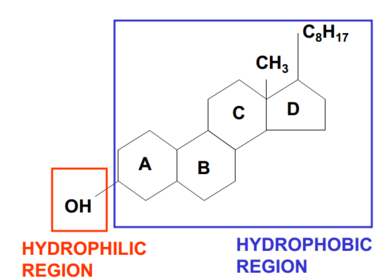
- 23The bulky steroid and the hydrocarbon chain are embedded in the_____________ , alongside the ________________membrane, nonpolar fatty-acid chain of the other lipids
- 24Lipid bilayers are described asasymmetrical
- 25Phospholipids facing extracellular environment includePhosphatidylcholine; sphingomyelin
- 26Phospholipids facing intracellular environment includePhosphatidylerserine, phosphatidylethanolamine
- 27Phospholipids are generated whereWithin the cell
- 28Fluidity is whatthe ease in which lipid molecules move about in the plane of bilayer
- 29Fluidity is important in the regulation of whatmembrane function (e.g. movement of proteins, signalling, exocytosis)
- 30Short chain fatty acids do what to fluidityReduce the tendency of hydrocarbon chains to interact and hence increase fluidity
- 31Kinks in unsaturated fatty acids do what to fluidityResult in less stable van der Waals interactions with other lipids and hence increase fluidity
- 32High cholesterol does what to fluidity and what is the clinical relevanceRestricts the random movement of polar heads, orders the lipid bilayer and decreases fluidity
Alters cell shapes, impairs oxygen transport, destruction of red blood cells and anaemia - 33Cholesterol is rich in which regions of plasma membranelipid rafts
- 34When are cholesterols levels abnormalWhen content of red blood cells is increased by 20-60% above normal
- 35Increased cholesterol content of red blood cell membranes is associated with whatsevere liver diseases e.g. Cirrhosis
- 36What are the components of plasma membrane structureHydrophobic regions, hydrophilic regions, proteins, glycoprotein, carbohydrate side chain
- 37Carbohydrate side chain will usually face which directionout into the extracellular space
- 38Membrane composition varies according to whatcellular location
- 39Carbohydrates only found in what of cellsplasma membrane
- 40Carbohydrates make up how much of the plasma membrane (%)8%
- 41What is the protein lipid ratio of the plasma membrane1:1
protein : lipid - 42What is the protein lipid ratio of the outer mitochondrial membrane1:1
protein : lipid - 43What is the protein lipid ratio of the inner mitochondrial membrane3:1
protein: lipid ratio - 44What is the protein lipid ratio of the nuclear membrane3:1
protein: lipid ratio - 45What is the most common lipid in the cell membranephos/choline
- 46Integral (intrinsic) proteins are found whereEmbedded in lipid bilayer, most span the entire bilayer
- 47Transmembrane spanning domains of intrinsic proteins are either what or whatalpha helices or beta sheets
- 48Integral or intrinsic proteins usually serve what functionChannel or transporter
- 49Anchored proteins are usually found whereanchored to membrane by covalently bound fatty acid (part of a glycolipid)
- 50Alkaline phosphate is an example of whatan enzyme; anchored protein
- 51RAS is an example of whatfatty acyl anchored protein
signalling protein; relays information from the cell membrane - 52Peripheral (extrinsic) proteins are found whereattached to the plasma membrane surface by ionic interactions with integral proteins or with polar head group of phospholipids
- 53Spectrin is an example of whatperipheral or extrinsic protein
structural protein; on the cytoplasmic surface of erythrocytes - 54Phospholipase A2 is an example of whatperipheral or extrinsic protein
- 55Phospholipase A2 is capable of whatcleave fatty acids from phospholipids
- 56Sites of phospholipase A2 action (3)(1) Polar head (choline, ethanolomaine, myo-inositol) from phosphate group (PLD)
(2) Phosphate group from glycerol backbone (PLC)
(3) Remove the fatty acids (PLA1 - usually saturated), (PLA2, usually unsaturated) - 57High salt - urea treatment can remove which proteinsperipheral proteins
- 58Detergent (protein solution) can remove which proteinsperipheral, anchored and integral proteins of the bilayer
- 59Phospholipase can remove which proteinsperipheral and anchored proteins of the bilayer
- 60Detergents have a similar structure to what naturally occurring molecule and for what reasonphospholipids with a hydrophilic head and a hydrophobic tail
- 61Detergent monomers form whatdetergent polymer micelles
- 62Micelles + membrane proteins results in what two componentswater-soluble-lipid-detergent complex and water-soluble-lipid-detergent micelles
- 63Removing detergent and adding phospholipids back to proteins allows you to do whatstudy your protein of interest and its function
Información
- Descripción
- El usuario ha eliminado su información de asignaturas Fichas sobre Th1L05 Lipids and membrane structure, creado por Usuario eliminado el 26/08/2016.
- Creado por
- Usuario eliminado · ago 2016
- Actualizado
- 27 ago 2016
- Visitas
- 22
- Historial
-
- Creado por Emma Allde · 16 ago 2016
- Copiado por Emma Allde · 26 ago 2016
- Valoración