
Shakespeare and the Elizabethan World
Diapositivas del conjunto (9)
-
Shakespeare and the Elizabethan World
-
Elizabethan Age Characteristics
- The Elizabethan Era is the period associated with the reign of Queen Elizabeth I (1558–1603) and is often considered to be a golden age in English history. Shakespeare was born a few years after Elizabeth had become queen and he had a strong influence on that era, which was the height of the English Renaissance.
- Culture: It was the flowering of English literature and poetry. Elizabethan theatres flourished and William Shakespeare, among others, composed plays that broke away from England’s past style of plays and theatre.
- New approaches: It was an age of expansion and exploration abroad, while at home the Protestant Reformation became well-established in the national mindset.
- Importancy: The
- Elizabethan Age is viewed so highly because of the contrasts with the
- periods before and after. It was a brief period of largely internal
- peace concerning the battles between Protestants and Catholics and the
- battles between parliament and the monarchy that surrounded the
- Elizabethan Age.
- Politics: The one great rival was Spain, with which England conflicted
- both in Europe and the Americas. These conflicts exploded into the
- Anglo-Spanish War of 1585–1604. An attempt by Philip II of Spain to
- invade England with the Spanish Armada in 1588 was famously defeated.
- Economics: England
- during this period had a centralised, well-organised, and effective
- government. Economically, the country began to benefit greatly from the
- new era of trans-Atlantic trade.
-
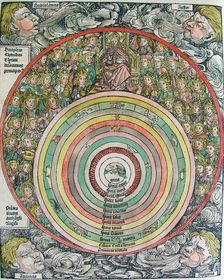
- The theory of the universe was of great
- importance to Shakespeares contemporaries and was used by him in
- developing events in his plays. According to this idea:
- everything in the world has its position fixed by God
- Earth = center of the universe. Stars move around it
- God is the head of everything
- everything in the world has its order
- Society reflected this order with fixed classes from highest to lowest – kings, churchmen, nobles, merchants and peasants.
- The animals had their own degrees too, lion = “king”.
- Plant life and minerals, too. Among flowers, it was the rose.
- Any break in the chain (such as killing the king) ensured chaos
- Fate = main controlling force in life. Ups & downs
- The Elizabethans called this hierarchical structure The Great Chain of Being
-
Theatre in the Shakespearan Era
- Theatre was of a very specific kind back in Shakespeares days. Here are the main characteristics:
- one of the most common form of mass entertainment
- people of all classes went to the theatre
- beautiful costumes and (sometimes) funny language
- most people stood in front of the stage (was cheaper)
- audience often took part in the performance: screamed, booed, cheered, helped
- stage: right in the middle of the audience
- actors were only male
- female parts were played by adolescent boys in women's costume
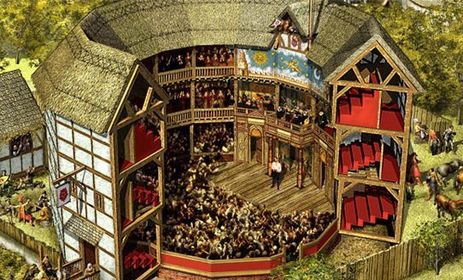
- Pie de imagen: The Rose Theatre
-
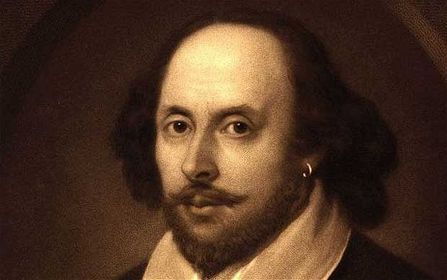
- Shakespeare is the greatest author of the Elitabethan age, if not the most important English author of all times. His works inspired hundreds of directors, films and writers. Even today in England you can hardly call yourself a good actor without having participated in a Shakespeare play.
- Private life: William Shakespeare was born in
- Stratford-upon-Avon, England, in 1564. He most likely
- attended King Edward VI Grammar
- School in Stratford, where he learned
- Latin grammar and literature. In 1582,
- he marriedAnne Hathaway at
- the age of 18 and had three children together.
- First plays: Between 1589 and 1590, William is
- believed to have written his first
- play, Henry VIII (part I). The next
- year, he completed the second part
- of the play.
- By 1592, William had begun a career
- as a playwright in London. Two
- years later, he was an actor and
- part-owner of a playwright company,
- Lord Chamberlain’s Men. The company
- was successful and was adopted by King
- James I. It was then renamed The King’s
- Men. By this time, William was
- well-known throughout the London theatre
- world.
- In 1595, William
- wrote some of his most famous
- stories including A "Midsummer’s Night Dream" and "Romeo and Juliet", which
- is arguably the most famous love
- story and tragedy of all time. In
- 1596, William wrote "The Merchant of Venice".
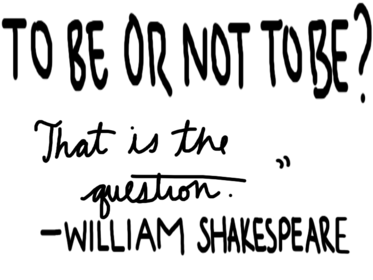
- Later works: After writing "Julius Caesar" in 1599, Shakespeare is thought to have written "Hamlet",
- historically thought of as his greatest
- masterpiece. To this day "Hamlet" is probably his
- most quoted and reproduced tragedy.
- It is also Shakespeare’s longest
- play.
- In general: Concerning Shakespeares work you have to differ between the "early
- plays", for example "Romeo and Juliet" or "Henry V", and the "great
- tragedies", which he created later on. The latter he wrote between 1599
- and 1606 and include „Othello“, „Macbeth“, „King Lear“ und „Timon of
- Athens“.He also wrote 154 sonetts during his life.
-
- This drama is one of the great tragedy themed plays by William
- Shakespeare. The themes illustrated include ambition, fate,
- deception and treachery.
- Three witches decide to confront the great
- Scottish general Macbeth on his victorious return from a war between
- Scotland and Norway. The Scottish king, Duncan, decides that he will
- confer the title of the traitorous Cawdor on the heroic Macbeth.
- Macbeth, and another General called Banquo, happen upon the three
- witches. The witches predict that he will one day become king. He
- decides that he will murder Duncan. Macbeth's wife agrees to his plan.
- He then murders Duncan assisted by his wife. The crown passes to Macbeth. More murders ensue and the bloodied
- ghost of Banquo appears to Macbeth. Lady Macbeth's conscience now
- begins to torture her and she imagines that she can see her hands
- covered with blood. She commits suicide. Macduff kills Macbeth. Malcolm becomes king.
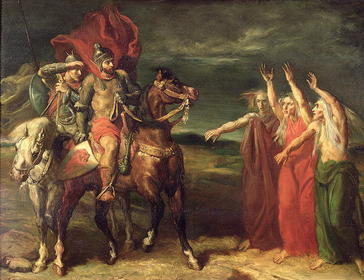
- Pie de imagen: Macbeth and the three witches
-
- Old Hamlet, King of Denmark, is dead and has been succeeded by his
- brother. The new king has also married Gertrude, the widowed queen.
- Hamlet, Gertrude's son, is already distressed by his father's death and
- the hasty remarriage; when his father's ghost appears to tell him that
- he was murdered by his own brother, Hamlet vows revenge.
- To cover his
- intentions, he feigns madness. Polonius, councillor to the court, whose
- daughter Ophelia is all but betrothed to Hamlet, believes that his
- madness is caused by love. Spied on by Polonius and the king, Hamlet
- encounters Ophelia and violently rejects her.
- Hamlet asks a group of actors to perform a play, hoping that its
- similarity to the murder of his own father will force the king to reveal
- his guilt. Hamlet's suspicions are confirmed. He visits his mother,
- reviling her for her hasty marriage, and accidentally kills Polonius,
- who is hiding in the chamber.
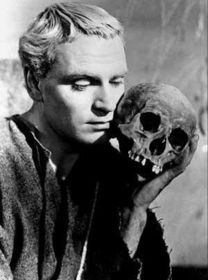
- Pie de imagen: Hamlet
-
- The king sends Hamlet to England, planning
- to have him murdered. Laertes, Polonius' son, demands revenge for his
- father's death. His sister, Ophelia, maddened by grief, has drowned.
- Hamlet returns and confronts Laertes at her funeral. The king,
- meanwhile, has plotted with Laertes to kill Hamlet in a fencing match in
- which Laertes will have a poisoned sword. The plot miscarries and
- Laertes dies. Gertrude drinks from a poisoned cup intended for Hamlet,
- and also dies. Hamlet, wounded by the poisoned sword, kills the king
- before he, too, dies. Young Fortinbras of Norway arrives and lays claim
- to the throne of Denmark.
Información
- Descripción
- Alles Wichtige rund um Shakespeare und sein Zeitalter.
- Creado por
- Usuario eliminado · sep 2016
- Actualizado
- 5 ene 2017
- Visitas
- 82
- Etiquetas
- Historial
-
- Creado por Laura Overhoff · 18 ene 2016
- Copiado por Andreas Fritsch · 18 ene 2016
- Copiado por Paula Raithel · 28 sep 2016
- Valoración