
Test
Solar System Quiz
Este test tiene tipos de pregunta que se abren en el reproductor de siempre.
Preguntas del test (21)
1The [blank_start]solar[blank_end] system has the star called the Sun at its center. It includes all the objects which travel around the sun in paths called orbits. These objects are different sizes and have different paths.
[blank_start]Planets[blank_end] - eight spherical planets travel around the Sun in near-circular orbits.
[blank_start]Dwarf Planets[blank_end] - the five known dwarf planets are much smaller than planets. They also travel around the sun in near-circular orbits.
[blank_start]Asteroids[blank_end] - these are lumpy rocks in near circular orbits.
[blank_start]Comets[blank_end] - these objects have very elongated orbits that stretch far away from the Sun and yet may also approach very near to it.
[blank_start]Moons[blank_end] - these are balls of rock that orbit a planet in near-circular orbits.- APlanets
- BDwarf Planets
- CAsteroids
- DComets
- EMoons
- Fsolar
2Choose the correct size order of the objects in the solar system, from largest to smallest.
- ASun, Planets, Dwarf planets, comets, asteroids, moons
- BSun, comets, planets, dwarf planets, moons, asteroids
3Distances in space are usually measured in....
- Alight years
- Bsun years
- Ckilometres
4Why might some stars seem to be brighter than others?
- AThese stars actually are brighter.
- BBecause they are closer than the other stars.
5How bright a star appears to be is called real brightness.
- AVerdadero
- BFalso
6An astronomer measures the distance to an object in space as about 100 light-years. The distance from the Sun to the nearest neighbouring star is about 4 light-years.
Which statement best describes the position of the object?- Aas far as very distant galaxies.
- Boutside the Milky Way, but not as far as nearby galaxies.
- Coutside the solar system but inside the Milky Way galaxy.
- Doutside the solar system but closer than the nearest stars.
- Einside the solar system.
7Why do space-based telescopes help us to make more accurate measurements?
- AThey are not affected by light pollution from cities and towns.
- BThey are closer to the stars.
- CThey would not be obscured by clouds, mist and fog in the Earth's atmosphere.
8As the Earth moves around the [blank_start]Sun[blank_end], we look at nearby stars from a different [blank_start]angle[blank_end]. The nearby star seems to stay in the same place, while the stars behind it seem to [blank_start]change[blank_end] their position. This [blank_start]parallax[blank_end] is used to measure the distances to nearby stars.
If an object is nearby, the parallax is [blank_start]greater[blank_end]. if it is further away, the parallax is [blank_start]smaller[blank_end].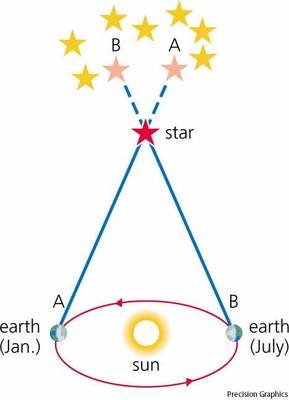
- ASun
- Bangle
- Cchange
- Dparallax
- Egreater
- Fsmaller
9Why is it hard to be sure that parallax measurements are correct?
- AIt is hard to get enough light from dim stars and galaxies.
- BAt long distances, parallax angles are too tiny to measure accurately.
- CWe are not making direct measurements.
- DAll of the above.
- ENone of the above.
10Very large stars end their life in a massive explosion - a supernova. The energy involved is huge and spreads particles throughout space. These particles include all the elements found on Earth. Some of these elements formed during the star's lifetime, while others formed during the explosion.
- AVerdadero
- BFalso
11The light and heat received from the Sun is a product of what process?
- ANuclear (hydrogen) fusion
- BNuclear fission
12Red light has a [blank_start]longer[blank_end] wavelength than blue light. This change in colour is caused by the [blank_start]stretching[blank_end] of light waves, and is called the [blank_start]redshift[blank_end]. Light from nearly all galaxies is redshifted. Light from galaxies further away from us have a [blank_start]greater[blank_end] redshift. The amount of redshift depends on the [blank_start]speed[blank_end] at which the galaxy is moving away. The further away a galaxy is, the faster it moves away from us.
Since we cannot assume that we have a special place in the Universe, this is evidence for a generally [blank_start]expanding[blank_end] universe. It suggests that everything is moving away from everything else, like the [blank_start]surface[blank_end] of a balloon as it is inflated.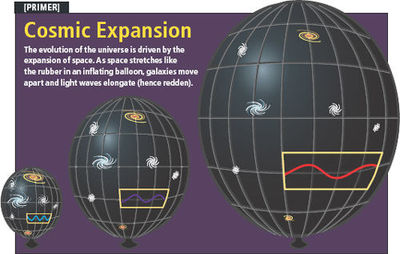
- Alonger
- Bstretching
- Credshift
- Dgreater
- Espeed
- Fexpanding
- Gsurface
13Erosion of rock can be caused by...
- Amoving water
- Bglaciers
- Canimals
- Dthe wind
- Egravity
- Fair pressure
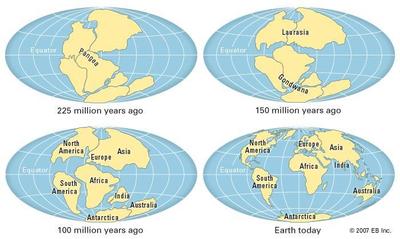
14Alfred Wegener suggested that the [blank_start]continents[blank_end] were joined to each other in the pat and drifted apart over [blank_start]millions[blank_end] of years. He said that the [blank_start]shapes[blank_end] of the continents looked as if they could interlock, that similar [blank_start]fossils[blank_end] and rock types were found on continents separated by [blank_start]oceans[blank_end], and that mountain chains made from similar rocks appeared on the edges of [blank_start]different[blank_end] continents.
- Acontinents
- Bmillions
- Cshapes
- Dfossils
- Eoceans
- Fdifferent
15Scientists at the time did not support Wegener's theory.
- AVerdadero
- BFalso
16In the centres of many oceans, there are mid-ocean [blank_start]ridges[blank_end]. At these places, the [blank_start]tectonic[blank_end] plates are moving apart. Molten material, known as [blank_start]magma[blank_end] from inside the Earth oozes out and solidifies. This movement of the mantle is referred to as [blank_start]convection[blank_end] due to heating by the core of the Earth. This process is called seafloor [blank_start]spreading[blank_end]. The typical speed of seafloor spreading is [blank_start]slow[blank_end]: about 10 cm per year. When the magma oozing out of mid-ocean ridges solidifies into rock, the rock records the [blank_start]direction[blank_end] of the Earth’s magnetic field. The Earth’s magnetic field changes with time, and sometimes even [blank_start]reverses[blank_end] its direction. These changes are [blank_start]recorded[blank_end] in the rocks. The same [blank_start]magnetic patterns[blank_end] are seen on both sides of the mid-ocean ridges.
- Aridges
- Btectonic
- Cmagma
- Dconvection
- Espreading
- Fslow
- Gdirection
- Hreverses
- Irecorded
- Jmagnetic patterns
17Volcanoes, mountains and earthquakes occur at the edges of tectonic plates - their creation depends on the direction the plates are moving.
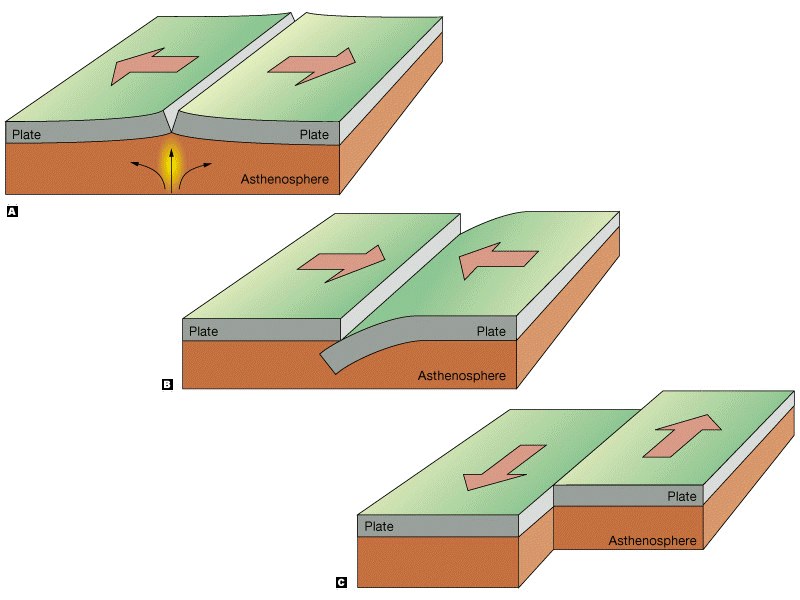
- APlates are moving apart, magma escapes.
- BPlates move together, one is forced down
- CVolcanoes produced.
- DMountains (sometimes volcanoes) form.
- EPlates slide against each other suddenly
- FEnergy is released, earthquakes occur
18Information from earthquake waves can be used to find out about the structure of the Earth.
S-waves can only travel through solids
P-waves can travel through both solids and liquids
What conclusions can you draw from the evidence?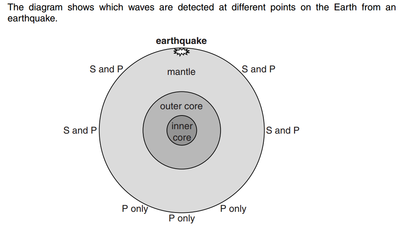
- Athe crust is solid
- Bthe crust is liquid
- Cthe mantle is solid
- Dthe mantle is liquid
- Ethe outer core is solid
- Fthe outer core is liquid
- Gyou cannot tell about the outer core
- Hthe inner core is solid
- Ithe inner core is liquid
- Jyou cannot tell about the inner core
19P-waves are transverse waves while S-waves are longitudinal waves.
- AVerdadero
- BFalso
20Label the diagram of a wave.
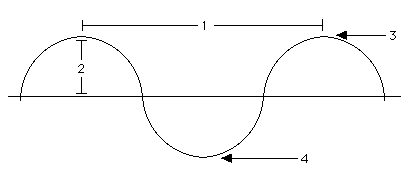
- Awavelength
- Bamplitude
- Cpeak/crest
- Dtrough
21Wavelength is inversely proportional to the frequency of any wave.
- AVerdadero
- BFalso
Información
- Descripción
- El usuario ha eliminado su información de asignaturas Test sobre Solar System Quiz, creado por Usuario eliminado el 04/10/2016.
- Autor
- Usuario eliminado
- Idioma
- English
- Visitas
- 79
- Historial
- Creado el 4 oct 2016 · actualizado el 15 mar 2019
- Etiquetas