
Mapa mental
OCR Chemistry - F322 - Module 1 (In progress)
Contenido del mapa
OCR Chemistry - F322 - Module 1 (In progress)
Organic Chemisrty
- Organic chemistry involves hydrocarbons as they play a huge roll in organic matter and life.
- Important definitions
- Key definitions, common easy mark questions.
- Homologous series
- A homologous series is a family of compounds that contain the same functional group with similar chemical properties. The next successive member will differ by 1 carbon and 2 hydrogen.
- Saturated/unsaturated
- A saturated hydrocarbon have only single bonds so is harder to react with. Unsaturated hydrocarbons have a carbon-carbon double bond, which is more reactive.
- Aliphatic/alicyclic
- There are 2 kinds of structure of hydrocarbons: Aliphatic are straight and branch chained hydrocarbons. Alicyclic are hydrocarbons that join to from a ring shape
- A Hydrocarbon
- A compound made of Hydrogen and carbon ONLY.
Nomenclature
- Nomenclature is the system for the naming of compounds
- Functional groups
- The different variations in the hydrocarbons, the suffix. The group of atoms that give a compound a characteristic set of reactions
- Alkane
- Alkene
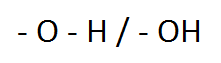
- Alcohol
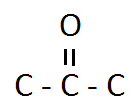
- Ketone
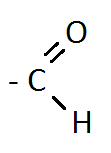
- Aldehyde
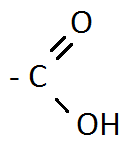
- Carboxylic acid
- The chain length
- The first stems of the names of the first 10 hydrocarbons
- Meth-
- 1 carbon
- Eth-
- 2 carbons
- Prop-
- 3 carbons
- But-
- 4 carbons
- Pent-
- 5 carbons
- Hex-
- 6 carbons
- Hept-
- 7 carbons
- Oct-
- 8 carbons
- Non-
- 9 carbons
- Dec-
- 10 carbons
- How its done
- The steps to name a hydrocarbon are: 1- count how many carbons there are. 2-determine the functional group 3- determine which carbon it is attached to in the chain (count from the shortest side) Each step or part of the name can be broken up by dashed, shown in the examples
- Must remember to state where the branches and functional groups are
- Examples
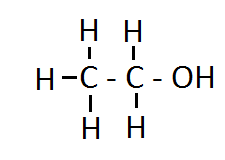
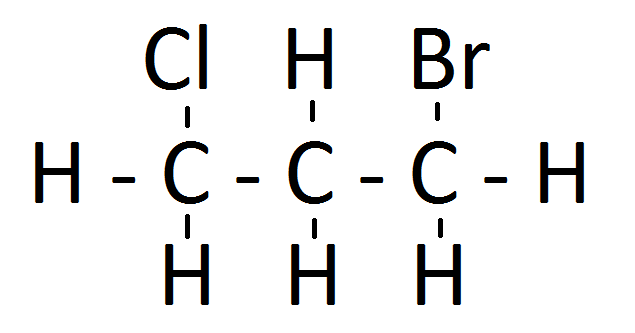
- This is called Ethan-1-ol. Stating where the functional group is not necessary as it would be ethan-1-ol on either side.
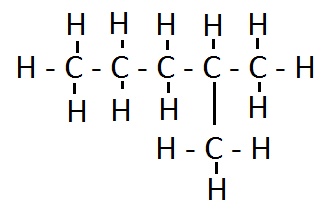
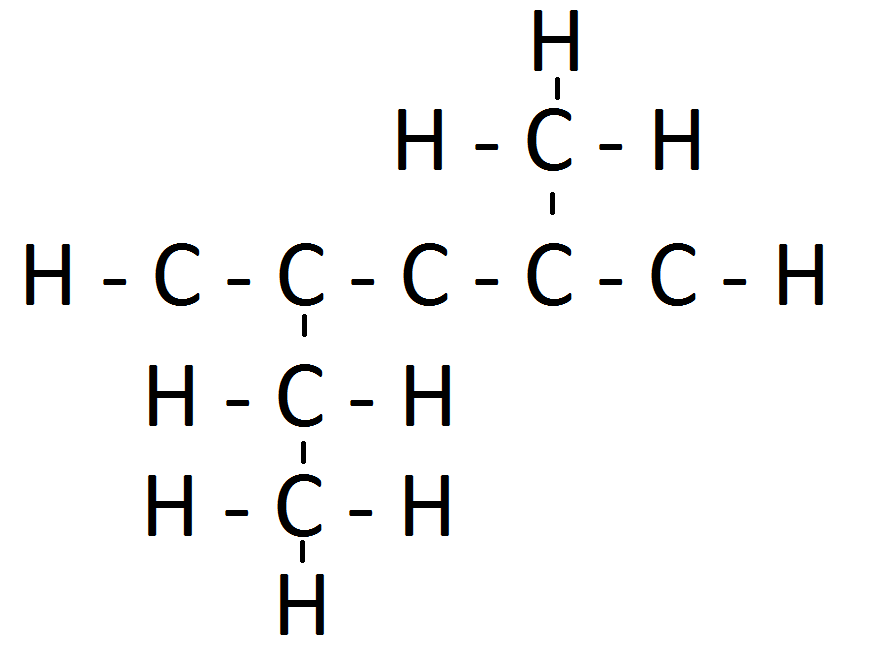
- This molecule is called 2-methylpentane. Branches also have to be named, they are simple the number of carbons-yl before the main chain e.g. 3-pentyldecane will have a branch of 5 carbons attached to the 3rd carbon of a chain 10 carbons long.
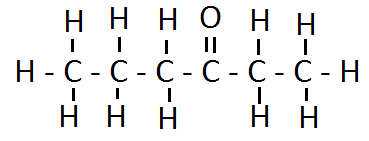
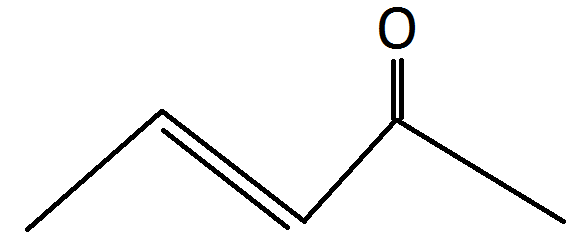
- This is Hex-3-one. It would not be called Hex-4-one as 3 is smaller than 4.
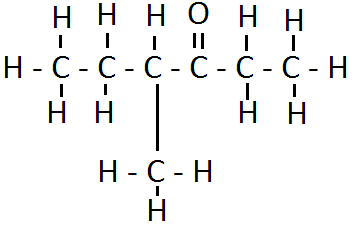
- Some molecules can have multiple parts on it. For example. this is 3-methylhex-4-ol
- Some molecule can have more than one functional group, e.g. multiple halogens attached. In that case, name the halogens in alphabetical order.
- Some molecules can have the same branch in multiple places, in that case, state where both are by saying E.g. 3,4 (separate them with a comma)
Formulae
- Empirical
- The smallest possible whole number ratio from a molecule
- Molecular
- Every atom in a molecule is represented (actual number of atoms per molecule)
- General
- The simplest algebraic formula of a homogolous series e.g. alkenes CnH2n Alkenes CnH2n+2 Alcohols CnH2n+1OH
- Displayed
- Drawn formula showing which atoms are bonded to which. Show relative positioning of every atom in a molecule
- Structural
- Minimum detail for arranging of atoms in a molecule. E.g. CH3CH2CH3 (propane) CH2=CH2 (ethene) CH3CH(CH3)CH3 (2-methylpropane)
- Skeletal
- Simplified formula showing the carbon skeleton with functional groups only.
- Methane
- Showing functional groups and double bonds
- Empirical
Isomerism
- For molecules to be isomers, they need to have the same molecular formula but different structural arrangement.
- Sterioisomers have the same structural formula and a different spatial arrangement of atoms.
- Structural
- This is isomers caused by branching
- Functional group
- This is caused by isomers having different functional groups
- Positional
- This is caused by the functional group being in different locations
- Stereoisomers
- Compounds with the same structural formula but different arrangement of atoms in space
- E/Z
- Different groups are attached to both the carbon in the double bond Z- group on same side E - Group on different side
- E/Z Isomers are possible due to the double bond restricting rotation of molecules
- Trans/cis
- To be classes as a trans/cis isomer, there needs to be a H and a non-H group attached to both the Cs in the double bond. Trans- Different side Cis - Same side
- Trans/cis Isomers are possible due to the double bond restricting rotation of molecules
Organic reactions
- Fission
- The breaking of bonds
- Homolytic
- When a bond breaks and the 2 atoms have the same charge and an unpaired electron (Forming a radical)
- Hetrolytic
- When a colalent bond breaks and each of the bonded electrons go to a single atom, the charge is different, one is negative and one is positive (an anion and cation)
- Nucleofile
- A reactant that attacks an electron deficient atom where it donates a pair of electrons to make a new covalent bond.
- Electrofile
- A reactant that attacks an area of high electron density, accepting a lone par of electrons. These are often positive ions or partial charges. E.g. H+, NO2+, HBr
- Addition
- 2 reactants become 1 product
- Substitution
- 2 reactant become 2 product (atoms are replaced)
- Elimination
- 1 reactant becomes 2 products (this is from a saturated molecule forming an unsaturated molecule)
- Fission
Crude oil
- Fractional distilation
- Crude oil is separated with fractional distillation, this is due to different molecules having different boiling point
- Hydrocarbons
- Fuels
- Cracking
- Turning a large molecule into smaller molecules, 1 saturated and 1 unsaturated.
- A large number of products are formed due to the fact any carbon - carbon bond can break
- Cyclic
- Cyclic hydrocarbons are produced because they promote efficient combustion and increase the octane number
- Improving
- Adding branched and cyclic hydrocarbons improve the octane rating meaning the fuel burns more efficiently
- Cracking
- Boiling point
- VAN DER WAALS
- Branching
- The more branched a molecule, the more exposed the bonds are to heat, this reduces the boiling point
- Chain length
- The longer the chain the more contact there is between molecules so the intermolecular forces are stronger, raising the boiling point
- Fuels
- Uses
- Economic
- Global warming
- For the future
- Fractional distilation
Alkenes
- The double bond
- Shape
- Cyclic
- Reactions
Mechanisms
- Free radical substitution
- 1. Initiation
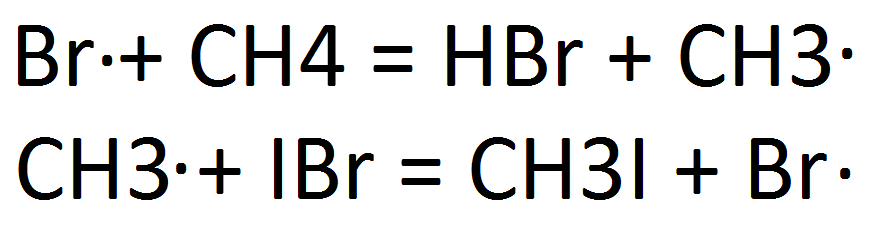
- Conditions needed are UV light to create the radials, this is homolytic fission
- 2. Propagation
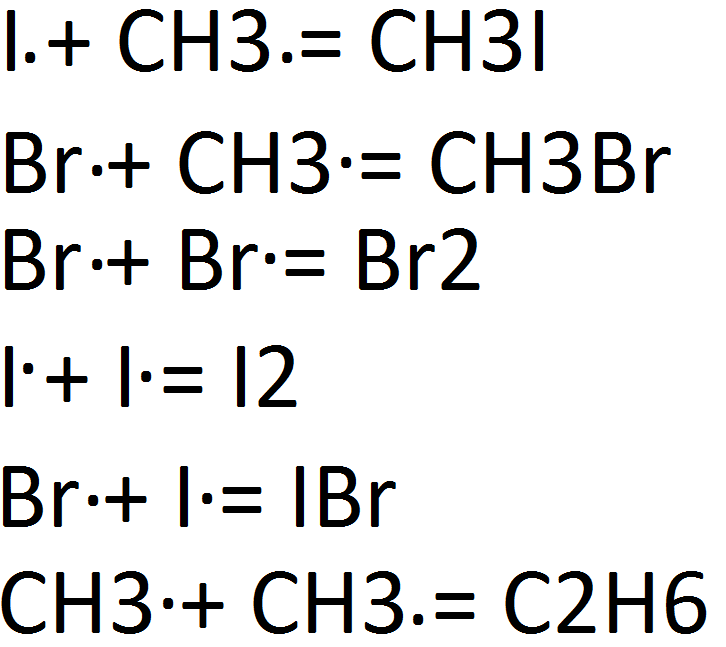
- 3. Termination
- 3. Termination
- Radicals
- A highly reactive atom as it has an unpaired electron in its outer shell
- 1. Initiation
- Addition reactions
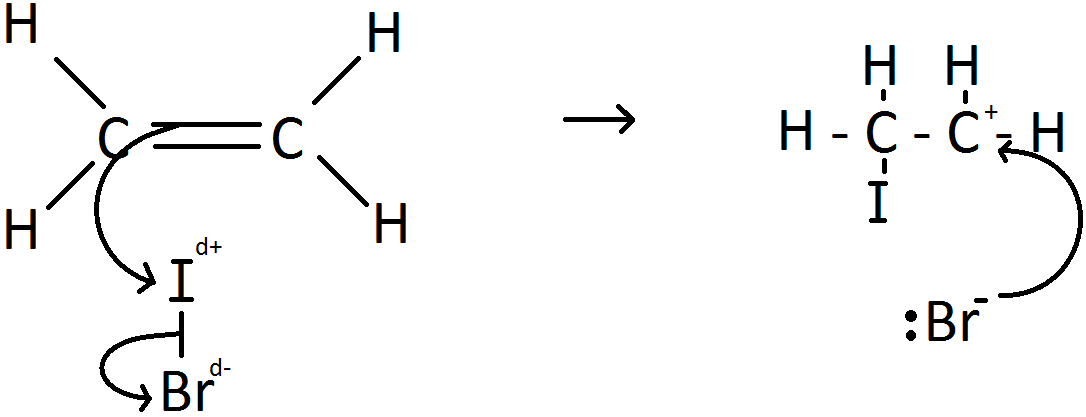
- This is electrophilic addition. Electophilc as it is a high electron density of the double bond and addition due to 2 reactants and 1 product
- There are 2 product that can be formed, a minor and a major, it depends what arrangement the I and Br are.
- Substitution
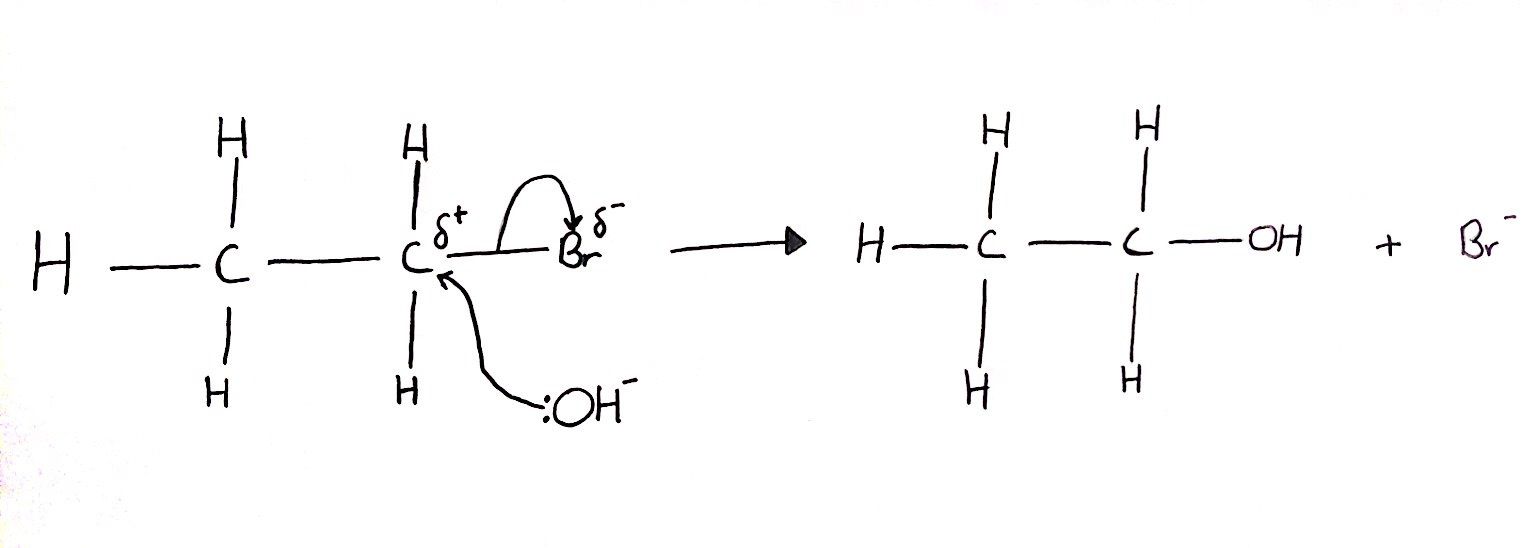
- This is nucleophilic substitution. The OH comes from a hot molecule such as KOH
- The reactivity of different halogens in this reaction will be due to down the group being easier to break the bonds, meaning it is more reactive down the group.
- Free radical substitution
Polymers
- Making
- Waste
- Uses
- Reduction
- Removal
Imágenes y archivos del mapa




Información
- Descripción
- El usuario ha eliminado su información de asignaturas Mapa Mental sobre OCR Chemistry - F322 - Module 1 (In progress), creado por Usuario eliminado el 30/11/2016.
- Creado por
- Usuario eliminado · nov 2016
- Actualizado
- 17 ene 2017
- Visitas
- 46
- Etiquetas
- Historial
-
- Creado por jacob gray · 14 mar 2015
- Copiado por Tariq hudda · 30 nov 2016
- Valoración