
BIO - S1 - Biological Molecules
Diapositivas del conjunto (11)
-
- Evidence for Evolution --> All organisms share the same biochemistry. They all contain the same groups of carbon-based compounds that interact in similar ways - e.g they use the same nucleic acids (DNA and RNA) as genetic material and the same amino acids to built proteins. This provides indirect evidence for evolution.
- Monomers and Polymers
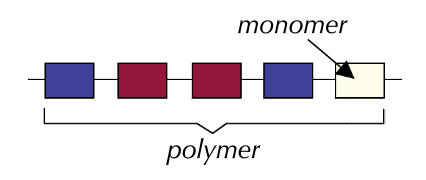
- Polymers are large, complex molecules composed of long chains of monomers joined together.
-
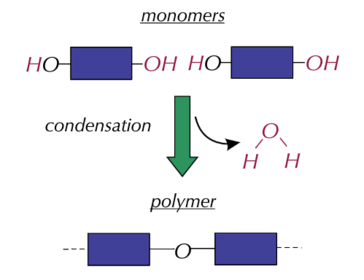
- Biological polymers are formed from their monomers by condensation reactions.
- A condensation reaction forms a chmical bond between monomers, releasing a molecule of water.
-
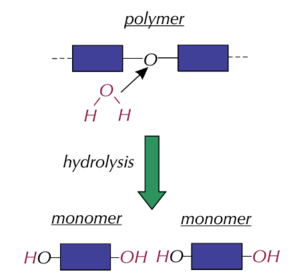
- Biologycal polymers can be broken down into monomers by hydrolysis reactions
- A hydrolysis reaction breaks the chemical bond between monomers using a water molecule
-
- All carbohydrates contain the elements C, H and O
- The monomers that carbohydrates are made from are monosaccharides - glucose, fructose and galactose
- Glucose is a hexose sugar - a monosaccharide with six carbon atoms in each molecules
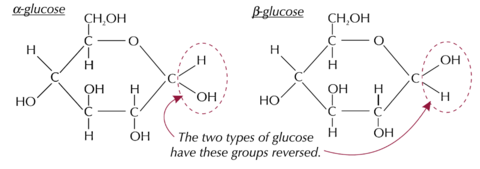
- Types of glucose --> alpha glucose and beta glucose
- They are isomers --> molecules with the same molecular formula as each other, but with the atoms connected in a different way
- Pie de imagen: Monosaccharides
-
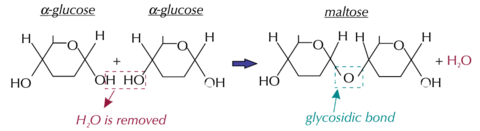
- A disaccharide is formed when two monosaccharides join together
- They join together by a condensation reactions
- A glycosidic bond forms between the two monosaccharides as a molecules of water is released.
- Glucose joined to fructose forms sucrose
- Glucose joined to galactose forms lactose
-
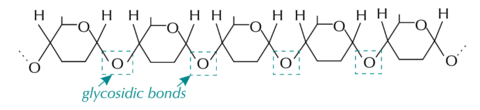
- A polysaccharide is formed when more than two monosaccharides are joined together by condensation reactions
- Polysaccharides can be broken down into monosaccharides by hydrolysis reactions.
-
1.4 Functions of Polysaccharides
- Starch
- Cells get energy from glucose
- Plants store excess glucose as starch
- starch is a mixture of two polysaccharides of alpha-glucose
- Is insoluble in water and does not affect the water potential, so it does not cause water to enter by osmosis --> this makes it good for storage
- Amylose
- Long, unbranched chain of alpha-glucose
- The angles of glycosidic bonds give it a coiled structure
- This makes it compact, so a lot of it can be stored
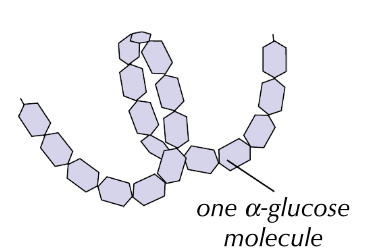
- Pie de imagen: Starch - Amylose
-
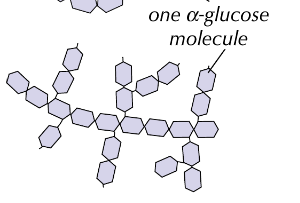
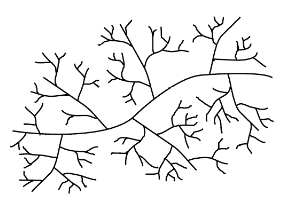
- Long, branched chain of alpha-glucose
- Its side branches allow the enzymes that break down the molecule to get at the glycosidic bonds easily
- This means that the glucose can be released quickly
-
- Animals store excess glucose as glycogen
- A polysaccharide of alpha-glucose
- Its strcture is very similar to amylopectin, except that it has loads more side branches coming off it
- Loads of branches means that stored glucose can be released quickly, which is important for energy release in animals
- It is a very compact molecule, so it is good for storage
-
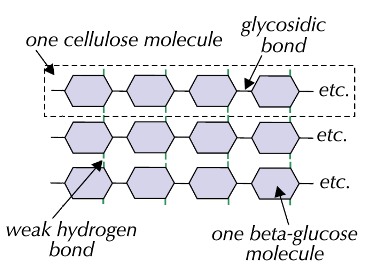
- Cellulose is made of long, unbranched chains of beta-glucose.
- When beta-glucose molecules bond, they form straight cellulose chains
- The cellulose chains are linked together by hydrogen bonds to form strong fibres called microfibrils
- The strong fibres mean cellulose provides structural support for cells
-
Información
- Descripción
- 1.1 Introduction to biological molecules 1.2 Carbohydrates and monosaccharides
- Creado por
- Usuario eliminado · feb 2017
- Actualizado
- 15 feb 2017
- Visitas
- 9
- Historial
-
- Creado por ashlycueva · 19 oct 2015
- Copiado por Elii Reboyo · 15 feb 2017
- Valoración