
Apuntes
Nano Technology
Contenido del apunte (1)
Página 1
Nanoparticles
Have at least one dimension in the range of 1-100nm.
The diameter is equivalent to the diameter of a soccer ball to that of the Earth's.
Exciting Innovations
Kalwall Nanogel - High light transmission, great insulation properties, waterproof and light (aerogel is 5% solid & 95% air)
Ultra-Ever Dry - a superhydrophobic (water) & oleo phobic coating that will completely repel almost any liquid. Proprietary Nanotechnology is used to coat an object and create a barrier of air on its surface. Also has vastly improved adhesions & abrasion resistance.
Other Functions of Nanotechnology
Flexible solar cells
Ground stabilisation
Corrosion resistant rebar - nanotechnology is used to manipulate the micro-structure of the steel to remove the carbides and ferrets that are responsible for corrosion.
Nano-electromechanical devices
Aerogel
Self-compacting concrete (SCC)
Self-healing concrete
Self-cleaning concrete
Flexible solar cells
Electrochomatic windows
Phase changing materials
Self-cleaning glass
Fire-resistant glass
High-performance translucent cladding
Super-insulation
High-strength welds
Vacuum insulation panels (VIP)
Nano-cement
Anti-graffiti paint
High-strength bolts
UPVC window protection - nanotechnology used to reduce UV damage and maintain the plastic used in the UPVC windows.
Growth in Nanotechnology
2006 saw 212 products with nanotechnology
2011 saw 521% increase from 212 to 1,317 nan-enabled products.
Largest product category for nanotechnology is health & fitness with 738 products.
Nanotechnology & Concrete
Nanotechnology provides improvements to concrete in the following areas:
Strength & Fracture Properties
Ultra-high compressive strength & improved tensile strength.
Controlled triggering of setting.
More efficient cement hydration.
Increased aggregate bond strength.
Control of cracks & self-healing.
Improvement in Ductility
Reduced permeability
Freeze/thaw resistant
Chloride/sulfate resistant
Volume Change Characteristics
Minimise shrinkage
Minimise pavement curling/warping
Sustainability & Safety
Self-cleaning/smog eating
Less CO2 emission clinkers
Longer life pavements/structures
Recycling concrete & using recycled components.
Sensing Technologies
Self-powered long last material based sensors, warning & communication systems.
Vibration harvesting for power.
Potential Health Hazards of Nanoparticles
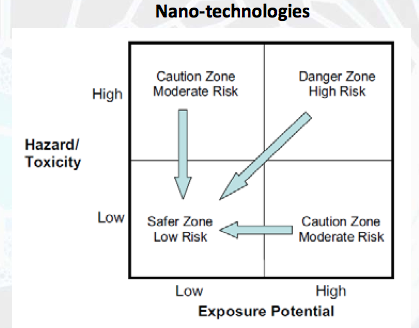
The exposure potential of a nano particles is dependent on:
Its bioavailability to humans through inhalation, ingestion & dermal pathways.
It's ability to accumulate, persist and translocate within the environment and human body.
Products containing hazardous nanoparticles can cause H&S risks through it's lifecycle, from material processing and transportation to use and disposal.
Problematic Nanoparticles are carbon nanotubes and quantum dots.
There is emerging evidence indicating exposure to some types of nano material can cause inflammation and fibrosis of the lungs or skin inflammation.
Insufficient data to confirm the health consequences and to understand the conditions that produce such effects.
Each nano particle is different, some are less harmful than others.
Zinc and Carbon Black have been identified as having detectable biological effects.
Silica nano particles have been found to exhibit size-dependent toxicity.
Methods of Exposure to Nanomaterials
Breathing
Swallowing
Eyes
Skin contact
How do Nano Particles Become Bio-Available?
The following downstream activities may release nano materials:
Bag dumping
Manual transfer between processes
Mixing or compounding
Powder sifting
Machining of parts that contain nano materials.
What Can We Do About Nano?
Keep researching
Clarify which are worse
Know how the particles are released
Develop methods of protection
Know which nano particles are in which components.
Tell people where they are.
The 5 Principles of Safer Nanotechnology
Size, surface and structure - key to how hazardous a particular nanotechnology is.
Alternative materials - replace the main material or nano with a less hazardous one.
Functionalisation - change or improve the bonding of the nano.
Encapsulation - enclose the nano within another material.
Reduce the quantity - use less of hazardous nano particles in materials.
Why isn't Nanotechnology Just Banned?
Nano particles exit in nature (e.g. bacteria)
Nano particles can be created from normal materials by traditional means (e.g. burning)
Nano is everywhere, it couldn't be banned even if it was wanted.
Nano particles are so small that they can't be seen, which is part of the worry.
The size isn't the only problem, it's their proportions.
Page 1
Images
Información
- Descripción
- Undergraduate Advanced Construction Apunte sobre Nano Technology, creado por d.moran-10 el 23/05/2014.
- Creado por
- d.moran-10 · may 2014
- Actualizado
- 6 abr 2018
- Visitas
- 72
- Valoración