
Functional Groups

Diapositivas del conjunto (9)
-
- "Alcohol" as we normally refer to it is in fact one member of a greater family of substances
- In organic chemistry, alcohols always end in -anol - so an alcohol with three carbons will be propanol, with one carbon will be methanol etc.
- Alcohols contain carbon and hydrogen, but also contain oxygen
- They have the general formula \(C_nH_{2n+1}OH\)
-
- Methanol, ethanol and propanol:
- ■ dissolve in water to form a neutral solution
- ■ react with sodium to produce hydrogen
- ■ burn in air
- ■Alcohols can be detected by a reaction with a solution of potassium dichromate (VI) mixed with sulfuric acid. This solution has an orange colour, but turns green in the presence of alcohol

- Pie de imagen: Ethanol burner
-
- Ethanol is widely used in alcoholic drinks
- Ethanol production is a massive industry but overconsumption of alcohol is one of the greatest health threats faced by our society
- Alcohol causes about 10% of the deaths and diseases in the UK
- Ethanol is also used as an industrial solvent and fuel
- Pie de imagen: Alcohol is a causal factor in more than 60 medical conditions, including various cancers, high blood pressure, cirrhosis of the liver and depression
-
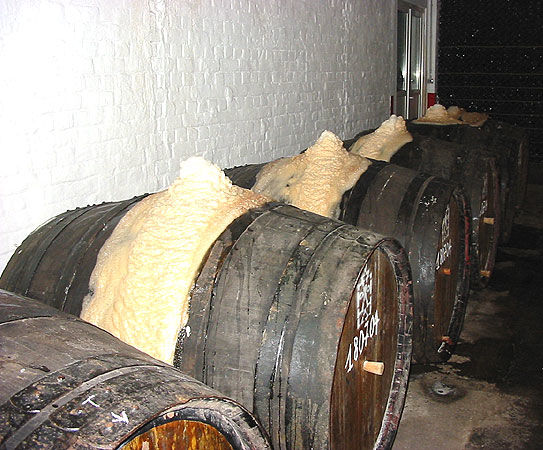
- The use of yeast to produce ethanol from a sugar called glucose
- \(C_6H_{12}O_6\rightarrow 2CO_2 + 2C_2H_5OH\)
- Glucose \(\rightarrow\) Carbon dioxide + Ethanol
- The reaction is catalysed by enzymes produced by yeast
- The temperature must be kept around 25-50'C
- Must be under anaerobic conditions - no oxygen
- Container must be sterile to keep microorganisms out
- Carbon dioxide must be allowed to escape to prevent the build up of pressure
-
- Advantages
- Renewable resource
- Emits less carbon dioxide than petrol
- Plants used to produce it use up carbon dioxide
- Produces less soot and carbon monoxide than petrol
- Disadvantages
- Less efficient than petrol
- Vehicle engines require modifications to use ethanol as fuel
- Large amounts of farmland required to produce the necessary crops
- Fossil fuels are used in the production of bioethanol, off setting the reduced emissions
-
- Carboxylic acids (containing the functional group -COOH) can be produced from ethanol
- Carboyxlic acids are named the same way as alcohols, but the suffix -anol is replaced by -anoic acid
- This is an oxidation reaction, carried out by microorganisms in aerobic conditions (oxygen is present) or by chemical oxidation
- If oxygen gets into a wine fermenter, the ethanol can be oxidised to produce ethanoic acid, which is also known as vinegar
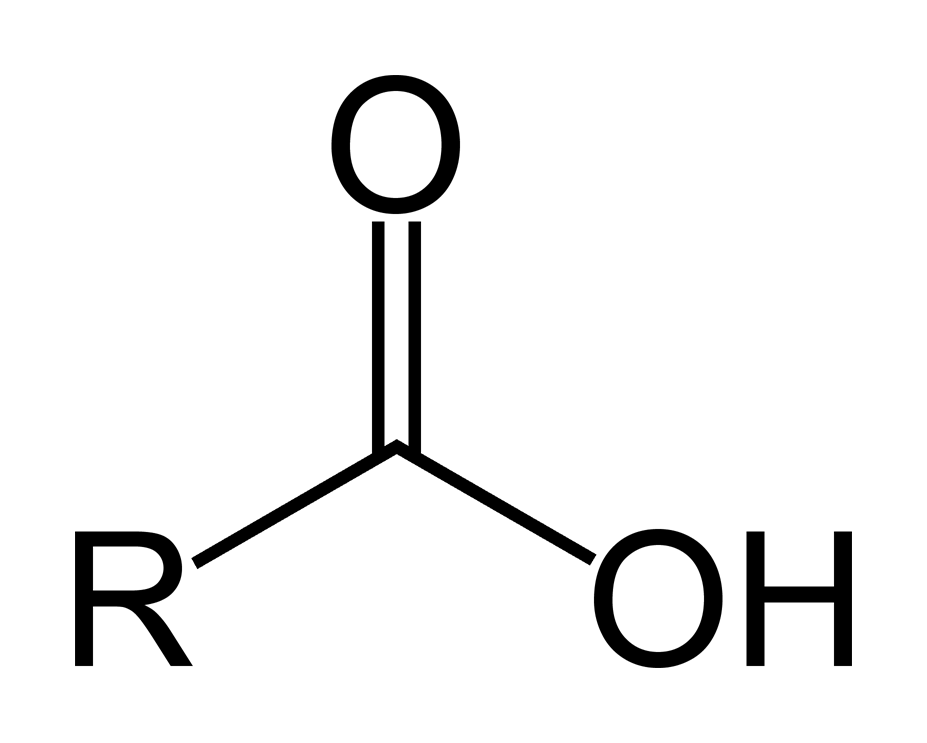
- Pie de imagen: Carboxylic acid functional group
-
Properties of Carboxylic Acids
- Carboxylic acids:
- ■ dissolve in water to produce acidic solutions
- ■ react with carbonates to produce carbon dioxide
- ■ react with alcohols in the presence of an acid catalyst to produce esters
- ■ do not ionise completely when dissolved in water and so are weak acids
- ■ aqueous solutions of weak acids have a higher pH value than aqueous solutions of strong acids with the same concentration
-
- Esters have the functional group -COO-
- Esters are formed when an alcohol is combined with a carboxylic acid
- Combining ethanol and ethanoic acid gives the ester ethyl ethanoate and water
- This process is known as esterification
- An ester will always have the name -yl-anoate - eg methylethanoate, butylmethanoate etc.
- (Note: You will not be expected to give the names of
- esters other than ethyl ethanoate, but should be able to
- recognise a compound as an ester from its name or its
- structural formula)
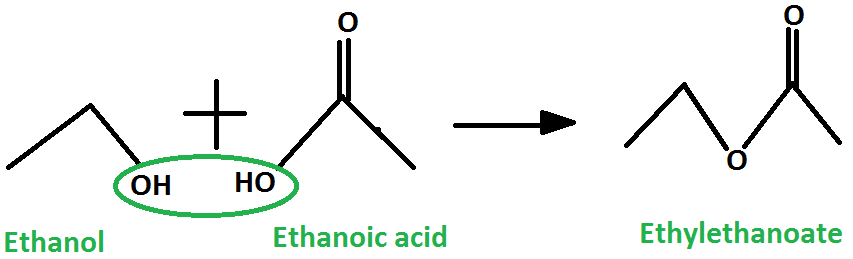
- Pie de imagen: Esterification
-
- Esters are volatile - this means they have a low boiling point .
- Esters are sweet smelling.
- They are used in perfumes and flavourings.

Información
- Descripción
- AQA Chem
- Creado por
- Usuario eliminado · jul 2017
- Actualizado
- 22 ago 2017
- Visitas
- 51
- Historial
-
- Creado por Niamh Ryan · 4 jul 2017
- Copiado por Niamh Ryan · 4 jul 2017
- Copiado por Niamh Ryan · 6 jul 2017
- Valoración