
Apuntes
Covalent bonding
Contenido del apunte (7)
Página 1
How Covalent Bonding Works
Covalent bonding: Involves the sharing of electrons
While ionic bonds are often formed beween metals and non-metals, covalent bonding usually involves non-metals bonding with non-metals.
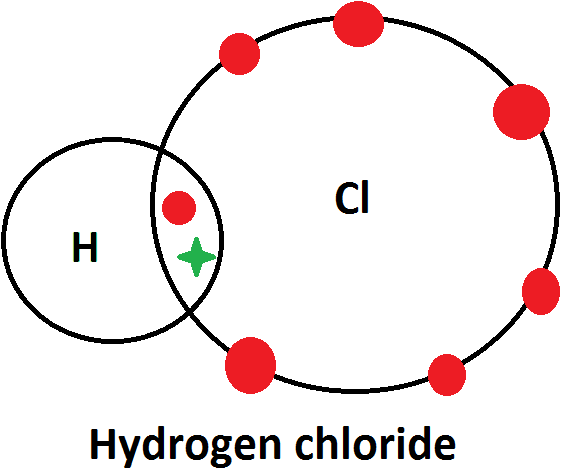
Just like in ionic bonding, when forming covalent bonds, atoms want to have a full outer shell. However, in this case instead of fully donating an electron, atoms share electrons in order to achieve the favourable electron configuration.
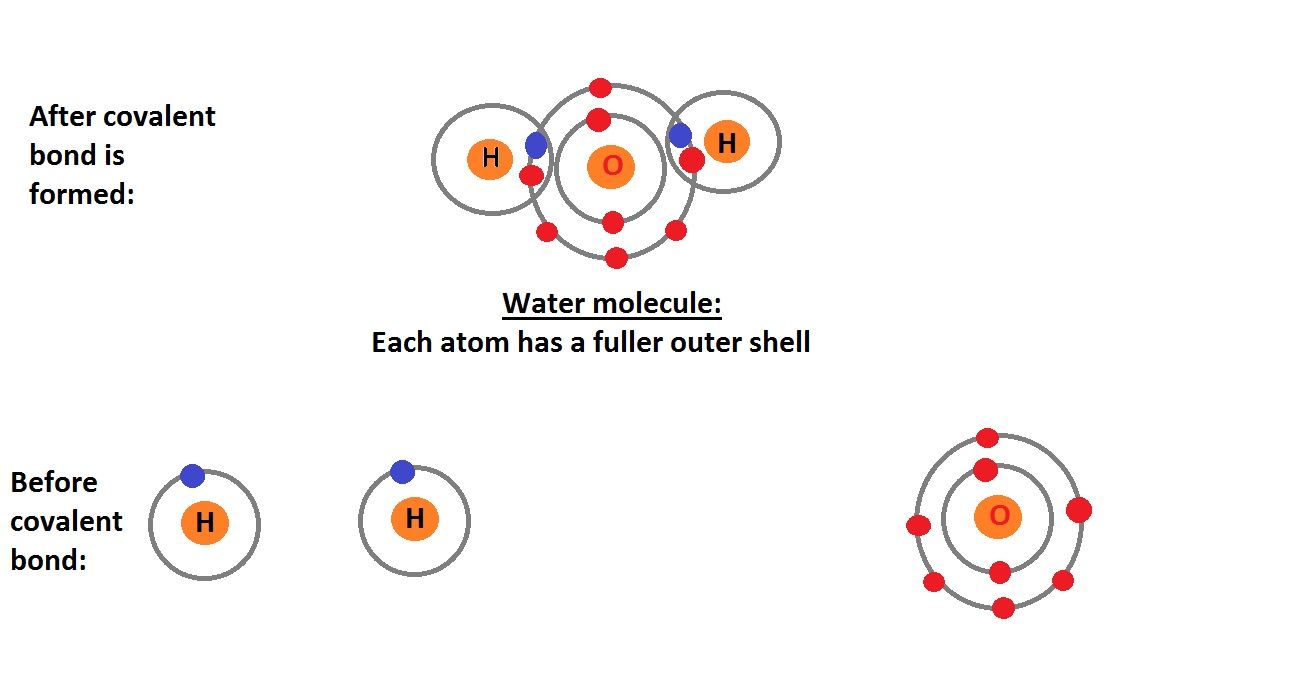
The diagram below shows the formation of covalent bonds between oxygen and hydrogen to form the molecule \(H_2O\), more commonly known as water
Both hydrogen atoms need to gain one electron to have a full outer shell. Oxygen needs to gain two electrons to have a full outer shell. When the covalent bond is formed, hydrogen has a full outer shell because it oxygen shares one of its electrons with each of the hydrogen atoms. Oxygen has a full shell because each hydrogen shares its electron with oxygen.
Note:
1. It is conventional when drawing covalent bonding diagrams such as the one shown above to use some notation to distinguish between electrons from different atoms. The example above uses different colours but dots and crosses are also often used. (You may hear these diagrams being referred to as "Dot and Cross Diagrams".) It's important to remember that, in reality, there is no difference between the electrons.
2. The diagram above shows all the shells of oxygen, for the sake of completeness. In practice, it is only necessary to draw the outer shells, as these are the ones involved in bonding.
Página 2
More Examples of Covalent Bonding
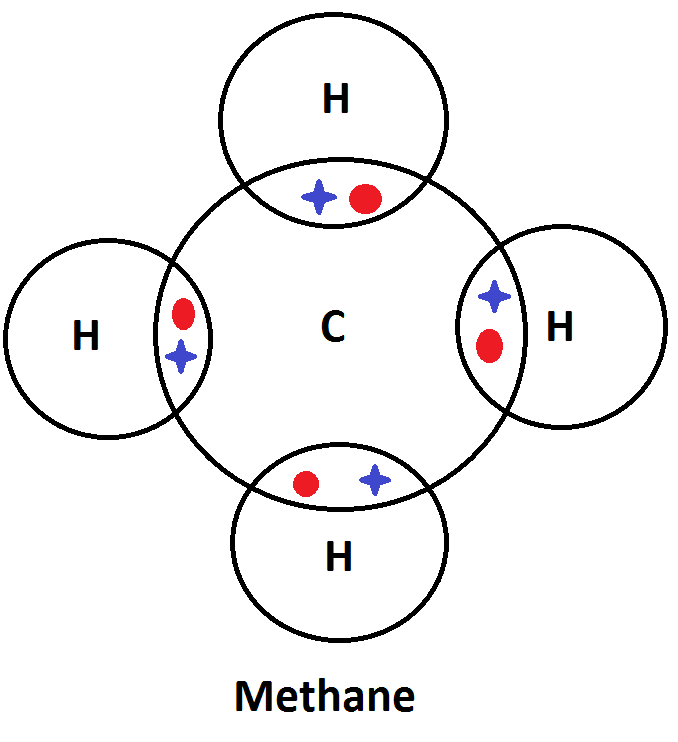
These molecules show only the valence (outer) shells of the atoms involved.
In methane, carbon forms four covalent bonds with different hydrogen atoms in order to achieve a full outer shell.
Página 3
Homoatomic molecules
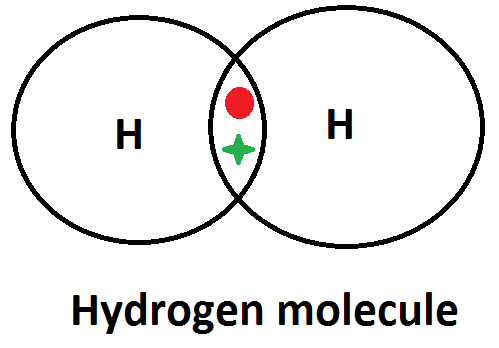
Elements such as hydrogen do not exist as individual atoms. Instead, they always form covalent bonds with each other in order to reach a more stable configuration. Hydrogen always exists as \(H_2\). Oxygen also forms a similar homoatomic molecule. (See next page)
Página 4
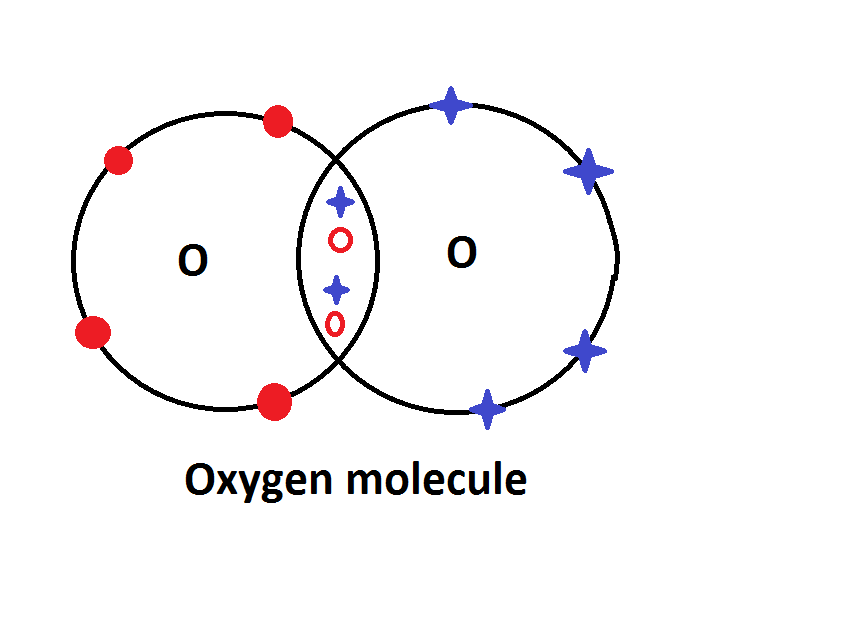
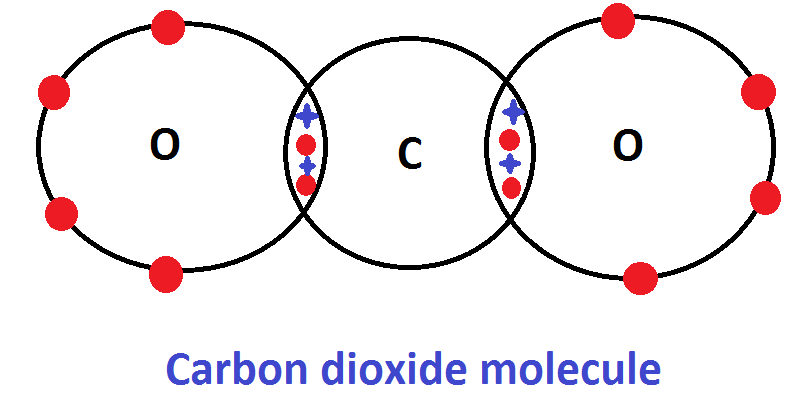
Double covalent bonds
Some atoms need two electrons in order to achieve a stable outer shell. In this case, atoms will form double covalent bonds, in which they share two electrons with a neighbouring atom.
Página 5
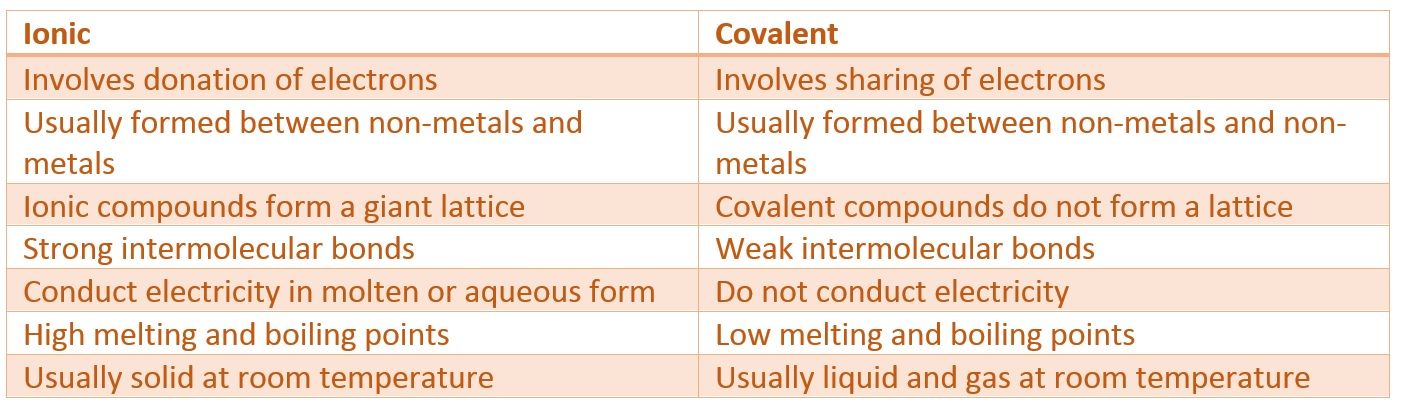
Differences between Ionic and Covalent Bonding

REMEMBER:
Water is commonly thought of as a good conductor of electricity. However, pure water is, in fact, a very poor conductor. It has no free electrons and does not form ions, so it contains nothing to carry charge. However, when there are ionic compounds dissolved in water, it can conduct electricity. The ions act as charge carriers to move current through the liquid. We rarely come across pure water in our everyday lives, and this is why we think of 'water' as a good conductor.
When covalent substances boil, it is not the bonds between atoms that break, but the bonds between molecules, i.e. steam is not composed of individual hydrogen and oxygen atoms, but simply \(H_2O\) molecules in the gas state.
Página 6
Giant Covalent Substances
Usually, covalent substances have low melting and boiling points.
However, some covalent substances have high melting and boiling points because they form a giant covalent structure.
These substances are, in effect, one large molecule.
Examples: Diamond, graphite, silica (found in sand)
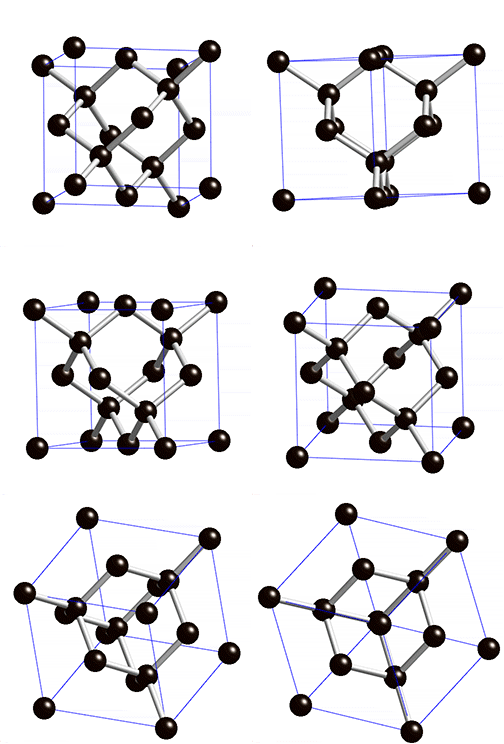
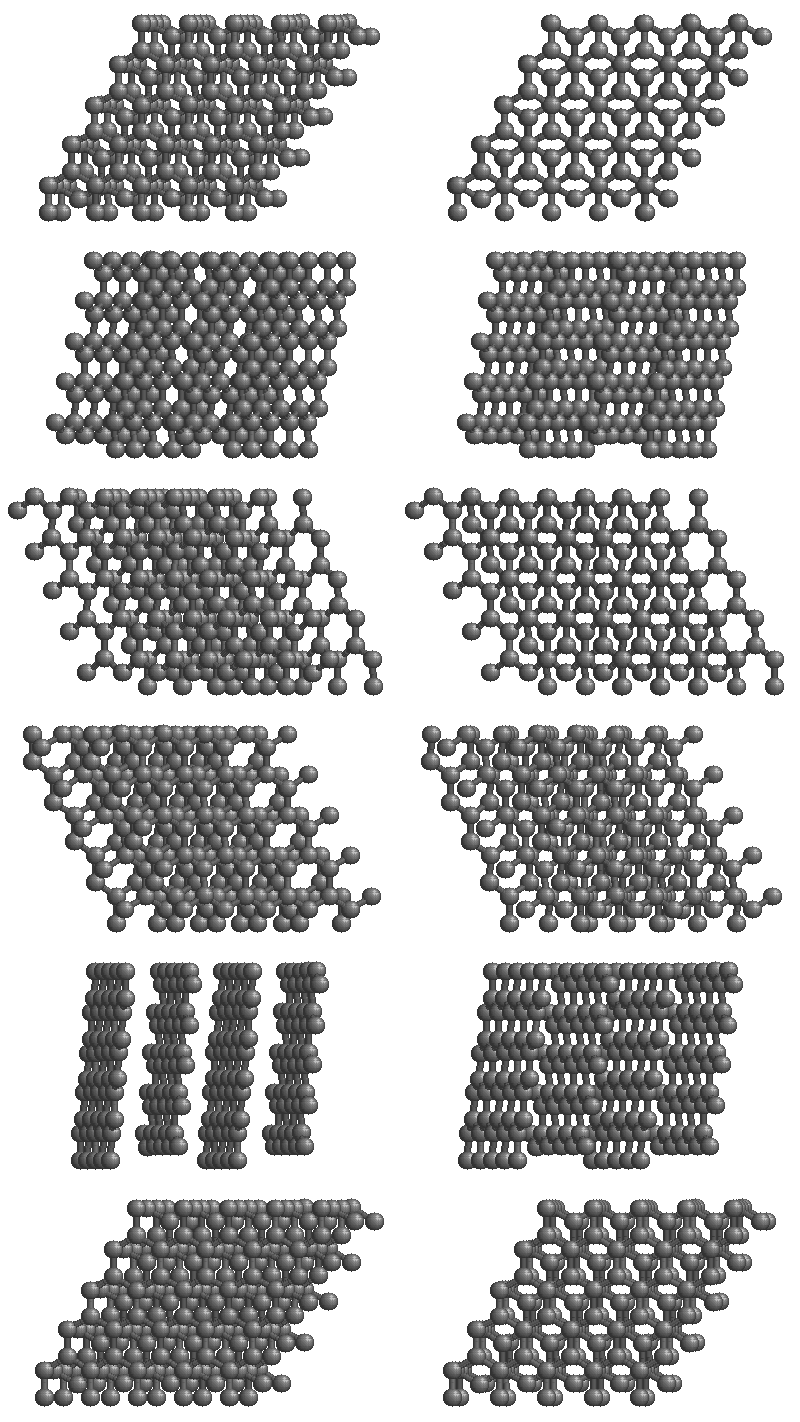
Diamond: Carbon atoms connected to four other carbon atoms by a strong covalent bond. This forms a tetrahedral unit cell. All four of carbon's electrons are involved in bonding with another carbon atom.
Graphite: Layers of carbon atoms, arranged in hexagonal rings. Strong covalent atoms between carbon atoms in rings, weak Van Der Waals forces between layers. Delocalised system of electrons between the layers
Diamond Unit Cell:
Graphite layers:
Página 7
Physical Properties of Diamond and Graphite
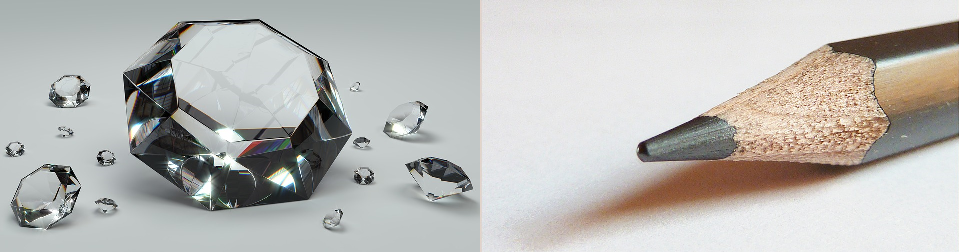
1. Appearance - Diamond is transparent and crystalline while graphite is a grey/black, shiny solid
2. Hardness - Diamond is extremely hard. It is often used in industry for cutting and in drill bits. Graphite is much softer - think how easy it is to break a pencil 'lead' Graphite is also used in lubricants for this reason. This is because of the weak bonding between layers in graphite. It is very easy for the layers to slide over each other.
3. Conduction of electricity - Diamond is an electrical insulator, while graphite is a conductor. Graphite is often used for electrodes in industrial processes. Electrons can easily move through the delocalised electron system in graphite, allowing charge to move through the material.
4. Melting point - Both have melting points over 3500°C. A lot of energy is needed to break down the strong carbon-carbon covalent bonds.
Información
- Descripción
- El usuario ha eliminado su información de asignaturas Apunte sobre Covalent bonding, creado por Usuario eliminado el 06/07/2017.
- Creado por
- Usuario eliminado · jul 2017
- Actualizado
- 28 ago 2017
- Visitas
- 25
- Historial
-
- Creado por Niamh Ryan · 5 jul 2017
- Copiado por Niamh Ryan · 6 jul 2017
- Valoración