
Ores and the Reactivity Series
Diapositivas del conjunto (4)
-
- Only six metals are found naturally in their pure form - gold, silver, platinum, mercury, platinum and iron
- These are the least reactive metals
- More reactive metals will be found in nature as part of a compound
- Usually they react with non-metals to form an ore.
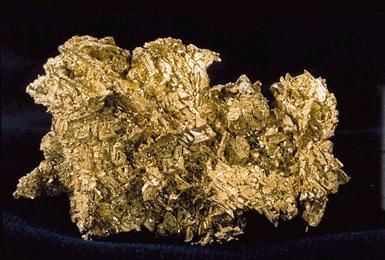
- Pie de imagen: Gold as it is found in its pure form
-
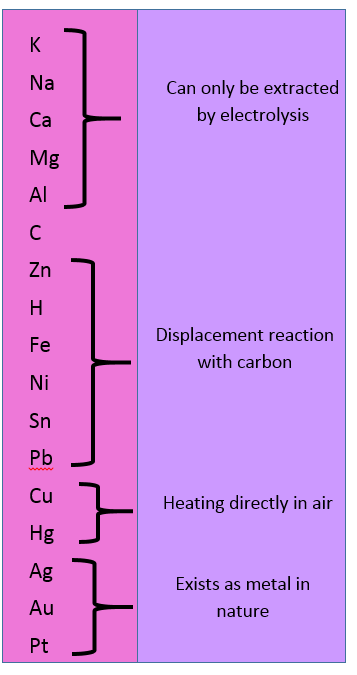
- The method of extraction required to obtain a pure sample from the ore depends on the reactivity of the metal in question.
- The reactivity series is an arrangement of metals in decreasing order of their reactivities.
- Metals at the top of the reactivity series can only be extracted by electrolysis.
- Any metal in the reactivity series can displace any metal below it in the series from a compound containing that metal.
- Carbon is included in the series, even though it is not a metal, because it can be used to extract all the metals below it.
-
How to remember the Reactivity Series
- Please Potassium
- Stop Sodium
- Calling Calcium
- Me Magnesium
- A Aluminium
- Careless Carbon
- Zebra Zinc
- If Fe - Iron
- Not Nickel
- That Tin
- Lazy Lead
- Cool Copper
- Hippo Hg - mercury
- Swims Silver
- Away Au - Gold
-
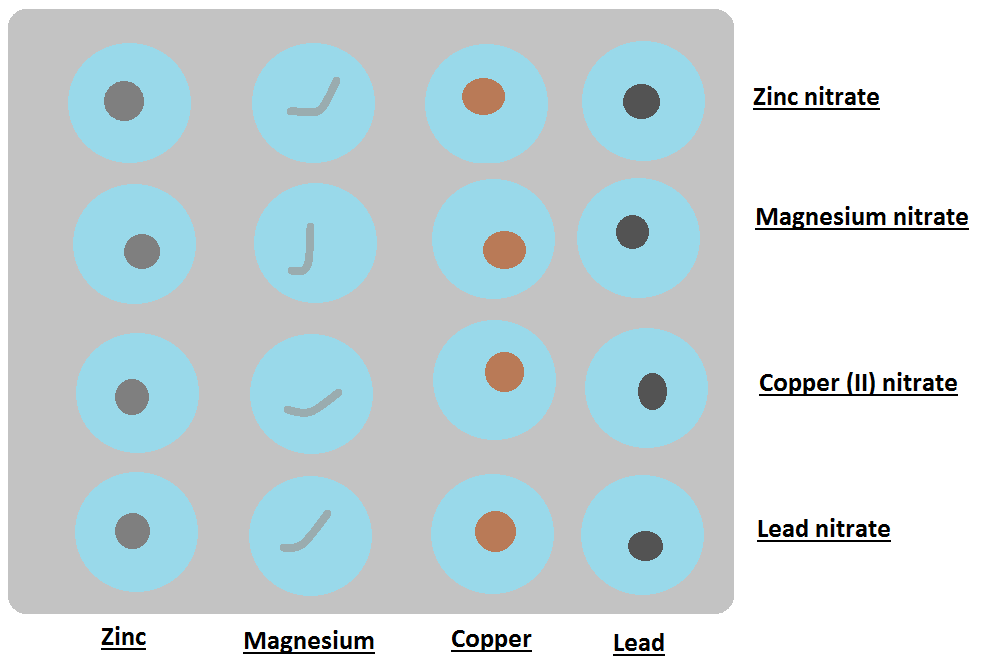
- Place the metal samples in the metal salt solutions on a spotting tile as shown in the diagram.
- Use a clean teat pipette for each solution.
- If the metal is more reactive than the metal in solution, it will displace the metal in solution.
- Example: Copper nitrate is blue, magnesium nitrate is yellow. During the reaction, the copper nitrate solution will change from blue to yellow as the magnesium, which is more reactive than copper, displaces it from the solution.
- \(Cu(NO_3)_2(aq) + Mg(s) \rightarrow Cu(s) + Mg(NO_3)_2(aq)\)
- If a less reactive metal is added to a metal salt solution
- there will be no reaction - nothing will happen!
Información
- Descripción
- El usuario ha eliminado su información de asignaturas Diapositivas sobre Ores and the Reactivity Series , creado por Usuario eliminado el 13/07/2017.
- Creado por
- Usuario eliminado · jul 2017
- Actualizado
- 13 jul 2017
- Visitas
- 97
- Historial
-
- Creado por Niamh Ryan · 10 jul 2017
- Copiado por Niamh Ryan · 13 jul 2017
- Valoración