
Public Health Medieval Era
Diapositivas del conjunto (4)
-
- Mortality rates were much higher in towns and cities than they were in the countryside. People lived in overcrowded conditions often in the presence of animals and their filth. As we saw earlier in the course, there was a lot of problems with medieval towns. There are some exceptions to this though like the medieval town of Coventry.
- 1421 - the mayor's proclamation required every man to clean the street in front of his house every Saturday, otherwise he would be fined 12 pennies
- 1420 - waste collection services were recorded, the council gave William Oteley the right to charge every resident 1 penny each quarter
- This was a weekly cleansing and waste removal service; waste was sold to nearby farmers
- The council specified designated waste disposal locations too
- The council at Coventry banned waster disposal in the Sherbourne river nine times from 1421-75
- 1421 - all latrines over the Red Ditch were ordered to be removed, to allow free flow of water and prevent flooding
- The mayor and corporation at Coventry were active with complaints made by residents about the quality of their town
-
- In 1348, a ship docked in Melcombe, Dorset and with it came the Black Death:
- The disease spread across the known world from the plains of Central Asia
- The most devastating singular episode for the bubonic plague was the Black Death
- This devastated Europe from 1346-1353
- In places of Britain whole villages were wiped out
- There is disagreement over how many died, but estimates suggest from 50-66% of the British population died 1348-1349
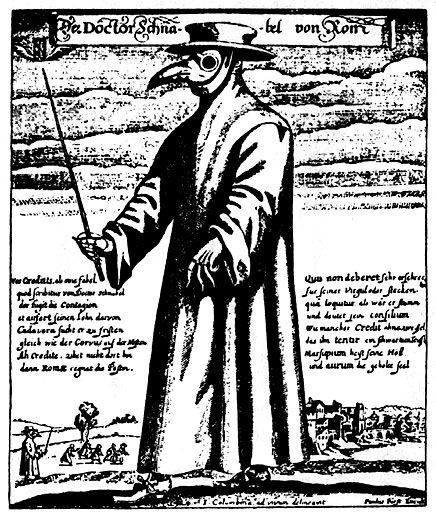
- Pie de imagen: A medieval doctor
-
- Suggestive causes of the Black Death:
- Suggestions varied alongside the main ideas of causes of illness of the day. Some blamed the four humours, others suggested this was punishment from God and few thought it had something to do with the aligning of the stars.
- With these invalid explanations of the Black Death. Historians have discussed that the bubonic plague was mainly spread by rats, while a less popular argument relates to the spread of the disease due to close human contact.
- Actual cause:
- Spread from fleas from black rats
- After being bit by a flea carrying the bacilli germ, large swelling developed called buboes
- These appeared in the armpits and the groin
- Fever and severe headache followed, before boils developed all over the body
- Death occurred in a few days

-
Preventions of the Black Death
- Some argued that people should eat less and not bathe
- Having a bath was believed to have opened the pores of the skin and allowed the disease to enter the body
- Other bizarre suggestions came about:
- Avoiding sex
- Drinking urine once a day
- Bleeding to let the evil spirits out
- Killing all cats and dogs as they spread the disease
- However, some promoted effect preventive measures:
- King Edward III ordered the cleaning of the streets of London
- Practical advice was given to keep away from people who had contracted the diseas
- Many attempted to avoid the plague by moving out of towns, this just led to more spreading of the disease
Información
- Descripción
- El usuario ha eliminado su información de asignaturas Diapositivas sobre Public Health Medieval Era, creado por Usuario eliminado el 19/07/2017.
- Creado por
- Usuario eliminado · jul 2017
- Actualizado
- 19 jul 2017
- Visitas
- 40
- Historial
-
- Creado por Andrew Burke · 19 jul 2017
- Copiado por Andrew Burke · 19 jul 2017
- Copiado por Andrew Burke · 19 jul 2017
- Valoración