
Industrialisation and Public Health Acts
Diapositivas del conjunto (4)
-
- In the 19th century, British citizens flocked to the cities to live as this is where the jobs were. Britain became the largest producer and exporter in the world. People needed to live close to where they worked and there were also very few building regulations.
- The supplies of gas, water and electricity were dealt with by private companies who wanted to make profits. Therefore, areas where better-off people lived received good supplies, whereas poor areas were not well served. At this time the government followed a philosophy of laissez-faire meaning it was not their job to regulate working conditions, housing and transport.
- As a result of this system working-class housing was often very poor in industrial cities. While in Manchester the average age of death for a member of a labourer's family was 17 in 1842.
-
- Chadwick was a member of the Poor Law Commission that was set up as a consequence of the Poor Law Reform Act 1834. He was convinced most people were poor because of ill-health, not idleness. He spent his life then advocating for improvements in public health. In 1842, he published 'Report on the Sanitary Conditions of the Labouring Population' this led to the Health Towns Association being established in 1844. Eventually, the Public Health Act was passed in 1848 and this was the first occasion the government legislated on health matters.
- Chadwick was an influential member of what was known as the 'Clean Party'; they pushed the government for actions to improve conditions in towns. The 'Dirty Party' were the MPs and other opposition to the movement, which was largely based on the costs of such public health projects.
-
- The cholera epidemic of 1848 is what really forced the government to act regarding public health
- 1848 - Public Health Act: allowed local councils to improve conditions in their town, if they were prepared to pay for it
- The Act encouraged local health boards to be set up with a medical officer, provide sewers, inspect lodging houses and check food being sold
- 1872 - only 50 towns has a medical officer
- Other acts followed:
- Sanitary Act 1866
- Artisans Dwellings Act 1875
- Public Health Act 1875
- The Public Health Act 1875 was a real breakthrough as it brought together acts covering sewage and drains, water supply, housing and disease
- Local councils were forced to provide clean water and appoint medical officers for slaughterhouses and for food markets
- Local authorities had to keep ordered sewer covers, keep them in good condition
- Also, supply fresh water to citizens, collect rubbish and provide street lighting
- 1875 - Food and Drugs Act regulated food and medicine
- London had a sewer building project in place since 1858
- The Housing Act 1875 allowed local councils to knock down poor housing and rebuild
- Flush toilets became more common and new products helped with the cleaning of people and clothes
-
- The 1848 Public Health Act allowed councils to improve conditions if they wished. In Birmingham, the council of the 1840s and 1850s consisted of ratepayers who resisted demands to spend money. The conditions of the town of Birmingham were overall very poor.
- All this changed when Joseph Chamberlain became the mayor in 1873. He devised a plan for 'gas and water socialism'; the council would take over gas and water companies and improve their supplies and then utilise the profits to make the city a better place to live. Chamberlain persuaded the council to borrow a sum of £2 million to purchase the gas companies in 1875.
- By 1879, the council made £165,000 in profits and was able to spend this on public projects. The death rate in Birmingham dropped from 25.2 per 1000 to 20.7 per 1000 by 1880. While in 1876, the Birmingham Improvement Act was passed allowing the council to clear 40 acres of slums in the centre of the city. These slums were replaced by a shopping centre and various other amenities.
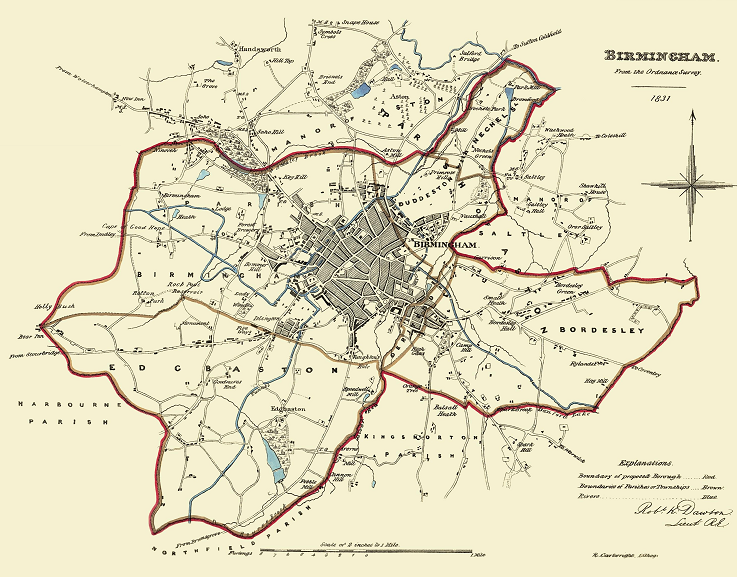
- Pie de imagen: Map of Birmingham 1831
Información
- Descripción
- El usuario ha eliminado su información de asignaturas Diapositivas sobre Industrialisation and Public Health Acts, creado por Usuario eliminado el 21/07/2017.
- Creado por
- Usuario eliminado · jul 2017
- Actualizado
- 21 jul 2017
- Visitas
- 22
- Historial
-
- Creado por Andrew Burke · 17 jul 2017
- Copiado por Andrew Burke · 21 jul 2017
- Copiado por Andrew Burke · 21 jul 2017
- Valoración