
Apuntes
Haydn - Symphony 101 in D major “The Clock”, Movt. 2
Contenido del apunte (10)
Página 1
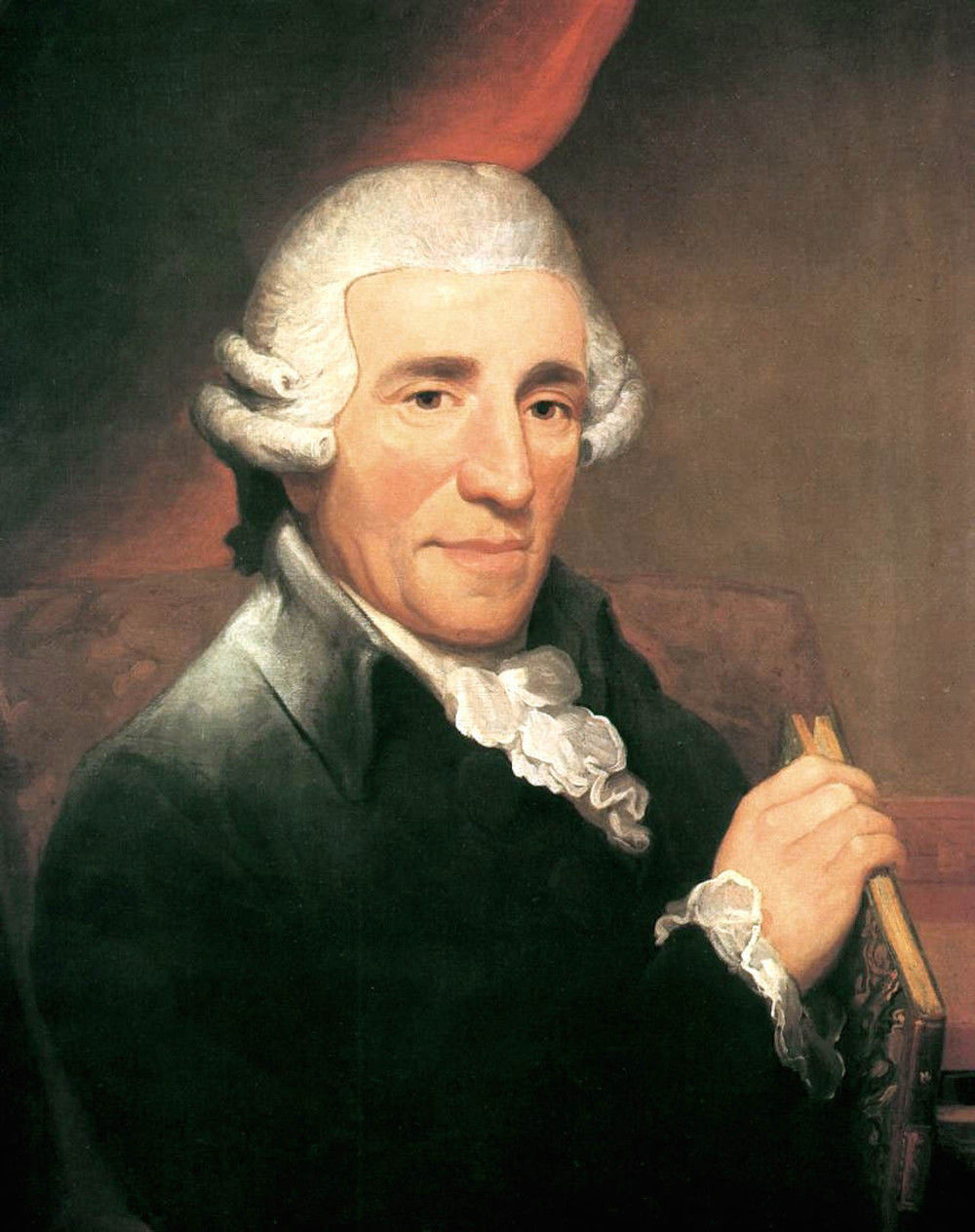
Franz Josef Haydn (1732-1809):
Haydn, alongside Mozart, is considered to be one of the key composers of the Classical period of musical history.
He is known as 'the father of the symphony' because of the number of works he wrote in the genres and the ways in which he developed it into the form still known to this day.
He also composed a large number of choral pieces, including settings of the mass, piano sonatas and concertos for a range of instruments, including the trumpet and the cello.
He was largely self-taught in music theory, using famous textbooks on the subject as his only teachers for a few years.
Though he was twenty-four years older, Haydn became close friends with Wolfgang Amadeus Mozart, who was also living in Austria.
When travelling in London, he was commissioned by Johann Peter Salomon to compose a set of six symphonies and then a further set following the success of the first six.
Página 2
About the Piece:
Key: G major
Tempo: Andante
Time Signature: 2/4
This movement is the second in Haydn's Symphony 101 in D major, sometimes called The Clock because of the nature of the second movement.
Symphony 101 in D major was written as one of Haydn's London symphonies, written between 1793 and 1794.
The work follows a traditional symphony structure (described below).
This slow movement is in G major. The moving quavers in the major sections are what gives this symphony its name. Towards the middle of the movement, there is a dark passage in G minor, followed by the clock theme once again.
The clarinet parts are notated in the key of B♭ major (a minor third higher) while the horns and trumpets become horns in G and trumpets in C respectively. This means that the music notated for the clarinets will sound a minor third lower than written. The horns will sound a perfect fourth lower than written, while the trumpets sound as written. The name for instruments that sound differently to how they are written is transposing instruments.
The overall form of the movement revolves around the two main musical sections, starting in bars 1 and 12 respectively. These sections are repeated throughout the piece with slight alterations.
The instrumentation for this movement is similar to the traditional orchestra during the Classical period. The instruments used include: a string section, 2 flutes, 2 oboes, 2 clarinets, 2 bassoons, 2 horns, 2 trumpets and 2 timpani (tuned to tonic and dominant).
Symphony Pattern:
The established pattern for a symphony became four movements:
An opening allegro, usually in sonata form
A slow movement, which could be in a range of forms, including: sonata form, theme and variations, ternary, da capo aria, etc.
A minuet and trio
A final allegro, usually in sonata form or rondo form
Página 3
Bars 1 - 11:
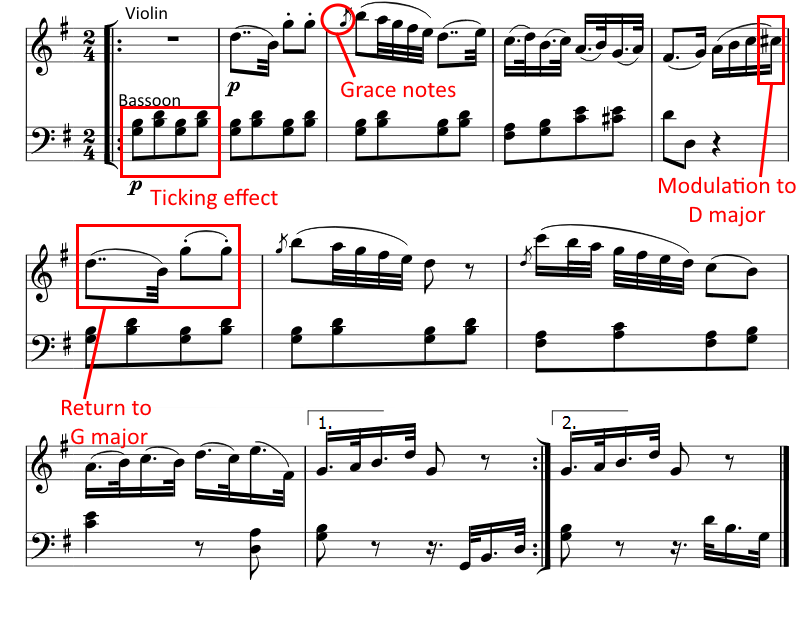
This movement opens with bassoons playing staccato and 2nd violins, cellos and double basses playing pizzicato to create the characteristic ticking effect which gave rise to this symphony’s nickname.
The main melody enters after just one bar and its opening note is double-dotted. It is very graceful and has a distinctive dotted rhythm, reflecting the characteristic detached nature of the accompaniment.
Acciaccaturas are also used to create really short and sharp sounds.
The melody falls into two phrases, the first modulating to the dominant D major before continuing with a balancing phrase which starts with the same two bars as the first phrase and then leads to a perfect cadence in G major.
The first phrase is four bars long but the second is five bars long: the extra bar is inserted after the restatement of the opening two bars. It gives an impression of a sequential extension of the second bar.
Página 4
Bars 12 - 24:
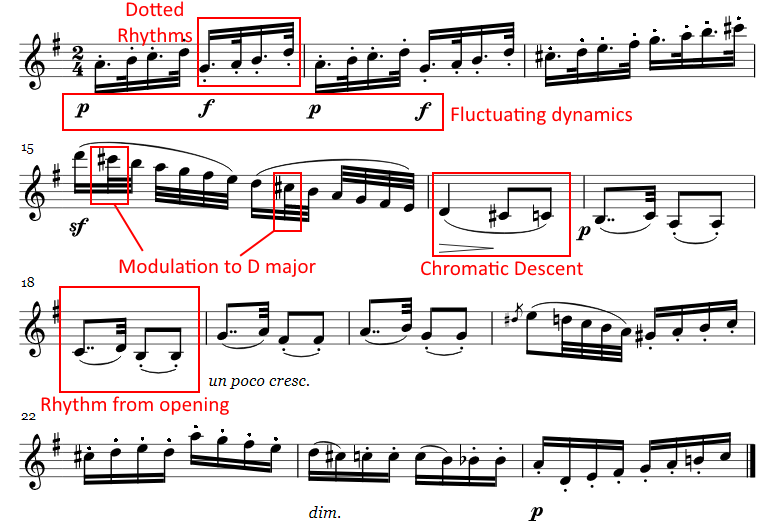
The melody in this section (bars 12-24) continues the dotted rhythms from the first section but alternates between piano and forte dynamics.
The pizzicato accompaniment is replaced by the strings playing arco though still staccato.
The harmony remains simple for two bars before another modulation to D major occurs, shown by the use of C#.
The melody rises to high D (above the treble clef), before descending by step through two octaves in bar 15, where a slower, chromatic phrase returns the tonality to the tonic. Haydn then uses another five-bar phrase, this time consisting of three bars of dotted rhythms, one of descending scales and one of a much slower, chromatic descent.
The oboe enters for the first time in bar 17, sustaining an inverted pedal note on the dominant, D. It then joins the melody with the violins at bar 21. The flute is also introduced for the first time here. Here, the melody is an ascent through the notes of the dominant seventh chord, returning the tonality to the tonic for the next section.
The violins’ rhythm is derived from the first bar of the opening melody and its melody is also played in sequence, forming a four-bar phrase.
Página 5
Bars 25 - 35:
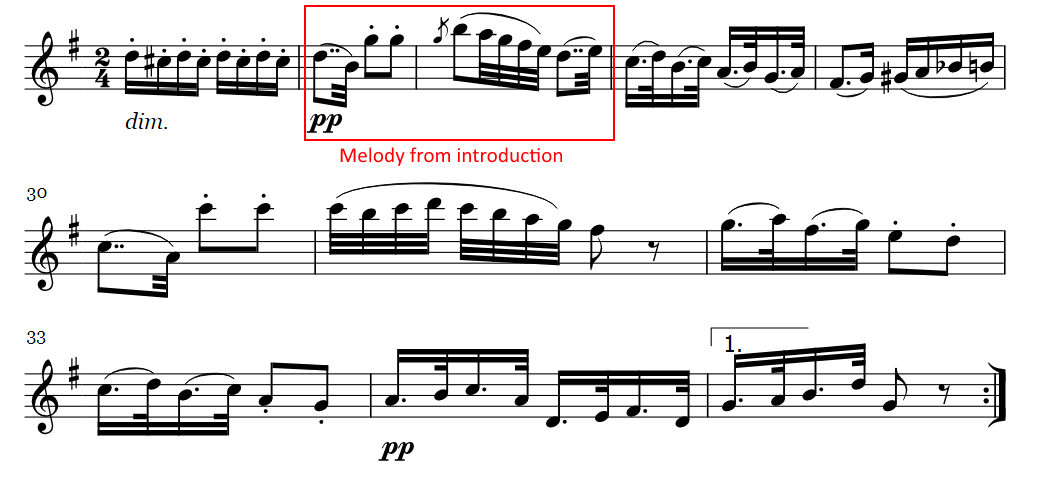
This section of the movement is a repeat of the first section with some variation.
The flute is added to double the 1st violins’ melody line.
Instead of doubling the cello line, the viola now plays triple-stopped crotchet chords on the first beat of the bar.
There are slight melodic and harmonic changes in bars 29-33.
After the repeat, the second time bar takes the music down to G minor for the next section of the piece.
Página 6
Bar 36 - 62:
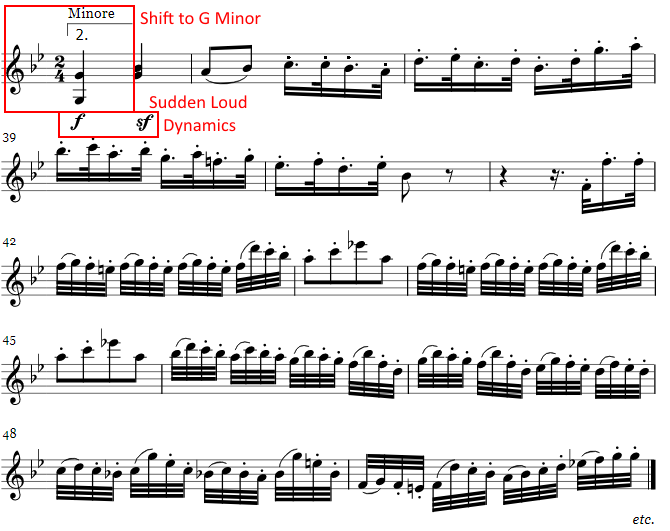
This section of the piece opens with sudden minor chords in G minor.
It is also at this point that the brass instruments and timpani enter for the first time in this movement and the dynamics are sustained at forte.
This episode is based on the third bar of the main theme (bar 4 of the movement).
As the music moves into bar 40, it modulates to B♭ major, the relative major of G minor.
There is an example of antiphonal writing as the 1st violins’ demisemiquavers are answered by a similar phrase in 2nd violins and violas (shown below).
The harmony alternates between tonic and dominant until bar 46, when the chords of Cm7 (C, E♭, G, B♭) and Edim7 (E, G, B♭, D♭) lead to a perfect cadence.
Over staccato quavers in the bass, woodwind instruments play the chords in the dotted rhythm which has featured extensively in this section.
The music gradually returns towards G minor and settles over a dominant pedal from bar 56. Alternating Ds and C#s in the 1st violins in bars 61-62 lead to a return to G major and into the second variation on the main theme.
Página 7
Bar 63 - 98:
Bars 63-72 mark the second return of the first section.
The flutes and bassoons take on the ticking accompaniment to the 1st violins’ melody with the addition of a single phrase from the oboe in bars 66-67.
The omission of the lower strings adds to the lightness of this variation.
Bars 73-98 mark a return of the second section from the beginning of the piece.
Página 8
Bar 99 - 112:
Haydn includes a complete bar of silence in bar 99. In the following bars, Haydn takes the G on which the previous melody has ended and uses it as a pivot note to effect a change of key to E♭ major for the next return and variation of section 1.
From bar 100, the 2nd violins, joined one bar later by cellos and double basses, take up the ticking figure in this new key. 1st violins enter in bar 101 with the original melody, the orchestration augmented by sustained notes in the oboes and bassoons and delicate decoration from the flute.
In bar 107, the chord of E♭ major leads to a chromatic chord which leads to a chord of D major and scalic descents through two octaves. This is first heard in bar 14, though now with an ascending scale played by flutes and oboes in the second half of the bar.
All woodwind and string instruments alternate D and C# for two bars. 1st violins continue alone but gradually rise through the octave before being joined by the flute for one further bar.
Página 9
Bars 113 - 144:
At bar 113, the bassoons, 2nd violins and violas join in with the ticking motif, joined, after one bar, by oboe 2, clarinets, horns, trumpets, cellos and double basses, adding depth to the harmonies.
Flutes, oboe and 1st violins enter with the main melody while the 2nd violins introduce a new sextuplet variation on the accompaniment figure, comprising staccato, semiquaver broken chords of G major. This new rhythmic idea is soon incorporated into the melody, thus varying this return even more.
The final statement of the main theme begins in bar 137, preceded by a rising scale, the second half of it chromatic, before the usual alternation of D and C# is also decorated.
The timpani emphasise the triplet/sextuplet rhythm on either G (tonic) or D (dominant). As the movement nears its end, the dynamics and instrumentation are reduced.
Página 10
Bars 145 - End:
There are three bars of G major, with the upper parts playing G - B - G, making a final reference to the 'ticking' accompaniment which has been such an important feature of this movement.
The final two bars present three detached tonic chords played quietly.

Información
- Descripción
- El usuario ha eliminado su información de asignaturas Apunte sobre Haydn - Symphony 101 in D major “The Clock”, Movt. 2, creado por Usuario eliminado el 26/07/2017.
- Creado por
- Usuario eliminado · jul 2017
- Actualizado
- 26 jul 2017
- Visitas
- 58
- Historial
-
- Creado por Antonia Blankenberg · 24 jul 2017
- Copiado por Antonia Blankenberg · 26 jul 2017
- Valoración