
Apuntes
Types of Socialism
Contenido del apunte (6)
Página 1
Primitive/Utopian Socialism
Utopian socialist ideas came before the advent of capitalism. Thomas More, in the 16th century, highlighted his vision for a simplistic rural life and a community deeply concerned of one another. The Levellers, a political movement in the English Civil War argued for greater equality and levelling in society before being destroyed by Cromwell.
These ideas of seeking equality were out of fashion with contemporary beliefs of the day
Following these ideas came the Utopian Socialism of thinker such as Charles Fourier and Robert Owen.
Fourier developed an idea of communism before Marx with his conception of cooperation and phalanxes (groups in society put together to seek the common good)
Owen created his own communes to test his ideas in practice; he understood the importance of efforts from the worker
While another thinker, William Morris, argued workers were used like machines to mass produce. Morris ordered this to be stopped and the value of a product should be equal to the amount of skilled work it took to make it.

Página 2
Evolutionary Socialism
Ideas of Evolutionary Socialism were much slower in their effects on government than revolutionary ideas that gripped countries such as Cuba and North Korea. Evolutionary Socialist believed figures such as Karl Marx and Vladimir Lenin were wrong about capitalism's inevitability of collapse.
Evolutionary Socialists believed workers needed to be appreciated and represented fairly in a democratic system.
Eduard Bernstein called for political change in governance of economic and social sectors of society. The government should seek to improve society through trade unions and nationalisation of industry.
Richard Henry Tawney noted the importance of education in developing a fairer society

Página 3
Democratic Socialism
Social democracy is closest to the centre of the political spectrum compared to all other forms of socialism.
In terms of economic policy:
Cooperation between government, unions and management would be commendable
Level of wealth in society should be reallocated through progressive taxation and welfare state programme (public and private sector play important roles)
Regarding education:
A comprehensive school system is needed to educate children of all abilities and social backgrounds
This is a non-elitist and non-divisive approach
Social democrats desire gradual approach to change
They reject the view of revolutionary socialists that the means towards a better society requires political violence
Social Democrats believed that capitalism can and should be humanised. Society is built around social justice and equality. An economic system based on private ownership can be civilised through left-wing policy.
e.g. minimum wage, health and safety legislation, full employment, anti-discrimination laws etc.
With a combination of policies as above, the owners of capital cannot exploit their workers.
Strands of Socialism that have existed in Britain have never been as extreme as some areas of Europe. Redistribution of wealth was one means in which capitalism has been harnessed for greater equality in the British state.
The Labour Party has shifted from being a party just for workers though:
1945-1979: Labour based its socialism in a few key areas
Equal rights and equality of opportunity, however, they did not prevent individuals striving to create wealth
Nationalisation - for the benefit of the people and means of create employment
Welfare State that generated wealth redistribution through compulsory contributions
Trade unions remained strong to represent the working man
Página 4
Third Way/New Labour Socialism
As previously outlined with Anthony Giddens, the third way is a political and theoretical perspective that seeks to modify left-wing ideas towards the economic and political realities of globalisation.
It is a form of centre-left thinking that seeks to balance rights and responsibilities and social justice alongside market-orientated economics. In practice, for example, it means the welfare state provides a "hand-up and not a hand-out".
A strong emphasis is placed on stakeholding (businesses are responsible to different groups)
The third way emphasises communitarianism (interests of the community and society are more important that the individual). Giddens argues this truly empowers people.
Página 5
Marxist Socialism
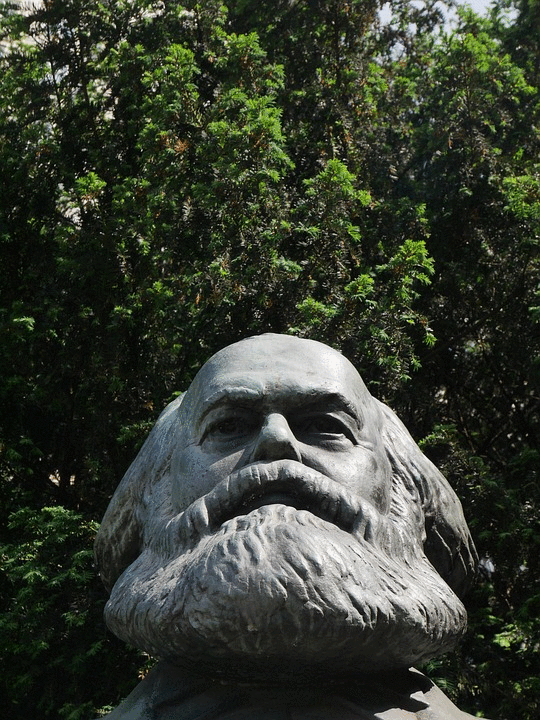
Marxism Socialism pursues social change in terms of economic factors. It is a system of economic, social and political philosophy thought.
Karl Marx outlined his vision for a better society in The Communist Manifesto (1848) - a utopian society based on the principles of common ownership
Communism was a system which resulted from the conclusion of final stage of human history i.e. the end of class conflict
Marx's classless society contained no social evils and poverty would be eradicated
An abundance of goods and services would be available to all people; working together for the common good generates more material supply then under the capitalist system
The working week would be shorter and people would be able to enjoy the leisures of life
Marx has been criticised for boiling human nature and interactions between society in purely economic terms. Moreover, his view of the working class has been labelled as romanticised.
Página 6
Revolutionary Socialism
Revolutionary Socialists argue the means to bringing about a society founded on socialism is by overthrowing the political and societal structures in existence.
The transformation of society lies in the hands of the proletariat
Class consciousness will enable the proletariat to realise their common goal in overhauling the economic system that exploits their labour
Capitalists are always motivated by the pursuit of profit and will always oppose anything that threatens their power. Marxists believe that a reformist stance in a capitalist society is counterproductive as it thwarts the revolutionary ability of the proletariat.
A socialist utopia cannot occur through parliamentary means; the focus must be on revolution.
"The revolutionary war is a war of the masses; only mobilizing the masses and relying on them can wage it".
(Be Concerned with the Well-Being of the Masses, Pay Attention to Methods of Work, Mao Tse-Tung,1934)

Información
- Descripción
- El usuario ha eliminado su información de asignaturas Apunte sobre Types of Socialism, creado por Usuario eliminado el 04/08/2017.
- Creado por
- Usuario eliminado · ago 2017
- Actualizado
- 4 ago 2017
- Visitas
- 8
- Historial
-
- Creado por Andrew Burke · 2 ago 2017
- Copiado por Andrew Burke · 4 ago 2017
- Valoración