
Test
Atomic Structure Quiz
Este test tiene tipos de pregunta que se abren en el reproductor de siempre.
Preguntas del test (16)
1Isotopes are atoms of the same element that contain different numbers of electrons.
- AVerdadero
- BFalso
2The mass number is always a whole number.
- AVerdadero
- BFalso
3How a mass spectrometer works:
Produces positive ions that are deflected by a [blank_start]magnetic[blank_end] field according to their mass-to-charge ratio (known as their [blank_start]m/z[blank_end] ratio)
Calculates the relative [blank_start]abundance[blank_end] of each ion
Displays abundance as [blank_start]percentage[blank_end]- Amagnetic
- Bm/z
- Cabundance
- Dpercentage
4Chlorine is an example of a [blank_start]diatomic[blank_end] molecule.
- Adiatomic
5Molecular ion peak: The peak with the [blank_start]highest[blank_end] m/z ratio, the [blank_start]M[blank_end] peak. This peak is helpful in figuring out the relative molecular mass of a compound using a mass [blank_start]spectrum[blank_end]
- Ahighest
- BM
- Cspectrum
6Orbital: A region within an atom that can hold up to [blank_start]two[blank_end] electrons with [blank_start]opposite[blank_end] spins
- Atwo
- Bopposite
7For all electron subshells, [blank_start]s[blank_end]>[blank_start]p[blank_end]>[blank_start]d[blank_end]>[blank_start]f[blank_end], in terms of energies.
- As
- Bp
- Cd
- Df
- Es
- Fp
- Gd
- Hf
- Is
- Jp
- Kd
- Lf
- Ms
- Np
- Od
- Pf
8The diagram shows a number of ways of representing
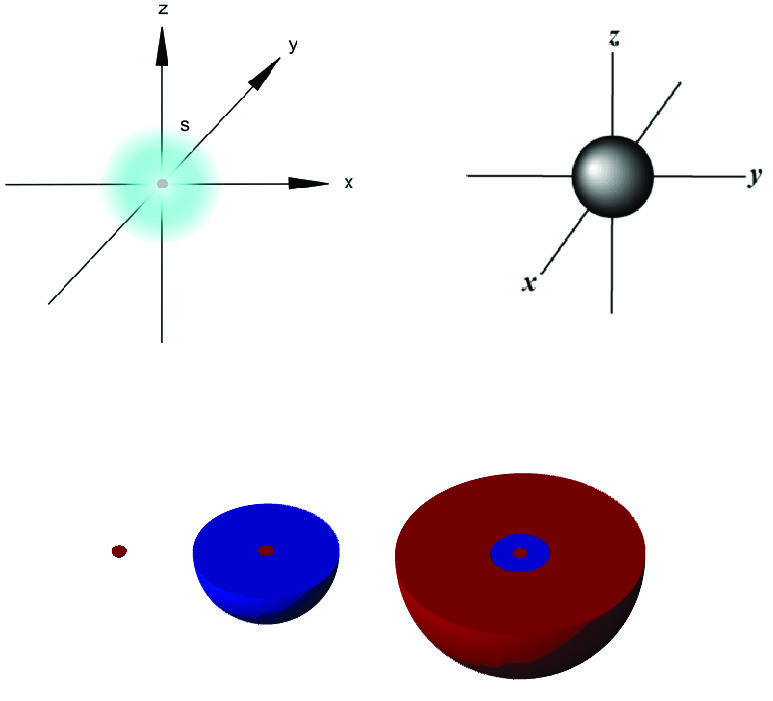
- AAn s oribital
- BA p orbital
- CA d orbital
- DAn f orbital
9The size and shape of the orbitals is such that there is a [blank_start]90[blank_end]% probability of finding the electron within their boundaries
- A90
10P orbitals are elongated and shaped like [blank_start]dumbbells[blank_end].
They have non-uniform charge [blank_start]density[blank_end].
There are 3 p orbitals in each p subshell - these are sometimes labelled as \(p_x\), \(p_y\) and \(p_z\) according to the axes along which they are oriented.
The p orbitals within a subshell differ only in their orientation - they are at mutual [blank_start]right angles[blank_end].- Adumbbells
- Bdensity
- Cright angles
11This is a way of representing
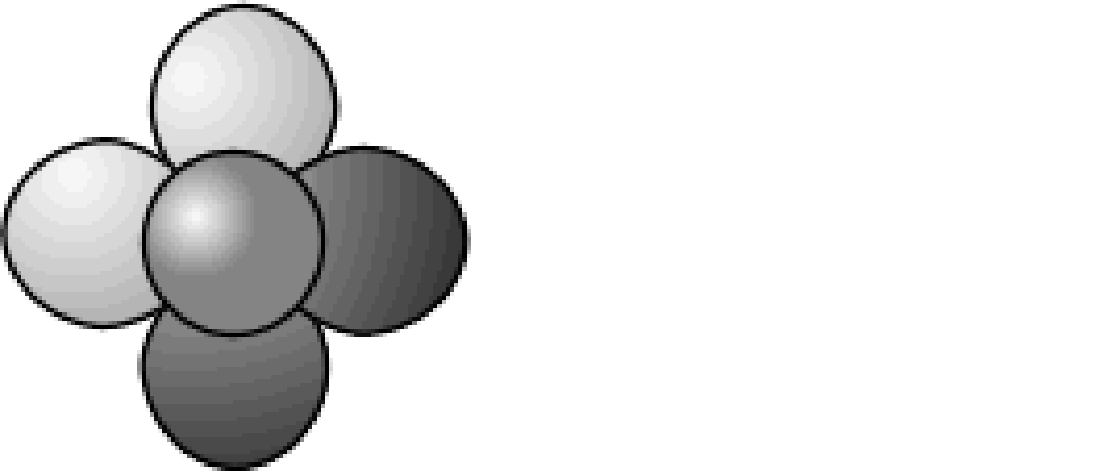
- Ap orbitals
- Bs orbitals
- Cd orbitals
- Df orbitals
12The first quantum shell can have [blank_start]2[blank_end] electrons.
The second quantum shell can have [blank_start]8[blank_end] electrons .
The third quantum shell can have [blank_start]18[blank_end] electrons.
The fourth quantum shell can have [blank_start]32[blank_end] electrons.- A2
- B8
- C18
- D32
13Match the measurements from the gas equation with their SI units:
P : Pressure - [blank_start]Pascals (Pa)[blank_end]
V: Volume -[blank_start]Metres cubed (\(m^3\))[blank_end]
n: Number of moles
R: The gas constant - 8.31 - Joules per mole per kelvin [blank_start](\(J mol^{-1} K{-1}\))[blank_end]
T: Temperature - [blank_start]Kelvins (K)[blank_end]- APascals (Pa)
- BMetres cubed (\(m^3\))
- C(\(J mol^{-1} K{-1}\))
- DKelvins (K)
14What is 30 °C in Kelvin?
[blank_start]303[blank_end]K- A303
15The [blank_start]actual yield[blank_end] of a reaction is the actual mass of product obtained (Measured by weighing, not calculating!).
The [blank_start]theoretical yield[blank_end] is the mass of product we would obtain according to the balanced equation.
[blank_start]Percentage Yield[blank_end] = \(100 \% \times \frac{ \text{Actual Yield}}{\text{Theoretical Yield}}\)- Aactual yield
- Btheoretical yield
- CPercentage Yield
16Primary standards should:
Be solids with [blank_start]high[blank_end] molar masses
Be available in a high degree of [blank_start]purity[blank_end]
Be chemically [blank_start]stable[blank_end]
Not absorb [blank_start]water[blank_end] from the air
Be [blank_start]soluble[blank_end] in water
React rapidly and completely with other substances when used in [blank_start]titrations[blank_end]- Ahigh
- Bpurity
- Cstable
- Dwater
- Esoluble
- Ftitrations
Información
- Descripción
- El usuario ha eliminado su información de asignaturas Test sobre Atomic Structure Quiz, creado por Usuario eliminado el 14/08/2017.
- Autor
- Usuario eliminado
- Idioma
- English
- Visitas
- 36
- Historial
- Creado el 14 ago 2017 · actualizado el 12 mar 2019
- Etiquetas
- Valoración
- Aún sin valoraciones Valora este test