
Apuntes
Ionisation Energies

Contenido del apunte (3)
Página 1
Emission Spectra
When atoms in the gaseous state are given energy - either heat or electrical - the electrons move to higher energy levels.
These higher energy levels are unstable, so the electrons soon fall back to their original energy levels. When they fall back, they emit energy in the form of electromagnetic radiation.
This radiation can be analysed using a spectroscope, which produces a line emission spectrum.
The line emission spectrum shows that only specific frequencies of electromagnetic radiation are released by the atoms.
The line spectrum of each element is unique.
This is compelling evidence for the face that the energy of electrons in atoms can only have certain, fixed values and not a continuous range - we say that the energy levels are quantised.
The line emission spectra of nitrogen, beryllium and boron are shown below.
Página 2
Ionisation Energies
Ionisation energy: A measure of the energy required to completely remove an electron from an atom of an element
First ionisation of energy of an element, A can be represented as follows:
\[ A(g) \rightarrow A^+(g) + e^-\]
Second ionisation energy of A can be represented by:
\[ A^+(g) \rightarrow A^{2+}(g) + e^-\]
Successive ionisation energies
When successive ionisation energies are listed, there are steady increases and big jumps at defined places.
The steady increases are due to removing successive electrons from the same shell.
The large jumps are due to removing an electron from a new shell.
Why do successive ionisation energies increase in magnitude?
"Completely removing" an electron involves moving it an infinite distance away from the atom that it no longer experiences any attractive force from the nucleus - this involves an increase in energy.
If the energy of the electron is already high, then this increase will not be large.
If the electron is in a low energy quantum shell, then a large increase in energy is required to move the electron away from the nucleus
This increase in energy is the ionisation energy, i.e. \[ \text{Ionisation energy (IE) = Energy of electron when removed - Energy of electron when in the orbital}\]
As each successive electron is removed from a shell, the electron-electron repulsion within the shell decreases. This results in a decrease in the energies of the remaining electrons, and therefore a steady increase in ionisation energy
Página 3
Trends in Ionisation Energies
What determines the energy of an electron?
The orbital in which it exists - Electrons in orbitals with a higher quantum number have higher energies
The nuclear charge of the atom - Electrons in atoms with a higher nuclear charge have lower energies
Other electrons present - Electrons in the same or lower shells repel each other, and in doing so, shield the electron from the attractive force of the nucleus, increasing the energy of the electron
Nuclear charge: Number of protons in the nucleus
Shielding effect: An electron can be repelled by electrons in the same or lower orbitals, thus decreasing the nuclear charge experienced by the electron in question.
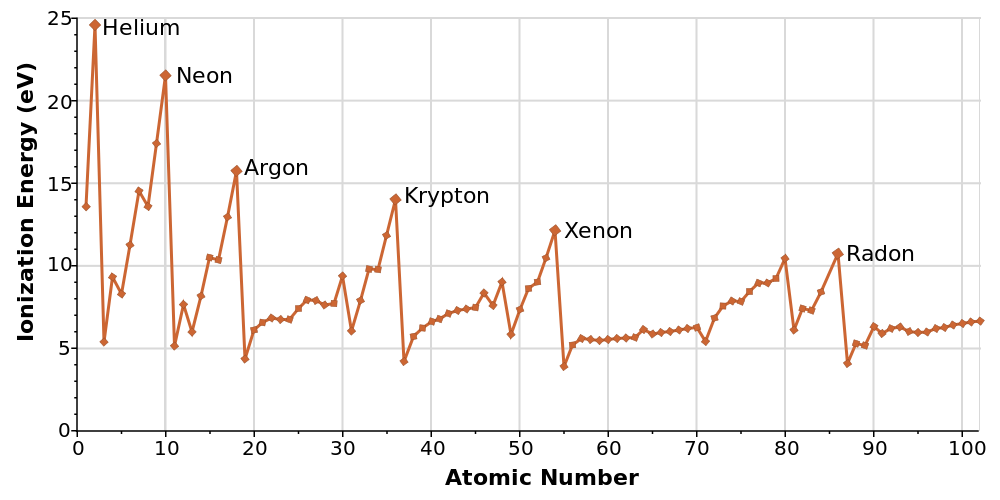
Trends in Ionisation Energies across a period
In general, ionisation energies increase moving across a period.
Moving across the period, there is an increase in nuclear charge as more protons are added to the nucleus. This increases the attraction to the nucleus felt by each electron, decreasing its energy.
More electrons are added moving across the period. This increases the electron-electron repulsion and shields the electron from the attractive force of the nucleus. This increases the energy of the electron.
However, the increase in nuclear charge is more significant than the increased shielding effect. So there is a general decrease in electron energies moving across the table, and thus an increase in ionisation energies.
Trends in Ionisation Energies down a group
In general, ionisation energies decrease moving down a group.
Moving down the group, the nuclear charge increases as more protons are added to the nucleus. This increases the attractive force of the nucleus felt by each electron, decreasing its energy.
However, each electron is added to a new quantum shell. Each quantum shell is higher in energy and electrons in higher shells also experience more repulsion from electrons in lower shells. These two factors lead to an increase in the energy of the electron.
However, the effect from the new quantum shell is greater than the increase in nuclear charge, so overall there is an increase in electron energy and a decrease in ionisation energies moving down the group.
Información
- Descripción
- El usuario ha eliminado su información de asignaturas Apunte sobre Ionisation Energies, creado por Usuario eliminado el 14/08/2017.
- Creado por
- Usuario eliminado · ago 2017
- Actualizado
- 14 ago 2017
- Visitas
- 111
- Historial
-
- Creado por Niamh Ryan · 3 ago 2017
- Copiado por Niamh Ryan · 14 ago 2017
- Valoración