
Prisons
Diapositivas del conjunto (12)
-
- Before the 18th century, prisons were never really utilised as a form of punishment. Prisons were a place to hold criminals up until they stood trial or until their execution. Conditions in the prisons were overall very poor.
- Moving into the 18th and 19th centuries, the use of prisons as a form of punishment grew. The Bloody Code went into decline and transportation no longer became a viable option for punishment. Prison sentences were viewed as a popular alternative of punishment:
- Opportunity to rehabilitate criminals
- Not only punished criminals, but would deter others from crime
- Involved hard work to pay back society for your crimes
- Society became more secure by segregating criminals from people
-

- There were disagreements regarding the purpose of prison sentences. However, those in favour of it as punishment believed prisoners should experience harsh conditions and perform labour.
- A common form of prison labour was the treadwheel; prisoners used this treadwheel for 8 hours in the day. Prisoners were prevented from communicating with one another during this activity.
- Three of the most influential reformers who argued that prisoners should be used for rehabilitation were John Howard, Elizabeth Fry and Sir George Paul.
-
Prison Reformers - Howard, Fry & Paul
- John Howard:
- Howard was appointed the high sheriff of Bedfordshire in 1773 and supervision of the county gaol came under his responsibility. Howard was shocked at the conditions in the local prison and the poorer prisoners lived in terrible conditions.
- Many jailers at the time demanded payment for the release of prisoners, this meant that many people stayed in jail even if they were innocent. In 1771, he published The State of Prisons in England and Wales which demonstrated prison conditions were the same across the country.
- Howard believed criminals would only change if they received a decent standard of living in prison. There should be decent food, clean water, Christian teaching and privacy for prisoners to reflect on their crimes. Howard went around the country asking other jailers to improve their practices.
- In 1774, his concerns led to two parliamentary acts; the abolishing of jailers' fees and improvements that led to better health of prisoners.
- Elizabeth Fry:
- Fry at age of 18 began a life of charity work caring for the sick and poor as well as prisoners. She visited prisons (Newgate 1813) that were dark and dangerous. Where children and mothers lived beside dangerous criminals.
- Fry taught sewing classes and facilitated Bible classes to encourage rehabilitation of prisoners in Newgate. In 1817, she helped establish the Association for the Reformation of Female Prisoners.
- Fry made sure that it was females who were employed to work with the mother and child prisoners. She educated these women and helped improve the living conditions they experienced, Fry wrote widely to promote reform of prisoners across the country.
-
Prison Reformers - Howard, Fry & Paul
- Sir George Paul:
- 1780 - Paul was made the High Sheriff of Gloucester and reacted to the condition of local prisons in disgust
- The Gloucestershire Act 1785 gave Paul the power to build a new prison
- Paul constructed a new model for prisons in 1780 based on the ideas of John Howard
- This system was secure, healthy, well-maintained and separated men from women and children
- Prisoners were to wear uniform and receive education for basic reading and writing skills
- Paul created a model which introduced the first system to separate minor offenders from major criminals
-
Prison Reformers - Howard, Fry & Paul
- Elizabeth Fry and the reformation of the prisons. (Enclavar)
- Pie de imagen: 1:35 onwards
-
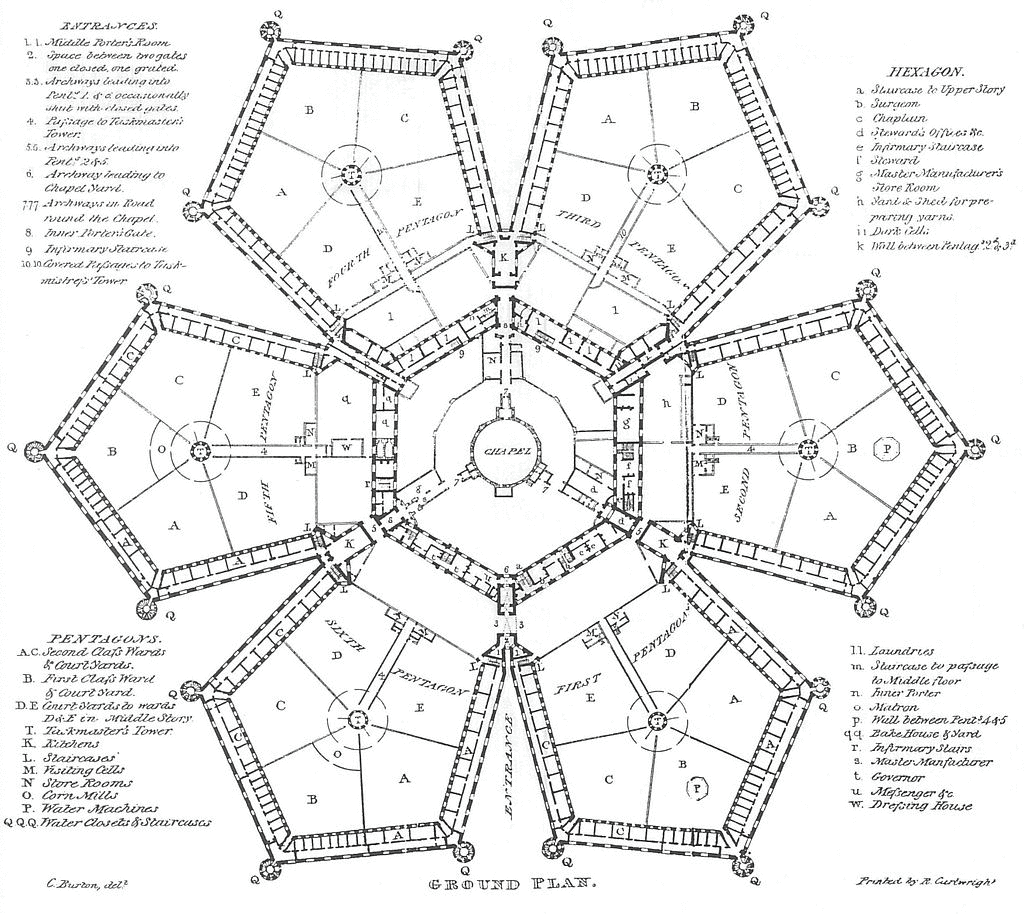
- Pie de imagen: By G.P. Holford - G.P. Holford, An Account of Millbank Penitentiary (1828): https://commons.wikimedia.org/w/index.php?curid=15805100
- Millbank Prison first opened in 1816, it was utilised mainly for holding prisoners before they were transported to Australia. It closed in the year 1890.
- The site of Millbank was originally purchased on behalf of the Crown by the famous English philosopher Jeremy Bentham. The prison was constructed in a panopticon design that was devised by Bentham.
- The first prisoners were women in 1816 and men first arrived in 1817. The average sentence time was 5-10 years was offered in the National Penitentiary to those thought most likely to reform, this was an alternative to transportation.
-
- After numerous problems relating to disease and construction, a decision was made to build a new model prison at Pentonville. This would be the new National Penitentiary and would take over the role of Millbank in 1842. An Act of Parliament in 1843, downgraded the status of Millbank prison and it becoming a holding spot for convicts before transportation.
- By 1850, roughly 4,000 convicted criminals were transported annually from the United Kingdom. After large scale transportation ended, Millbank ended up as a normal local prison. From 1870, it was a military prison and the prison finally closed its doors in 1890.
-
- Growth of the Prison system in mid-19th Century:
- From 1800-1840, the number of crimes reported increased from 5,000-20,000. People in Victorian England were increasingly worried about crime during the 19th century. Prison in the 19th century became a reasonable alternative to punishments of execution and transportation. Reformers argued for a prison system that maintained decent conditions but still was tough on the criminals put in prison.
-
- Separate System at the Pentonville Prison:
- Pentonville Prison in 1842 was a new idea where the 'separate system' was being tested for the first time. The purpose of this system was to keep prisoners apart as much as possible. Prisoners lived in separate cells and stayed isolated for 23 hours per day.
- What was the separate system intended for?
- Individual improvement for prisoners
- Encourage reformation of prisoners through religious faith and self-reflection
- Prevent prisoners from encouraging others from committing other crimes
- Deterrence - serious nature of punishment should discourage others from criminal activity
- Retribution - the criminal would 'pay' for their behaviour through punishment
-
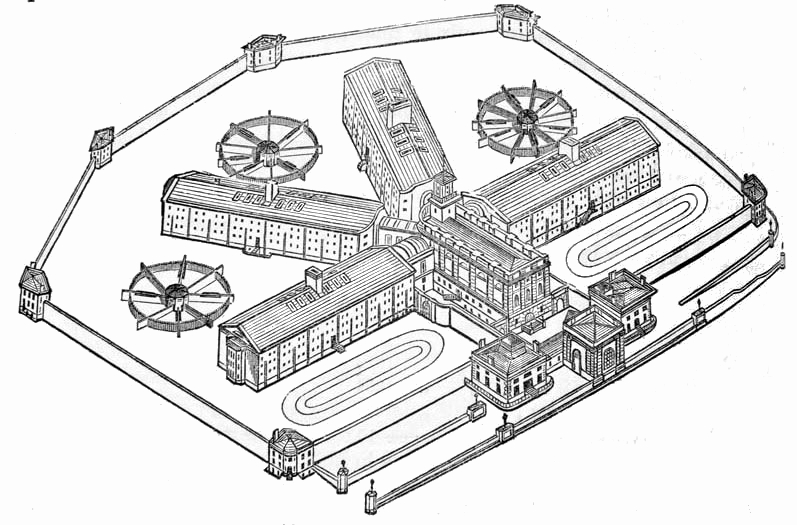
- Pie de imagen: Pentonville Prison drawing by Joshua Jebb, found in Report of the Surveyor-General of Prisons, London, 1844.
- This prison was specifically designed to support the aims of the separate system. The building consists of five wings with a central base which is for prison staff. Each wing contains dozen of individual prison cells and overall could accommodate around 520 prisoners.
- The size of the cells were 2x4m with a small window that were fixed with iron bars for extra security. The prison had a heating and ventilation system alongside piped water for each cell, a small washing basin and basic toilet.
- The purpose of these measures overall was to improve the health and living conditions of the prisoners. Further, prisoners would not have the chance to see and speak to one another.
-
- Living Conditions:
- The Pentonville Prison kept up high standards of discipline regarding. The features of the separate system were designed to isolate prisoners:
- Prisoners were allowed out of cells for a short period for exercise or to attend the chapel. The were not allowed to speak to another though, speech was restricted through the use of face masks or brown sack masks
- Walls were constructed so that sounds would not travel through and prisons could not communicate with one another
- Prisoners worked in their cells which maintained an environment of isolation. Work was repetitive
- These living conditions resulted in many prisoners falling into periods of mental illness, depression and psychosis. Further, there were high rates of suicide in Pentonville.

-
- Some reformers, such as Elizabeth Fry, were unhappy at the aim of the separate system. Reformers wanted prisons to be a place of rehabilitation and offer inmates the chance to change their ways. The separate system, some argued, was able to be used in this way. However, many government officials were concerned punishing wrongdoing and deterring criminal activities rather than rehabilitating criminals.
- In the second half of the 19th century, the conditions in Pentonville became a lot harsher. The 1865 Prisons Act focused on dishing out punishment to prisoners rather than reforming prisoners through religion or labour. Sir Edmund Du Cane (Assistant Director of Prisons) promised prisoners: 'hard labour, hard fare and hard board':
- Hard labour: physically demanding work for 12 hours each day
- Hard fare: boring and plain diet, same food served every day
- Hard board: beds made out of wood, instead of hammocks
Información
- Descripción
- El usuario ha eliminado su información de asignaturas Diapositivas sobre Prisons, creado por Usuario eliminado el 14/08/2017.
- Creado por
- Usuario eliminado · ago 2017
- Actualizado
- 14 ago 2017
- Visitas
- 15
- Historial
-
- Creado por Andrew Burke · 10 ago 2017
- Copiado por Andrew Burke · 14 ago 2017
- Copiado por Andrew Burke · 14 ago 2017
- Valoración