
Apuntes
Ionic Bonding
Contenido del apunte (6)
Página 1
Nature of Ionic Bonding
Ionic bonding is the strong electrostatic attraction between oppositely charged ions
It is confined to solid materials consisting of a regular array of oppositely charged ions extending through a giant lattice.
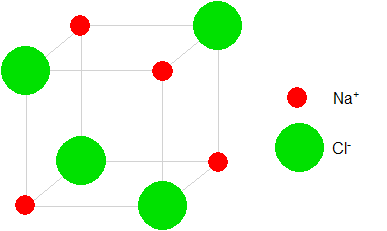
You will often see ionic bonding represent like the lattice shown in the diagram below which shows the unit cell or repeating unit in the sodium chloride lattice structure. However, this model is spaced out - in practice the ions are almost touching each other.

Página 2
Strength of ionic bonding
The strength of an ionic bond can be measured by how much energy would be required in one mole of solid to separate the ions to infinity, where they can no longer interact.
For ions of the same charge, the smaller the ion the higher this bond energy will be. This means that we see decreasing bond energy in ionic compounds when the atoms involved are further down the group in the periodic table. The size of the ion is known as its ionic radius.
For ions of different charge, the higher the charge the higher the bond energy will be.
Página 3
Trends in Ionic Radii
Ionic radii can be difficult to measure because the radius can depend on the environment of the ion.
Factors which can affect the radius include:
Coordination number - how many oppositely charged ions are touching it
The nature of those ions
Moving down the group, ions have more electron shells and so their ionic radius increases
However, isoelectronic ions do not necessarily have the same radius. If they have more protons, the electrons will be more strongly attracted to the nucleus, making the ion smaller.
Página 4
Physical Properties of Ionic Compounds
Ionic compounds usually have the following physical properties:
High melting temperatures → Giant lattice network of ions → Large attractive electrostatic force → Large amount of energy required to overcome this force
Brittleness →Applying a stress causes layers to slide over each other → Ions of same charge now side by side → Strong repulsive force causes crystals to break apart
Poor electrical conductivity when solid, but good when molten → Solid ionic compounds have no delocalised electrons and cations are not free to move → Molten ionic compounds have mobile ions which can migrate to charged electrode
Often soluble in water →Energy required to break lattice apart can be supplied by hydration of separate ions → Water can attract positive and negative ions because of its polarity → Conduct electricity when dissolved in water
Página 5
Formation of cations and anions
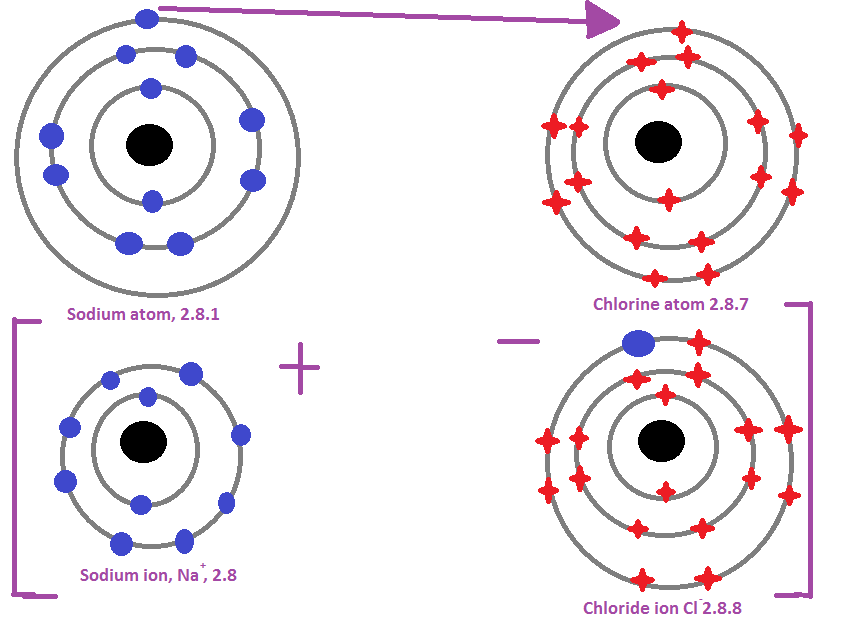
Some ionic compounds such as sodium chloride or magnesium oxide can be formed by the direct combination of two elements.
Sodium chloride can be formed by burning sodium in chlorine.
This can be represented in full or half equations:
\[2Na +Cl_2 \rightarrow 2NaCl\]
\[2Na \rightarrow 2Na^++ 2e^-\]
\[Cl_2+ 2e^- \rightarrow 2Cl^-\]
Página 6
Evidence for the existence of ions
How do we know ions exist?
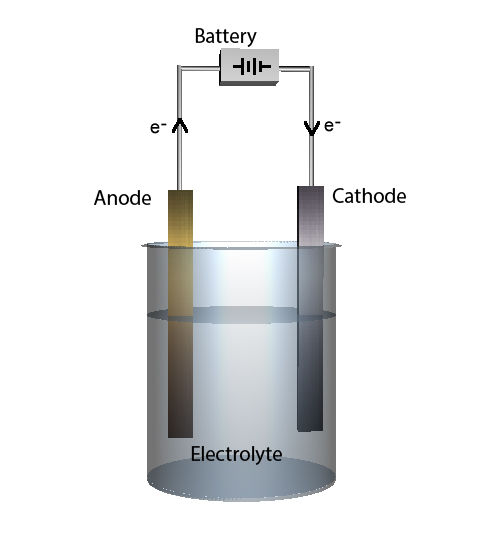
An ionic compound can conduct electricity and undergo electrolysis when either molten or in aqueous solution.
What happens during electrolysis?
When a direct electric current is passed through molten sodium chloride, chlorine gas forms at the positive electrode and sodium forms at the negative electrode.
The negative chloride ions are attracted to the positive electrode. They migrate towards this electrode where they lose an electron to form neutral chlorine diatomic molecules.
The positive sodium ions are attracted to the negative electrode. They migrate towards this electrode where they gain an electron to become neutral sodium atoms.
The equations for this process are the reverse of the equations given on the previous page for the formation of sodium chloride.
Información
- Descripción
- El usuario ha eliminado su información de asignaturas Apunte sobre Ionic Bonding, creado por Usuario eliminado el 21/08/2017.
- Creado por
- Usuario eliminado · ago 2017
- Actualizado
- 21 ago 2017
- Visitas
- 25
- Historial
-
- Creado por Niamh Ryan · 11 ago 2017
- Copiado por Niamh Ryan · 21 ago 2017
- Valoración