
Apuntes
Metallic Bonding

Contenido del apunte (4)
Página 1
Introduction to Metals
Metals usually have the following properties:
High melting temperature
Good electrical conductivity
Good thermal conductivity
Malleability
Ductility
Between one and three electrons in their outer shells
Low ionisation energies
Increasing electrical conductivity with increasing number of outer electrons
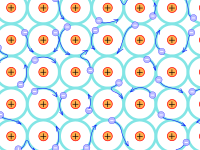
These properties are largely due to the presence of delocalised electrons - electrons that are free to move throughout the structure without being localised between any pair of cations.
There is an electrostatic force of attraction between the nuclei of the cations and the delocalised electrons which is known as metallic bonding.
Página 2
Melting Points of Metals
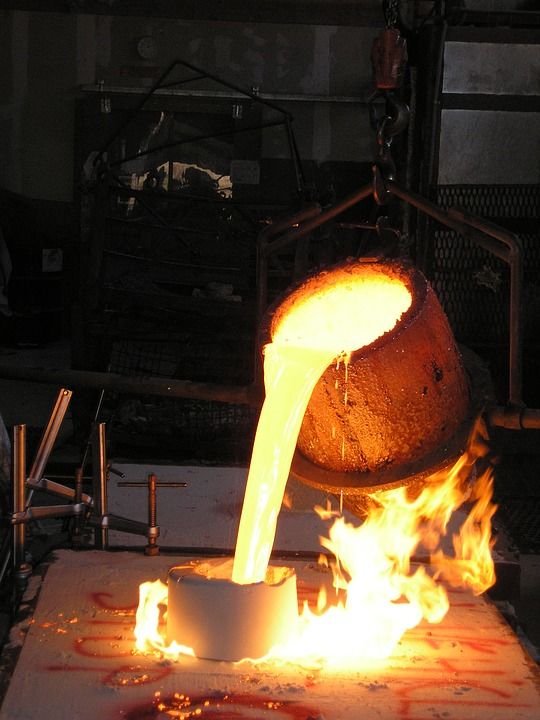
Typically metals have very high melting temperatures.
Generally an increase in the number of delocalised electrons per ion leads to an increase in the melting point of the metal.
Group 1 metals have slightly lower melting temperatures
Group 2 have slightly higher melting temperatures
Metals in the d-block have high melting temperatures
Smaller cation → Delocalised electrons closer to nucleus → Stronger forces of attraction → Higher melting point
Página 3
Conductivity of metals
Electrical Conductivity
When a potential difference is applied across the ends of a piece of metal, the delocalised electrons move towards the positive terminal of the cell.
The movement of charge carriers, in this case electrons, constitutes an electric current.
Thermal conductivity
There are two factors which contribute to the high thermal conductivity of metals:
Delocalised electrons can pass kinetic energy along the metal
Cations are closely packed and can easy pass kinetic energy from one cation to the other
Página 4
Malleability and Ductility
Malleability: Can be hammered or pressed into different shapes
Ductility: Can be drawn into wire
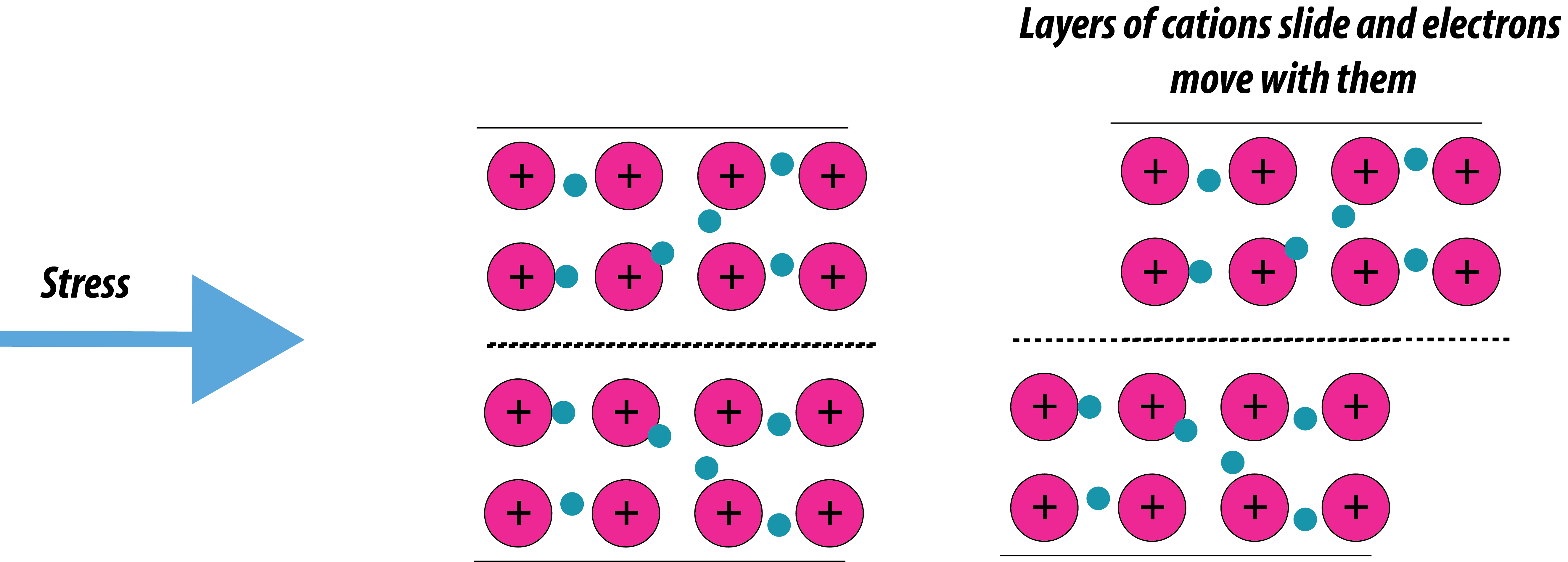
As shown in the diagram below, when a stress is applied to a metal, layers of cations may slide over each other. However, since the delocalised electrons are free moving, they move with the cations and prevent strong forces of repulsion forming between the cations in one layer and the cations in another layer.
Información
- Descripción
- El usuario ha eliminado su información de asignaturas Apunte sobre Metallic Bonding, creado por Usuario eliminado el 21/08/2017.
- Creado por
- Usuario eliminado · ago 2017
- Actualizado
- 21 ago 2017
- Visitas
- 26
- Historial
-
- Creado por Niamh Ryan · 11 ago 2017
- Copiado por Niamh Ryan · 21 ago 2017
- Valoración