
Test
BIOL2022 L13 Dealing with CLASS INDEPENDENT VARIABLES
Este test tiene tipos de pregunta que se abren en el reproductor de siempre.
Preguntas del test (7)
1What conditions must be present in order to use an independent t-test?
A [blank_start]____________[blank_end] dependent variable;
A [blank_start]____________[blank_end] independent variable (with [blank_start]____________[blank_end] levels).- AContinuous
- BClass
- C2
- D>2
- E≥2 (>=2)
2What conditions must be present in order to use a 1-way ANOVA?
A [blank_start]____________[blank_end] dependent variable;
A [blank_start]____________[blank_end] independent variable (with [blank_start]____________[blank_end] levels).- AContinuous
- BClass
- C≥2 (>=2)
- D2
- E>2
3In an ANOVA, the F value is obtained by the formula:
---- Groups MS / Error MS ----
...where Groups MS = Groups SS / Groups DF
...and Error MS = Error SS / Error DF
In these, what are the following defined as?
DF = [blank_start]____________[blank_end];
MS = [blank_start]____________[blank_end];
SS = [blank_start]____________[blank_end];
…therefore:
Groups MS represents [blank_start]____________[blank_end], whereas Error MS represents = [blank_start]____________[blank_end].- Adegrees of freedom
- Bmean squared deviation from the mean
- Cmean squares
- Dsum of squared deviation from the mean
- Esum of squares
- FBETWEEN groups’ mean-squares
- GWITHIN groups’ mean-squares
- HBSOD
4When reporting an ANOVA, what do each of the following numbers represent?
Options are:
#1 - df BETWEEN groups (# of treatment groups)
#2 - df BETWEEN groups (# of treatment groups - 1)
#3 - df BETWEEN groups ( (# of treatment groups) x (# of samples in each group) )
#4 - df BETWEEN groups ( (# of treatment groups - 1) x (# of samples in each group - 1) )
#5 - df WITHIN groups (# of treatment groups)
#6 - df WITHIN groups (# of treatment groups - 1)
#7 - df WITHIN groups ( (# of treatment groups) x (# of samples in each group) )
#8 - df WITHIN groups ( (# of treatment groups - 1) x (# of samples in each group - 1) )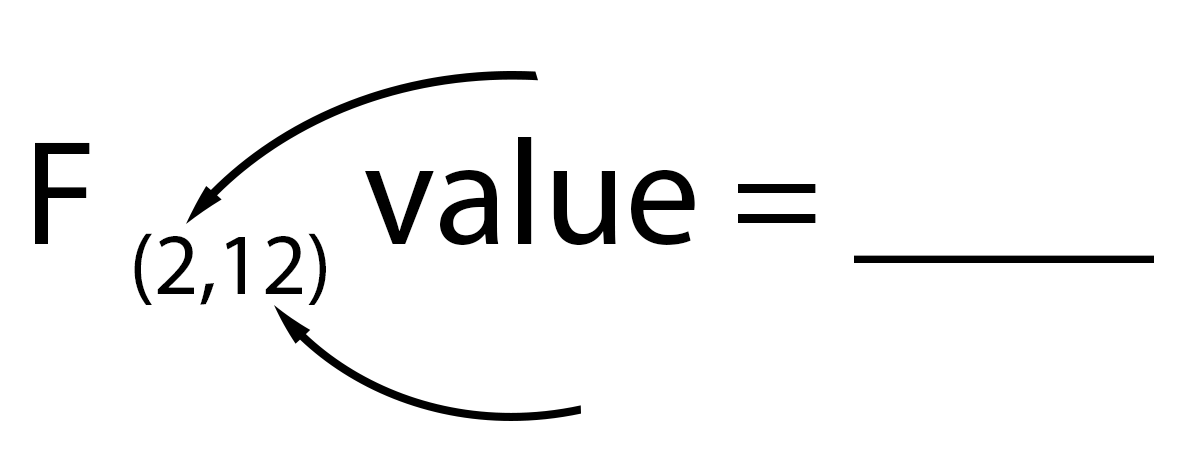
- A#2 BETWEEN
- B#1 BETWEEN
- C#3 BETWEEN
- D#4 BETWEEN
- E#5 WITHIN
- F#6 WITHIN
- G#7 WITHIN
- H#8 WITHIN
5Homoscedasticity vs heteroscedasticity:
Heteroscedasticity means:- AVariance is unequal, e.g. error gets larger on one side
- BVariance is unequal, e.g. more samples on one side
- CDistribution is unequal, e.g. error gets larger on one side
- DDistribution is unequal, e.g. more samples on one side
6In order to perform an ANOVA, you should transform if your data is:
- AHeteroscedastic
- BHomoscedastic
- CReally shitty
7Question: “Is aerobic enzyme activity greater in males than females?
Dependent variable: [blank_start]____________[blank_end], which is a [blank_start]____________[blank_end] variable;
Independent variable: [blank_start]____________[blank_end], which is a [blank_start]____________[blank_end] variable.- AAerobic enzyme activity
- BContinuous
- CSex
- DClass
Información
- Descripción
- Module 2, Lecture 2 Learning outcomes: • Dealing with class independent variables • Type of analysis driven by types of variables • ANOVA – one useful parametric test • Reliable analyses depend on assumptions met • Transforming can “improve” data • Today, there are alternatives to transforming
- Autor
- Usuario eliminado
- Idioma
- English
- Visitas
- 18
- Etiquetas