
Test
110: ALL Study Problems (FINAL)
Este test tiene tipos de pregunta que se abren en el reproductor de siempre.
Preguntas del test (54)
1Someone who has anterograde amnesia would have an inability to remember which of the following?
- Atheir mother's name
- Bhow they drove to work that day
- Cthe location of the home they grew up in
- Dall of the above
2Which of the following were important discoveries regarding learning and memory that patient H.M. contributed to?
- Aneuronal activity in the medial temporal lobes is necessary for recalling long-term memories
- Bneuronal activity in the medial temporal lobes is necessary for procedural learning
- Cneuronal activity in the medial temporal lobes is necessary for the formation of new episodic memories
- Dneuronal activity in the medial temporal lobes is necessary for performing cognitive tasks
3The hippocampus is necessary for [blank_start]relational memory[blank_end], connecting memories of objects through space and time.
- Arelational memory
4Many CA3 neurons project to a dense network of additional neurons creating an [blank_start]autoassociative[blank_end] network of recurrent connectivity.
- Aautoassociative
5Cells that have “wired together” in a cell assembly can spread an input from a subset of neurons to the entire assembly. This process is called_____________.
- Asequence learning
- BHebbian synapse
- Cpattern completion
- Dlong term potentiation
6Memory consolidation requires relocation to the neocortex, which is termed [blank_start]systems[blank_end] consolidation.
- Asystems
7In rat experiments, it has been shown that the conditioned fear response is mediated predominantly by the ___________, while the contextual fear response also involves the ______________ .
- Aneocortex, amydala
- Bhippocampus, amydala
- Camydala, hippocampus
- Dthalamus, hippocampus
8What sort of search are you performing when you identify the green heart in the image above?
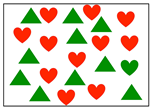
- Aserial search
- Bparallel search
- Csalient search
- Dall of the above
9The amplitude of an EEG of a drowsy individual is _________(than) an individual that is behaviorally aroused.
- Ahigher
- Blower
- Cfaster
- Dslower
- Ethe same as
10Projections from the [blank_start]locus coeruleus[blank_end], located near that fourth ventral, that are important for the arousal system include the cerebellum, thalamus, neocortex, and brainstem.
- Alocus coeruleus
11The feeling of “sleep paralysis” is caused by caused by the hyperpolarization of skeletal muscle neurons in a state called [blank_start]muscle atonia[blank_end]
- Amuscle atonia
12Stimulus (or object) identification is primarily accomplished by which cortical circuitry?
- Athe ventral stream from the occipital cortex to the frontal cortex
- Bthe ventral stream from the visual cortex to the inferior temporal cortex
- Cthe dorsal stream from the visual cortex to the posterior parietal cortex
- Dthe dorsal stream from the occipital cortex to the motor cortex
- Enone of the above
13Sparse coding that neurons that sensory neurons employ to reduce the number of action potentials necessary for a sense organ to get information to the sensory processing areas of the brain. This is analogous to what technique used in digital processing?
- Ahigh resolution data processing where each data point is treated with equal processing
- Bdata compression where multiple data points with the same value are treated as one or two points
- Cdata compression where multiple data points are just averaged to give one uniform value
- Dall of the above
14Which of the following is true of the visual cortical hierarchy?
- Avisual information usually flows from the striate cortex to the extrastriate cortex
- Bvisual information cannot flow from the extrastriate cortex to the striate cortex
- Cvisual information is completely reciprocal along every available pathway in the visual cortical circuits
- Dvisual information from striate cortex always flows to the extrastriate cortex
15Which of the following statement is true of surround inhibition in the retina?
- Asurround inhibition helps to localize visual stimuli, similar to how lateral inhibition in the somatosensory system localizes tactile stimulus
- Bsurround inhibition is conducted via horizontal cells which are excited by cone cells
- Csurround inhibition is only necessary for on-center bipolar cells
- Dsurround inhibition is conducted via horizontal cells which are inhibited by cone cells
- Eall of the above
16Which of the following is not a characteristic of a simple cell?
- Athey are located in the primary visual cortex
- Bthey respond prefer flashing or moving stimuli
- Cthey receive input from multiple lateral geniculate neurons
- Dthey respond to lines
- Ethey respond to spots
17Which of the following of Hubel and Wiesel’s discoveries support the idea that when looking at an object, the V1 primarily code for the outline of an object?
- Asimple and complex cells primarily respond to dark and bright lines in a particular orientation in space
- Borientation sensitivity varies across V1 in a detectable, systematic manner
- Cdirect input of retinal ganglionic cells to V1 is always in arrays of straight lines that overlap to form a contour
- Dsimple and complex cells primarily respond to dark and bright lines in a particular orientation in space AND orientation sensitivity varies across V1 in a detectable, systematic manner
(a and b) - Esimple and complex cells primarily respond to dark and bright lines in a particular orientation in space AND orientation sensitivity varies across V1 in a detectable, systematic manner AND direct input of retinal ganglionic cells to V1 is always in arrays of straight lines that overlap to form a contour
(a-c)
18Which stimuli directionality would you expect to elicit the response of the above V1 neuron recording below?
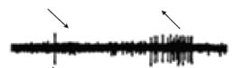
- A

- B

- C

- D

- A
19What sort of search are you performing when you identify the green heart in the image above?
- Aserial search
- Bparallel search
- Csalient search
- Dall of the above
20Which statement is true regarding the distribution of face-sensitive and category-sensitive neurons in the brain?
- Aface-and object-sensitive neurons are found in the neocortex but category-sensitive neurons are found in the hippocampus
- Bface- and category-sensitive neurons are both found in the temporal cortex
- Cface- and category-sensitive neurons are both found in the prefrontal cortex
- Dface-sensitive and object-sensitive neurons are in highest density in the inferior temporal cortex, while category-sensitive neurons are primarily found in the prefrontal cortex
21Which of the statement below most accurately describes the binding problem of sensory perception?
- Awe preferentially choose one sense over another when recognizing objects and therefore we are bound to a specific type of object
- Bmultiple senses are called into play when you confront a complex object that may have many identifying features (color, texture, motion, smell, sound) and it is necessary to put all of the input together for object recognition
- Cmultiple senses are called into play when you confront a complex object that may have many identifying features (color, texture, motion, smell, sound) and it is necessary to catagorize all of the input individually before we can recognize an object
- Dsome senses are inherently bound together like smell and taste and therefore treating them independently to analyze a stimulus that might have a taste but no odor is impossible
22Which of the statements is best supported by the data above of recorded individual action potentials from the two neurons?
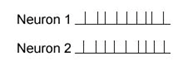
- Athe two neurons are located in different parts of the cortex
- Bthe two neurons are synchronous
- Cthe two neurons are asynchronous
- Dthe two neurons are located in close proximity
- Eall of the above
23A 13 year old boy always describes different numbers with a corresponding color. What is the perception disorder he most likely has?
- Aamusia
- Bsynethesia
- Cprosopagnosia
- Dauditory agnosia
- Eassociative agnosia
24Which structure is located between the frontal lobe and parietal lobe of the human brain?
- Acentral sulcus
- Boccipital fissure
- Ctemporal gyrus
- Dlateral sulcus
25Cutting a brain into several coronal sections can be done from_________.
- Asuperior to inferior
- Brostral to caudal
- Cmedial to lateral
- Ddorsal to ventral
26What is resting membrane potential? Choose the correct option.
- ADifference in electrical charge across the membrane at rest
- BGeneration and conduction of action potential at rest
- CPositive charge inside the membrane with respect to outside at rest
- DIsolation of the cytosol from extracellular fluid
27Which of the following is the major charge carriers involved in the conduction of
electricity in neurons? Choose the correct
option.- AAnions
- BCations
- Cions
- Dionic bonds
28How do the lipids of the neuronal membrane contribute to the neuronal membrane potential? Choose the correct option.
- AForms a barrier to water-soluble ions and water
- BIntegrates cytosol of neuron with extracellular fluid
- CCatalyzes chemical reactions
- DEncourages chemical interactions with water
29How do action potentials differ from passively conducted electrical signals?
Choose the correct option.- AAction potentials occur only in nerve cells; passively conducted signals occur only in muscle cells
- BAction potentials are transmitted over short distances; passively conducted signals are conducted over long distances
- CAction potentials are signals of fixed size and duration; passively conducted signals are not signals of fixed size and duration
- DAction potentials diminish over distance; passively conducted signals do not diminish over distance
30Which of the following is true of ion channels?
- AThey permit the passage of ions through a cell membrane
- BThey are composed of proteins that form pores in the cell membrane
- CThey are responsible for passive transport of ions through the cell membrane
- Dall of the above
31Which of the following might cause a neuron to fire?
- AEPSPs triggered by activity at five synapses at the same time
- BEPSPs triggered by activity at five nearby synapses
- CMultiple EPSPs at the same synapse triggered in rapid succession
- Dall of the above
32The blind spot is
- Athe region of the retina where axons leave the retina and enter the optic nerve
- Bresponsible for mostly black and white vision
- Cresponsible for mostly color vision
- Dthe area of the retina with the most photoreceptors
33Photoreceptors respond differently to a stimulation than typical neurons. Which of the following is the difference?
- Aall of the above
- BIntracellular calcium rises lead to the release of neurotransmitters in vesicles.
- CA depolarization occurs because of ion channels that permit an influx of cations
- DIn response to a stimulus, photoreceptors hyperpolarize.
34Hair cell depolarization in the inner ear is normally the result of
- Anone of the above are true
- Baction potentials arriving from the auditory nerve
- Cdeflection by fluid movement in the cochlea
- Ddeflection by “sound waves” (variations in air pressure)
3510. Olfaction, the sense of smell, is used by an organism for which of the following purposes?
- AMate identification
- BIdentification of food sources
- CDetection of predators
- Dall of the above
36What is the primary function of the round window of the cochlea?
- ATo allow for displacement of the oval window by relieving pressure in the cochlea.
- BTo allow for displacement of the ear drum by relieving pressure in the middle ear.
- CTo transmit sound from the outer ear to the bones of the middle ear.
- DTo transmit sound from the middle bones of the ear to the fluid filled cochlea.
37Consider the auditory system. Place the following structures in order based on the
sequence that they are involved in auditory transduction.
__[blank_start]6[blank_end]__ cochlea
__[blank_start]5[blank_end]__ oval window
__[blank_start]4[blank_end]__ stapes
__[blank_start]3[blank_end]__ malleus
__[blank_start]1[blank_end]__ pinna
__[blank_start]2[blank_end]__ tympanic membrane- A6
- B5
- C4
- D3
- E1
- F2
38The process of converting an external signal to a neural signal is called [blank_start]sensory transduction[blank_end].
- Asensory transduction
- Bsignal transduction
- Cneuronal cascade
- Dexternal neuronal signals
39The loss of part or all of your sense of smell is known as ________________
- Ainsomnia
- Banosmia
- Colfactory reduction
- Dnone of the above
40What is the difference between ON-center ganglion cells and OFF-center ganglion cells?
- AON-center ganglion cells receive input from ON bipolar cells while OFF-center ganglion cells receive input from OFF bipolar cells.
- BON-center ganglion cells receive input from OFF bipolar cells while OFF-center ganglion cells receive input from ON bipolar cells.
- COFF-center ganglion cells receive input from ON bipolar cells while ON-center ganglion cells receive input from OFF bipolar cells.
41Refer to the diagram below and correctly identify if the synapses labeled a and b are excitatory or inhibitory.
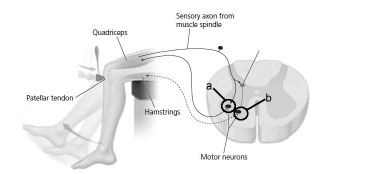
- Aa is excitatory and b is inhibitory
- Bb is excitatory and a is inhibitory
- Cboth a and b are excitatory
- Dboth a and b are inhibitory
- Ea and b can be excitatory or inhibitory depending on the strength of the stimulus
42All of the following are true statements about reflexes, except.
- Areflex circuits can have multiple effectors
- Breflexes are not learned behaviors
- Creflexes are involuntary
- Dreflex circuits contain both excitatory and inhibitory neurons
- Ethe strength of a reflex can change with different stimuli
43Which of the following reflexes is the most rapid?
- Avestibulocollic reflex
- Bcrossed extensor reflex
- Ceye blink reflex
- Dleg withdrawal reflex
- Evestibulo-ocular reflex
44When you experience a leg withdrawal reflex when you step on a sharp object excitatory/inhibitory (circle one) signals stimulate motor neurons synapsing on the quadriceps and excitatory/ inhibitory (circle one) signals stimulate motor neurons synapsing on the hamstrings.
- Ainhibitory, excitatory
- Bexcitatory, inhibitory
- Cexcitatory, excitatory
- Dinhibitory, inhibitory
45The main reflex pathway that underlies the ability to walk is the
- Aall of the above
- Bquadriceps stretch reflex
- Ccrossed extensor reflex
- Dvestibulocollic reflex
- Eleg withdrawal reflex
46What is the minimum number of neurons necessary for a stretch reflex?
- AThe number of neurons in the stretch reflex depends on the strength of the stimulus.
- B5: 2 sensory neurons, one inhibitory neurons, and 2 motor neurons
- C4: one sensory neuron, one inhibitory neuron, and 2 motor neurons
- D3: one sensory neuron, one interneuron, and one motor neuron
- E2: one sensory neuron and one motor neuron
47In the vestibulo-ocular reflex, the eyes move in the __________direction as the head.
- Asame
- Bopposite
- Clateral
- Dmedial
48Match each reflex with it’s appropriate function: (a) optocollic reflex, (b) vestibulo-ocular
reflex, (c) vestibulocollic reflex, (d) quadriceps stretch reflex, (e) leg withdrawal reflex, (f)
crossed extensor reflex, (g) optokinetic reflex, (h) eye blink reflex.
___[blank_start]c[blank_end]___stabilization of the head as the rest of the body turns left to right
___[blank_start]a[blank_end]___stabilization of the head backward as the body moves forward
___[blank_start]g[blank_end]___prevention of retinal slip by rapid left to right or up and down movements of the eyes
___[blank_start]b[blank_end]___stabilization of the eyes with turning or tilting of the head
___[blank_start]f[blank_end]___stabilization of a leg when the other leg is lifted off the ground
___[blank_start]e[blank_end]___rapid bending at the knee when your foot experiences a sharp stimulus
___[blank_start]d[blank_end]___activation of the quadriceps muscles when your knee bends when walking
___[blank_start]h[blank_end]___prevents irritants from entering the eye and spreads tears- Ac
- Ba
- Cg
- Db
- Ef
- Fe
- Gd
- Hh
49The rhythmic patterns of neural activity that are created by the molecular activity of single
cells or interactions of multiple neurons are called _______________.- Acentral pattern generators
- Brhythmic pattern generators
- CCluster neurons
- Dvestibulo-ocular reflex
50In order for a CPG to utilize a half-center oscillator it must contain a minimum of
__________ set(s) of inhibitory neurons that response to (a) ________ excitatory input(s).- Aone, double
- Btwo, single
- Ctwo, double
- Done, single
51All of the following are part of the motor cortex in primates, except
- Acorpus callosum
- Bsupplementary motor area (SMA)
- Cpremotor cortex
- Dprimary motor cortex (M1)
52Which of the following is a true statement about the projections of the motor cortex?
- Aprojections of the motor cortex are necessary for the ability to talk
- Bprojections of the motor cortex all synapse on interneurons
- Cprojections of the motor cortex directly to the spinal cord control vegetative processes
- Dall projections of the motor cortex synapse on motor neurons controlling voluntary movement
- Eall of the above
53Which of the following might be symptoms of a lesion to the right motor cortex?
- Aloss of movement of the left leg
- Ball of the above
- Ccomplete loss of bladder control
- Dloss of movement of the head and trunk
- Eloss of movement of the right leg
54Motor control and movement is dependent upon activity of which of the following structures and reflexes?
- Aall of the above
- Bspinal reflexes
- Cpremotor cortex
- Ddeep cerebellar nuclei
- Evestibular reflexes
Información
- Descripción
- Psychology 110: Brain & Behavior Test sobre 110: ALL Study Problems (FINAL), creado por Jade P el 05/06/2019.
- Autor
- Jade P
- Idioma
- English
- Visitas
- 1
- Etiquetas
- Valoración
- Aún sin valoraciones Valora este test